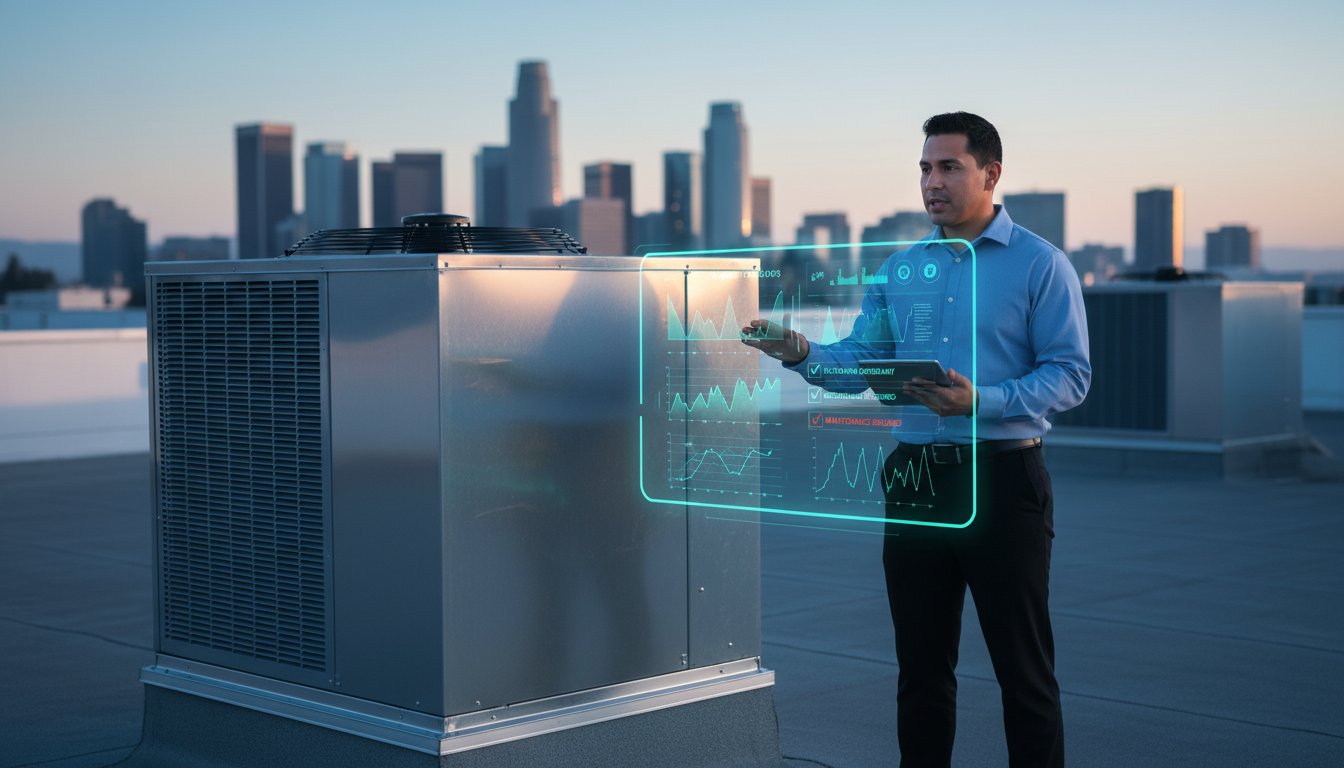
In 2024, California commercial electricity rates hit 23.41 cents per kilowatt-hour, which is nearly double the national average. For facility managers, this means an inefficient commercial hvac design isn't just a technical oversight; it's a direct threat to your annual bottom line.
You likely recognize that keeping up with the 2025-2026 Title 24 updates feels like chasing a moving target. It's a constant struggle to maintain precise climate control for critical inventory while satisfying the state's aggressive energy mandates.
This guide simplifies that complexity by showing you how to master commercial hvac design to lower operational costs and guarantee compliance. You'll learn how to build a resilient infrastructure that protects your assets and eliminates the risk of system failure.
We'll examine the specific engineering standards, smart control integrations, and energy management strategies required for modern California facilities. From local PLC logic to heat recovery, here's how to optimize your mechanical systems for 2026 and beyond.
Key Takeaways
- Navigate the strict 2026 Title 24 updates, focusing on mandatory economizers and demand-controlled ventilation to ensure your facility remains compliant.
- Discover why professional commercial hvac design requires precise Manual N/Q calculations over "rule of thumb" sizing to optimize efficiency and equipment longevity.
- Learn how to integrate Energy Management Systems (EMS) that move beyond simple thermostats to provide a total solution for climate control and cost reduction.
- Identify how building orientation and insulation impact your thermal load, allowing for a more bespoke and cost-effective mechanical installation.
- Understand the importance of selecting a design-build partner that offers 24/7 emergency response to maintain operational continuity for your critical infrastructure.
What is Commercial HVAC Design and Why Does it Matter?
California's commercial landscape demands more than standard cooling. Effective commercial hvac design is the precise engineering of Heating, ventilation, and air conditioning (HVAC) systems to meet the unique thermal loads of a specific building. It's a bespoke blueprint for operational performance.
Proper design ensures high indoor air quality (IAQ), which directly impacts your bottom line. Research from Harvard University indicates that improved ventilation can lead to an 8% increase in employee productivity. When your team breathes better, they perform better and take fewer sick days.
Design is the primary driver of long-term operational costs. HVAC systems account for approximately 40% of the energy used in commercial buildings. A poorly designed system forces equipment to cycle too often, leading to premature failure and inflated utility bills that erode your margins.
The Core Components of a Commercial System
Commercial systems rely on heavy-duty hardware like rooftop units (RTUs), chillers, and sophisticated air handlers. These hvac components must operate as a unified energy management system to maintain climate stability across large floor plans.
- Rooftop Units (RTUs): Compact, all-in-one systems that save internal floor space.
- Chillers: Essential for large-scale cooling by removing heat from liquids.
- Ductwork Layout: The "circulatory system" that must be balanced to prevent stagnant air.
Balanced air distribution is critical for comfort. If your ductwork layout is inefficient, you'll experience "hot spots" that drive tenant complaints. Proper airflow ensures every square foot of your facility remains within specific temperature parameters without overworking the fans.
HVAC vs. Refrigeration: The Total Solution
Many operators view climate control and refrigeration as separate entities. In high-stakes environments like grocery stores or warehouses, these systems are deeply intertwined. A commercial hvac design that ignores refrigeration heat loads is destined for inefficiency.
An integrated approach prevents "system fighting." This occurs when your HVAC heaters work against the cooling discharge from open refrigeration cases. Using a smart refrigeration controller helps synchronize these elements, ensuring they work together rather than in opposition.
Adopting a total solution approach eliminates energy waste. Integrated thermal management can reduce energy consumption by up to 15% in retail environments. It's about creating a seamless environment that protects your inventory while lowering your total cost of ownership.
California Title 24 and Local Design Standards
Compliance with the California Title 24 Standards is the most critical factor in modern commercial hvac design. The 2026 updates for Part 6 focus heavily on decarbonization and the transition to electric heat pump technology. These regulations aren't just suggestions; they're mandatory requirements that dictate how every component of your system must function to reduce the state's carbon footprint. To meet these benchmarks, your system must include specific hardware and logic controls. Two of the most important are:- Air-Side Economizers: These units use sensors to pull in "free cooling" from outside air when temperatures drop, significantly reducing compressor wear.
- Demand-Controlled Ventilation (DCV): This technology utilizes CO2 sensors to adjust fresh air intake based on actual building occupancy, preventing the energy waste of conditioning air for an empty room.
Compliance in the Bay Area and Central Valley
Designing commercial hvac east palo alto systems requires a balance between coastal air quality and the heat of the Peninsula. Inland designs must prioritize high-ambient cooling capacity, while coastal zones focus on corrosion-resistant coatings for condenser coils. Every project must conclude with Title 24 Acceptance Testing. This is a formal verification process where a certified technician proves the system operates exactly as the commercial hvac design intended before the building receives its certificate of occupancy.Understanding SEER, EER, and IEER Ratings
Efficiency metrics often confuse business owners, but they're simple when broken down by usage. SEER measures seasonal efficiency, while EER measures performance during the hottest peak hours. However, most commercial systems spend 90% of their time running at partial capacity. Integrated Energy Efficiency Ratio (IEER) is the industry standard for part-load efficiency, measuring how well a unit performs at various speeds rather than just at full throttle. Selecting the highest rating doesn't always guarantee the best ROI. If your facility operates 24/7, a high IEER rating is essential to lower your monthly bills. If you're managing a warehouse with minimal cooling needs, a mid-range unit might offer a faster payback period. For a clear picture of your potential savings, you can request a custom energy audit.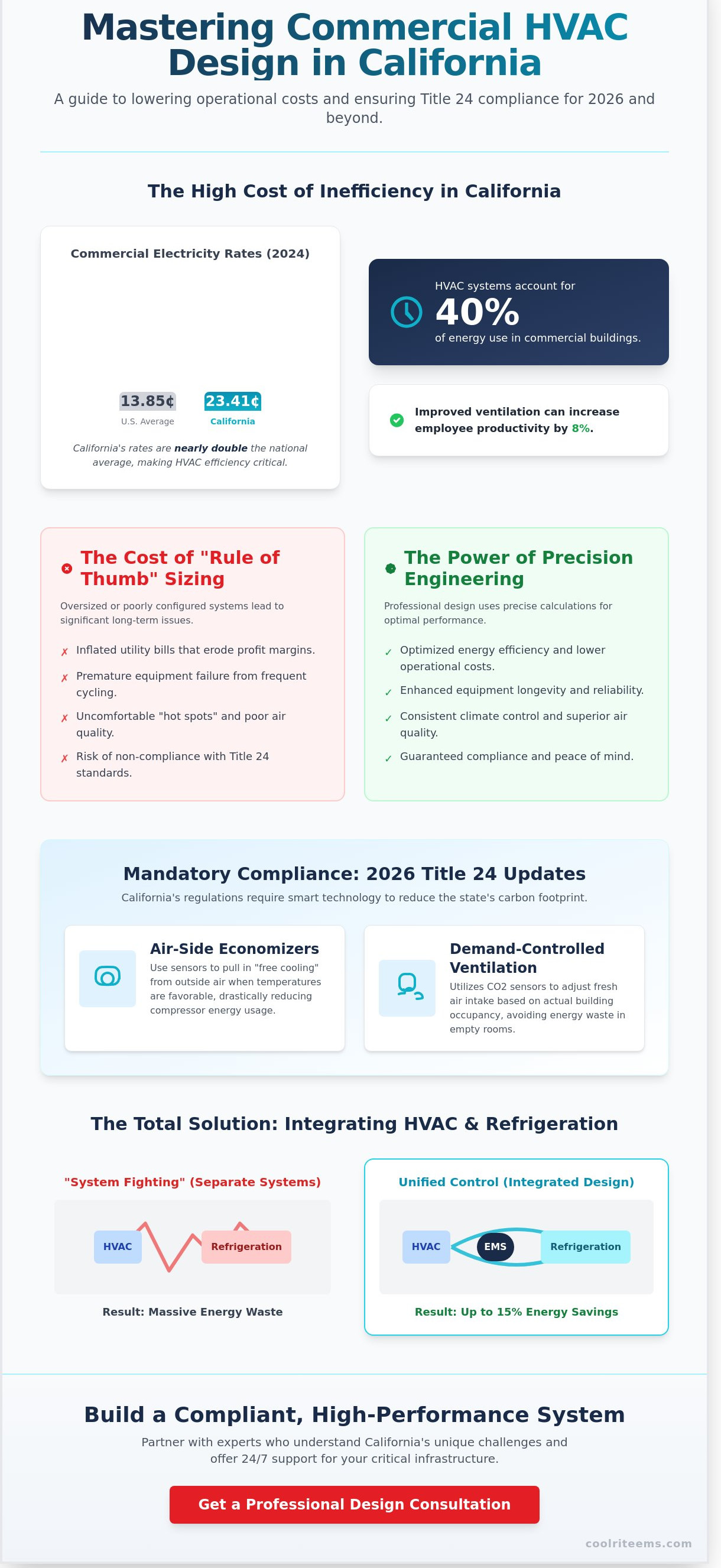
The Design Process: Sizing and Load Calculations
Guessing the capacity of your climate control system is a recipe for operational failure. Many contractors still rely on "rules of thumb," such as allocating one ton of cooling per 500 square feet, but this outdated approach ignores the unique thermal dynamics of modern California commercial spaces. Precision commercial hvac design requires a deep dive into Manual N and Manual Q calculations to ensure your equipment matches your actual needs.
We analyze every variable that impacts thermal load. This includes building orientation to account for solar gain, the placement of high-performance windows, and specific insulation R-values. Adhering to ASHRAE design standards ensures your facility meets professional benchmarks for performance and safety. We also factor in internal heat gains from high-output lighting and refrigeration rack systems, which can significantly alter the cooling requirements of a supermarket or warehouse.
Future-proofing is a core component of our design philosophy. A business that plans to expand its server room or add more display cases needs a system that can scale. We design for modularity, ensuring your infrastructure supports growth without requiring a total system overhaul in three years.
Common Pitfalls of Oversized Systems
Bigger is rarely better in the world of HVAC. An oversized system suffers from short-cycling, where the unit reaches the temperature setpoint too quickly and shuts down. This constant starting and stopping causes excessive wear on compressors, leading to premature equipment failure and expensive emergency repairs.
- Humidity Control: Systems that short-cycle fail to run long enough to remove moisture from the air. This leads to clammy environments and potential mold growth.
- Energy Waste: Oversized units consume a massive amount of power during startup. You can expect your monthly energy bills to be 15% to 20% higher than a properly sized system.
- Operational Costs: Short-cycling reduces the lifespan of your hardware, forcing capital expenditures much sooner than necessary.
Integrating Critical Refrigeration Needs
Your HVAC system and refrigeration infrastructure are inextricably linked. When commercial hvac design is executed correctly, your refrigeration service requirements actually decrease. This happens because managed ambient temperatures reduce the workload on walk-in coolers and display cases, preventing compressors from running at 100% capacity around the clock.
We prioritize adequate airflow for condensing units and evaporator coils to maintain peak efficiency. For facilities like server rooms or grocery stores, we integrate local PLC-based controls. Our Coolrite EMS solution offers secure remote monitoring with real-time SMS alerts and no monthly subscription fees. This setup operates without an internet connection if necessary, providing a secure and reliable way to prevent product loss and downtime through custom control logic.
Energy Management: The Brain of the Design
A sophisticated commercial hvac design is only as effective as the logic governing its daily operation. Without a centralized brain, even the highest-quality chillers and air handlers operate in silos, which leads to massive energy waste and inconsistent climate control. A mechanical design isn't complete until it includes a smart control strategy that coordinates every component.
Modern facilities have moved beyond simple thermostats to integrated Energy Management Systems (EMS). These systems don't just turn units on and off; they synchronize cooling cycles and ventilation rates to ensure the entire building works toward a single efficiency goal. This transition is essential for maintaining comfort while managing the rising costs of operation.
In California, where outdoor temperatures can spike by 30 degrees in a single afternoon, real-time monitoring is vital. It prevents catastrophic inventory loss in grocery stores and warehouses by identifying mechanical drifts before they become total equipment failures. This proactive approach saves thousands of dollars in spoiled product and emergency repair fees.
CoolriteEMS: Secure, Subscription-Free Control
The CoolriteEMS Controller utilizes local PLC technology to maintain full operational integrity without an internet connection. This eliminates the vulnerability of cloud-dependent systems that often fail when the web goes down. By keeping the control logic on-site, we ensure your building stays at the target temperature regardless of external connectivity issues.
High-performance HVAC systems should be an investment, not a recurring liability. We eliminate monthly subscription fees to maximize the ROI of your HVAC design, allowing you to own your data and your controls outright. This transparent approach provides long-term financial predictability for facility managers and business owners alike.
- Instant Alerts: Receive real-time SMS and email notifications for temperature excursions and equipment faults before they escalate.
- Total Security: Local control means your operational data isn't sitting on a vulnerable third-party server.
- Reliable Hardware: Industrial-grade components provide the longevity required for critical commercial infrastructure.
Customizable Logic for Maximum Savings
Our engineers program custom control logic that adapts to your specific building usage patterns and occupancy schedules. This level of precision is essential for effective commercial hvac design in high-cost energy markets. Whether you run a 24-hour distribution center or a retail boutique, the system adjusts to your specific load requirements.
By automating load shedding during California’s peak pricing hours, typically between 4 PM and 9 PM, businesses can significantly slash their utility bills. Local PLC control ensures 100% bandwidth and 100% uptime regardless of web outages, keeping your critical infrastructure functional even during total network failures. This ensures your cooling stays active when you need it most.
Take full control of your facility's climate and energy costs with a system built for reliability. Contact us today to schedule a demo of the CoolriteEMS Controller.
Implementation: Choosing Your California Design Partner
Successful commercial hvac design requires a partner who bridges the gap between engineering theory and operational reality. In Northern California, selecting a design-build contractor ensures your project moves from blueprint to commissioning without the communication gaps that plague traditional bid-spec models. You need a team that understands the specific Title 24 requirements and local climate variations from San Jose to Sacramento.
Reliability is the cornerstone of any commercial installation. Prioritize contractors who offer 24/7 emergency support as a standard part of their service package. Commercial infrastructure doesn't follow a 9-to-5 schedule; a cooling failure at 2:00 AM in a grocery warehouse or medical facility requires immediate technical intervention. This level of commitment ensures your business maintains 100% uptime and avoids costly inventory loss.
The transition from a design concept to a professional installation involves several critical steps:
- Detailed site surveys and thermal load calculations.
- Selection of high-efficiency hardware tailored to California energy standards.
- Integration of local PLC controls to ensure system autonomy.
- Final commissioning to verify that energy savings targets are met.
Maintenance as a Design Feature
A system is only cost-effective if it can be serviced efficiently. We prioritize serviceability by ensuring technicians have clear access to coils, motors, and electrical panels. This foresight ensures that air cooler repair costs remain low over the equipment's 15 to 20-year lifespan.
Strategic sensor placement and high-grade filtration reduce the frequency of emergency calls. By integrating the CoolriteEMS, we provide real-time monitoring that identifies performance drifts before they become failures. Regular service contracts act as an insurance policy, protecting your high-end commercial hvac design investment from premature wear and efficiency loss.
Get Your Professional HVAC-R Design Quote
Coolrite Refrigeration Inc. delivers a total solution for businesses across Northern California. We combine mechanical engineering expertise with advanced energy logic to optimize every square foot of your facility. Our team handles the entire lifecycle of your equipment, from initial design to decommissioning.
- Secure remote monitoring with real-time SMS and email alerts.
- Local PLC control that works without an internet connection.
- Zero monthly subscription fees for your control software.
- Fully customizable control logic to match your specific operational needs.
Don't settle for a generic setup that drives up your utility bills. Schedule a demo of the CoolriteEMS or request a comprehensive design consultation today. Let's build a resilient system that supports your bottom line and ensures long-term operational continuity.
Future-Proofing Your California Facility
Navigating the 2026 Title 24 requirements demands more than standard equipment. It requires a strategic approach to commercial hvac design that balances precise load calculations with advanced energy management systems. Since 1995, Coolrite Refrigeration Inc. has leveraged deep California roots to deliver infrastructure that meets strict compliance standards while reducing operational overhead. Our proprietary technology ensures your facility operates with local PLC control, meaning your systems keep running even if the internet goes down.
By eliminating monthly subscription fees and focusing on custom control logic, we help grocery store operators and warehouse managers prevent costly product loss. This solution-oriented approach transforms your HVAC-R setup from a utility expense into a high-performance asset. You'll benefit from real-time SMS alerts and secure remote monitoring that keep you in command of your energy bills and equipment health 24/7. It's time to move beyond outdated controls and embrace a smart refrigeration controller designed for longevity and technical precision.
Contact Coolrite Refrigeration Inc. for a custom HVAC-R design and CoolriteEMS demo to secure your facility's future. We're ready to help you optimize your building's performance today.
Frequently Asked Questions
What is the most efficient HVAC system for a commercial building in California?
Variable Refrigerant Flow (VRF) systems are the most efficient option for California commercial properties because they modulate compressor speeds to match real-time demand. This technology can reduce energy consumption by 30% compared to traditional rooftop units. These systems are particularly effective in California's varied climate zones, as they provide precise temperature control and heat recovery capabilities for large-scale facilities.
How does Title 24 affect my commercial HVAC design in 2026?
The 2025 Title 24 updates, effective in 2026, require commercial hvac design to prioritize heat pump technology and advanced demand-response capabilities. Buildings must now include automated controls that can reduce electrical loads during peak grid stress. These standards aim to support California's mandate to reduce greenhouse gas emissions from buildings by 40% before the year 2030.
What is the difference between a single-split and multi-split HVAC system?
A single-split system connects one indoor unit to one outdoor compressor, while a multi-split system links several indoor units to a single outdoor condenser. Single-splits are often ideal for small cafes or individual offices. Multi-split systems save 50% more outdoor space and allow for independent climate control in different zones, making them a versatile choice for complex commercial layouts.
How much can a smart energy management system save on commercial cooling?
A smart energy management system typically saves between 20% and 40% on annual cooling costs for California businesses. CoolriteEMS optimizes performance through local PLC control, which operates without a constant internet connection or monthly subscription fees. This ensures your cooling systems run at peak efficiency, preventing energy waste and protecting your bottom line from rising utility rates.
Why is proper HVAC sizing so critical for California businesses?
Accurate sizing is critical because oversized units lead to short-cycling, which increases mechanical wear and raises energy bills by 15%. A precise commercial hvac design ensures that the system effectively removes humidity and maintains consistent temperatures. Proper load calculations prevent the common mistake of installing high-capacity units that fail to provide comfort or operational longevity.
Do I need a separate controller for my refrigeration and HVAC systems?
You can eliminate the need for separate controllers by using an integrated energy management system that handles both refrigeration and HVAC. A unified PLC platform provides a total solution for monitoring walk-in freezers and building climate from a single interface. This setup includes real-time SMS and email alerts, ensuring you're notified of any temperature deviations before they cause product loss.
What are the ventilation requirements for commercial buildings in the Bay Area?
Commercial buildings in the Bay Area must provide a minimum of 15 cubic feet of outdoor air per minute per occupant to comply with Title 24 standards. These systems must also utilize MERV 13 filters to maintain indoor air quality during wildfire events. Modern designs incorporate CO2 sensors for demand-controlled ventilation, which adjusts airflow based on the number of people in the building.
Related: See our transparent pricing for refrigeration repair, browse customer success stories, or get a quote at your local service area.