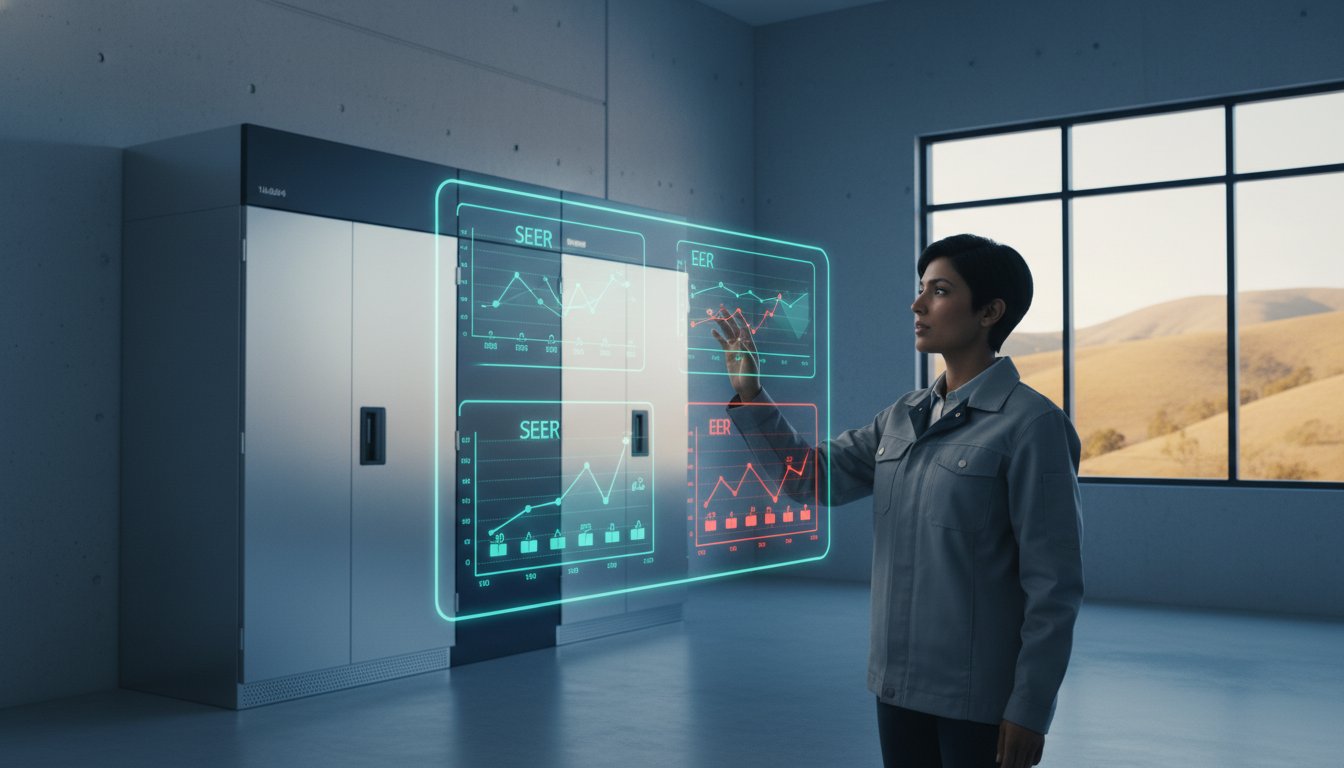
California's commercial electricity prices surged by 22% between 2021 and 2024, turning your refrigeration system's efficiency into a critical line item for your bottom line. You likely recognize that running an inefficient facility in the Bay Area isn't just expensive; it's a liability during peak summer demand. Understanding the nuances of seer eer ratings is no longer optional for facility managers who want to avoid 2026 regulatory pitfalls. We agree that the transition to SEER2 and EER2 standards has introduced significant confusion into an already complex technical environment.
This guide provides the technical clarity you need to master these efficiency metrics, slash your operational overhead, and ensure full Title 24 compliance. You'll learn how to select equipment that remains reliable when temperatures exceed 100 degrees and how to optimize your energy management strategy for the long term. We'll examine the specific engineering differences between seasonal and peak load performance to help you make data-driven decisions for your facility's infrastructure.
Key Takeaways
- Learn to distinguish between seasonal averages and peak-load performance to optimize equipment selection for California’s unique climate.
- Master the technical nuances of seer eer ratings to accurately forecast energy ROI and reduce operational overhead for your commercial facility.
- Navigate the updated 2026 Title 24 requirements and DOE standards to ensure your next refrigeration installation meets strict Northern California compliance mandates.
- Identify how proactive maintenance and real-time system controls prevent expensive efficiency losses caused by refrigerant leaks and dirty coils.
- Explore how a comprehensive energy management strategy translates nameplate efficiency into tangible long-term savings for your business.
Understanding SEER and EER: Why Efficiency Metrics Matter in 2026
California commercial utility rates reached record highs in 2025, making energy management a critical operational priority for every facility manager. Your equipment nameplate serves as the first line of defense against escalating overhead. To truly optimize a facility, you must understand how seer eer ratings impact your monthly expenditure. These metrics provide a direct correlation between hardware performance and your bottom line, moving beyond simple technical jargon into actionable financial data.
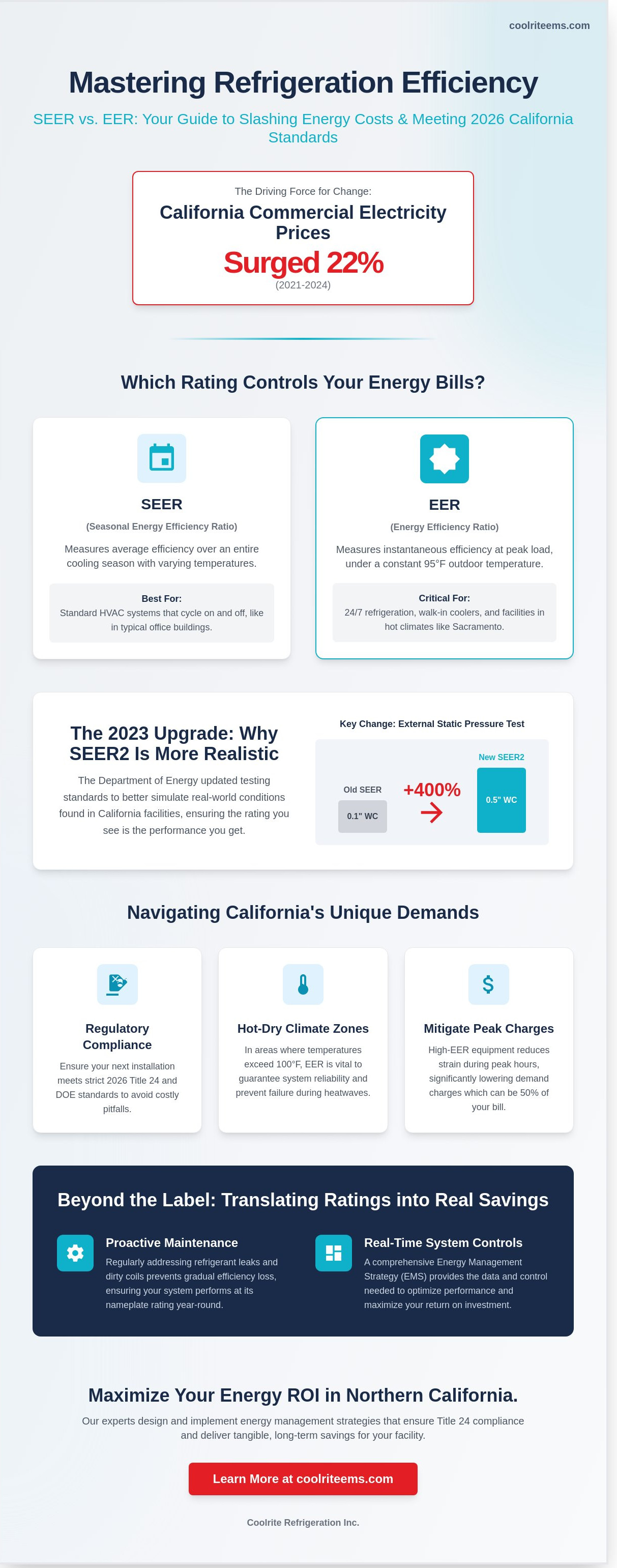
The Seasonal Energy Efficiency Ratio (SEER) calculates the total cooling output of a system divided by the total electric energy input during a typical cooling season. It offers a weighted average that accounts for the variable climates found throughout the state. In contrast, the Energy Efficiency Ratio (EER) measures instantaneous efficiency during peak-load conditions, specifically at a fixed outdoor temperature of 95°F. While SEER predicts how a system performs over an entire year, EER identifies how it handles the most grueling California heatwaves.
Recent updates to SEER2 and EER2 testing standards in 2023 and 2024 corrected long-standing discrepancies in laboratory data. These updated metrics ensure that the equipment installed in 2026 performs as promised under real-world physical pressure. Relying on outdated data leads to undersized systems and unexpected maintenance cycles that disrupt operational continuity.
What is SEER2 and How Does It Differ from SEER?
SEER2 represents a fundamental shift in how engineers evaluate HVAC and refrigeration performance. The primary difference lies in the external static pressure used during testing. The Department of Energy increased this requirement from 0.1 to 0.5 inches of water column, a 400 percent increase that better simulates the resistance found in actual California ductwork. SEER2 is the current industry standard for measuring seasonal cooling efficiency. These ratings provide a transparent view of how equipment operates when airflow is restricted by high-efficiency filters and complex architectural layouts.
The Role of EER in Commercial Refrigeration
While SEER2 is effective for general climate control, EER remains the vital metric for walk-in coolers and industrial units with constant thermal loads. These systems don't benefit from seasonal cooling averages because they must maintain precise temperatures 24/7 regardless of the weather. High EER ratings are essential for mitigating peak demand charges from providers like PG&E, which often account for up to 50 percent of a commercial energy bill. In regions like Sacramento, where summer temperatures frequently exceed 100°F, engineers use EER to size systems that won't fail during the year's most extreme thermal events. Choosing high-EER equipment ensures operational continuity when the local grid is most stressed.
SEER vs. EER: Which Rating Controls Your Bay Area Energy Bills?
Understanding seer eer ratings is the first step toward reducing operational costs for any Northern California facility. SEER (Seasonal Energy Efficiency Ratio) measures efficiency over an entire cooling season. It calculates total cooling output in BTUs divided by total electric energy input in Watt-hours, assuming a range of outdoor temperatures. EER (Energy Efficiency Ratio) is a more rigid metric. It represents a steady-state measurement of cooling capacity divided by power input at a fixed outdoor temperature of 95°F.
For businesses running 24/7 refrigeration, EER is often the superior metric. It reflects how equipment performs during the hottest parts of the day when the grid is most stressed. Standard office HVAC systems that cycle down during cool Bay Area nights rely more on SEER for an accurate efficiency profile. High-load environments like data centers or commercial kitchens should prioritize EER to ensure the system doesn't falter when ambient temperatures peak.
Climate Considerations for Northern California
San Jose businesses must balance these metrics carefully. While the morning fog keeps temperatures mild, afternoon spikes require equipment that won't lose efficiency under pressure. The California Energy Commission classifies much of the inland region as a "Hot-Dry" zone. In these areas, EER is critical because the dry heat forces compressors to work harder for longer durations. Modern commercial HVAC design in California now integrates both ratings to ensure systems remain stable whether it is a 65°F spring morning in San Francisco or a 104°F heatwave in Fresno.
Predicting Your ROI and Payback Period
Calculating your return involves more than just the purchase price. To estimate annual savings, use this formula: (Cooling Load in BTUs x Annual Hours / Rating) x Electricity Rate. Moving from a SEER 14 to a SEER 18 unit can reduce cooling-related energy consumption by approximately 22% annually. Compliance with California’s Title 24 Standards often qualifies businesses for utility rebates that can offset 15% to 20% of the initial capital expenditure.
- High-SEER Units: Best for retail spaces with variable occupancy and fluctuating outdoor temperatures.
- High-EER Units: Essential for cold storage and facilities where consistent 24/7 cooling is non-negotiable.
- Utility Rebates: Local programs frequently offer tiered incentives based on how far your equipment exceeds state minimums.
Investing in higher seer eer ratings typically results in a payback period of 3 to 5 years, depending on your local utility rates and usage patterns. Before finalizing your equipment selection, consider requesting a technical audit to ensure the hardware matches your specific thermal load and operational schedule.
Navigating California’s Title 24 and DOE Efficiency Standards
California's Building Energy Efficiency Standards, known as Title 24, Part 6, set the most rigorous benchmarks for commercial cooling in the United States. For 2026, California Title 24 standards require commercial systems to meet specific seer eer ratings that account for the state's diverse climate zones. In Northern California, including the Bay Area and Central Valley, new installations must adhere to SEER2 and EER2 metrics. These updated testing procedures reflect real-world external static pressure, ensuring that the equipment performs as efficiently in your facility as it does in a laboratory.
Compliance isn't optional for Bay Area businesses. Local building departments now require detailed energy documentation before issuing permits for new construction or major retrofits. If your selected hardware fails to meet the 2026 minimums, you'll face permit denials and potential fines. These state mandates also accelerate the transition to low-GWP (Global Warming Potential) refrigerants. Modern systems utilize high-efficiency coils and advanced compressors to maintain performance while using refrigerants that meet the California Air Resources Board (CARB) limit of 150 GWP for large systems.
Compliance for Walk-In Coolers and Industrial Systems
Walk-in systems don't rely solely on SEER2. Instead, Title 24, Part 6 mandates strict Annual Walk-in Energy Factor (AWEF) ratings. This metric measures the ratio of the total heat removed to the total energy consumed over a year. When sourcing commercial refrigeration equipment, you must verify that both the condensing units and unit coolers are AWEF-compliant. Our team confirms these ratings during the design phase to ensure your hardware meets the 2026 California Energy Commission (CEC) database requirements before any site work begins.
Future-Proofing Your Facility Against New Mandates
While current seer eer ratings provide a baseline, the DOE's 2028 roadmap suggests another 15% jump in efficiency requirements. Investing in high-efficiency hardware today prevents forced upgrades when the next regulatory cycle begins. It's a strategy for long-term operational continuity. Beyond the initial install, preventative maintenance is the only way to protect these ratings. Dirt accumulation on coils or minor refrigerant leaks can degrade a system's "as-built" efficiency by 30% in just two years; regular calibrations ensure your equipment actually delivers the energy savings promised by its technical specifications.
Beyond the Label: How to Improve Equipment Efficiency in Real-Time
A high rating on a factory sticker is only a starting point. Real-world performance rarely matches laboratory conditions, especially when California temperatures exceed 100 degrees Fahrenheit during peak summer months. If your system isn't monitored and managed, a high SEER unit can perform like a decade-old model within weeks of installation. Efficiency is a dynamic metric that requires active management to maintain.
Mechanical issues represent the biggest threat to your seer eer ratings. Dirty evaporator coils act as unintended insulation, forcing the compressor to run longer cycles to move the same amount of heat. Industry data suggests that a 10% refrigerant leak can increase energy costs by 20% while significantly shortening the compressor's lifespan. The CoolriteEMS Controller addresses these variables by optimizing the performance of your existing hardware, ensuring every watt of electricity translates into effective cooling power.
Preventing short-cycling is a priority for operational longevity. High-efficiency compressors are precision-engineered tools that rely on stable run times. When they cycle on and off too rapidly, they suffer from mechanical fatigue and high startup current draws. We implement control logic that stabilizes these cycles, preserving the mechanical integrity of your investment and preventing the "hunting" behavior that wastes energy.
The Power of Energy Management Systems (EMS)
Modern facilities must move from passive cooling to commercial energy management solutions. These systems use real-time data to adjust cooling cycles based on ambient California temperatures and internal load demands. This proactive approach eliminates the waste associated with static thermostat settings. Local PLC control ensures 99.9% uptime without internet dependency. Your facility remains efficient and protected even if your external network connection fails, providing a layer of reliability that cloud-only systems lack.
Maintenance: Keeping Your Ratings Peak
Your maintenance schedule dictates your actual energy draw. Issues like blocked filters or bent condenser fins directly impact how much power your system requires to function. Regular air cooler repair prevents efficiency degradation before it leads to catastrophic equipment failure. There is a direct relationship between airflow and maintained seer eer ratings; if the air can't move, the efficiency drops regardless of the hardware's potential. We identify these performance gaps through precision diagnostics, ensuring your system operates at its peak nameplate efficiency year-round.
CoolriteEMS: Maximizing Energy ROI for Northern California Facilities
CoolriteEMS acts as the essential bridge between laboratory seer eer ratings and the actual financial savings realized on your monthly utility bill. While manufacturers provide these ratings based on controlled environments, real-world variables in Northern California, such as San Jose’s summer heat spikes or high-traffic grocery aisles, often cause equipment to underperform. Our system ensures that your hardware achieves its theoretical efficiency by applying intelligent, real-time adjustments to your specific operational environment.
We understand the financial pressures on California small businesses. That's why we utilize a "No Monthly Fees" model. Many competitors lock facility managers into perpetual subscription costs that eat into the ROI of new equipment. Our approach provides a high-performance energy management system without the recurring overhead, allowing you to retain 100% of your energy savings. Reliability is built into the hardware through local PLC control. Unlike cloud-based alternatives that are vulnerable to internet outages and cybersecurity threats, our controllers operate independently on-site. Your refrigeration remains secure, responsive, and fully operational even if the local network fails.
In 2024, a 15,000-square-foot grocery store in San Jose implemented our custom control logic to address rising energy costs. By fine-tuning compressor cycles and optimizing defrost schedules based on actual load rather than simple timers, the facility reduced its annual energy expenditure by 18%. This transformation turned a standard refrigeration setup into a precision-tuned asset.
Total Solution Approach for Bay Area Businesses
Effective facility management requires a unified view of all mechanical systems. CoolriteEMS integrates HVAC, refrigeration, and energy monitoring into one streamlined interface. This eliminates the need to jump between different software platforms to check facility health. Our system provides customizable SMS and email alerts that notify you the moment a temperature threshold is breached, preventing costly product loss.
When comparing refrigeration service vs. energy management, the difference lies in long-term facility health. Standard service focuses on reactive repairs, while our energy management approach focuses on proactive optimization. We don't just wait for a component to fail; we ensure the entire system operates at its peak efficiency 24/7.
Request Your Efficiency Audit Today
Coolrite Refrigeration Inc. offers comprehensive technical audits to evaluate how your current hardware performs against modern seer eer ratings. Our experts analyze your existing equipment and identify specific bottlenecks in your cooling cycle that lead to energy waste. Upgrading your facility with the CoolriteEMS controller follows a proven path:
- On-Site Assessment: We evaluate your existing HVAC and refrigeration hardware.
- Custom Integration: Our team installs the PLC hardware and integrates it with your systems.
- Logic Optimization: We program bespoke control logic tailored to your specific business hours and load requirements.
Don't let inefficient settings drain your profits. Contact our team today to schedule a personalized demo and receive a detailed energy savings estimate for your facility.
Future-Proof Your California Refrigeration Strategy
Navigating the 2026 Department of Energy efficiency standards requires a precise understanding of how seer eer ratings impact your specific operational environment. While SEER measures seasonal performance, EER provides the critical data needed for peak load management during California’s intense high-heat periods. Staying compliant with Title 24 mandates isn't just about avoiding regulatory penalties. It's about securing long-term operational uptime and reducing the total cost of ownership for your mechanical assets.
You can bridge the gap between manufacturer labels and real-world performance by implementing advanced control systems. CoolriteEMS provides Title 24 compliant solutions that feature local PLC control for 100% security and real-time SMS or email failure alerts to prevent costly inventory loss. Because our hardware-based approach requires no monthly subscription fees, your facility achieves a faster return on investment while maintaining peak efficiency. Expert energy management ensures your infrastructure remains a reliable, cost-effective asset for years to come.
Schedule a Demo of the CoolriteEMS Controller and Start Saving Today
Taking proactive steps now protects your bottom line and guarantees your cooling systems are ready for the rigorous demands of the coming years.
Frequently Asked Questions
What is a good SEER rating for a commercial building in California?
A good SEER rating for a California commercial building in 2026 is 16 or higher. The Department of Energy set the minimum standard at 14.3 SEER2 for the northern United States in 2023. In California's warmer climates, aiming for a rating of 18 or 20 provides the best long-term value against rising utility costs. High-efficiency units ensure your facility remains compliant with evolving state energy mandates.
Is SEER or EER more important for a restaurant in the Bay Area?
EER is the more critical metric for Bay Area restaurants because commercial kitchens face constant high-heat loads. While SEER measures seasonal performance, EER tests equipment at a steady 95 degrees Fahrenheit. Kitchens generate internal heat 365 days a year, so you need a system that handles peak demand. Choosing high EER equipment ensures your refrigeration stays cool during the most intense dinner rushes.
Do higher SEER ratings actually save money on PG&E bills?
Higher seer eer ratings directly lower your PG&E bills by reducing total kilowatt-hour consumption. Upgrading from an old 10 SEER unit to a modern 16 SEER system can cut cooling energy use by 37% according to Department of Energy data. For a facility operating 24/7, these efficiency gains represent a significant reduction in monthly overhead. It's a proven way to protect your bottom line from energy price hikes.
What happens if my commercial refrigeration does not meet Title 24 standards?
Failure to meet Title 24 standards leads to rejected building permits and potential citations from California enforcement agencies. The 2022 Energy Code requires specific efficiency benchmarks for all walk-in coolers and refrigerated warehouses. If your equipment doesn't comply, you'll face mandatory retrofits before you can finalize renovations or clear a building inspection. It's essential to verify compliance during the design phase to avoid these delays.
Can I improve the EER of my existing walk-in cooler without replacing it?
You can improve the EER of an existing walk-in cooler by installing variable speed fan motors and electronic expansion valves. Adding heavy-duty strip curtains can reduce air infiltration by up to 75% based on industry research. Regular preventative maintenance is also vital. Cleaning your condenser coils every 90 days prevents the 5% annual efficiency loss that typically occurs when systems are neglected.
What is the difference between SEER and SEER2 for 2026?
SEER2 is the updated testing standard that became mandatory on January 1, 2023. It uses a new M1 testing procedure that increases external static pressure by 500% to better simulate actual field conditions. While people still discuss seer eer ratings, SEER2 is the more accurate figure for 2026. It ensures the equipment you buy actually delivers the efficiency promised on the label once it's installed in your building.
Are there tax credits for installing high-EER equipment in California?
The Inflation Reduction Act offers the Section 179D tax deduction for commercial buildings that meet specific energy reduction targets. You can claim between $0.54 and $5.36 per square foot for improvements in HVAC and refrigeration efficiency as of 2024. Many California businesses also qualify for PG&E's Golden State Rebates, which provide instant point-of-purchase discounts for high-efficiency motors and controllers.
How does the CoolriteEMS controller help with energy efficiency?
The CoolriteEMS controller boosts efficiency by using intelligent defrost cycles and precision temperature monitoring. It's designed to reduce compressor runtime by approximately 20% while maintaining strict food safety standards. This total solution manages your equipment's workload to prevent unnecessary wear and energy waste. It's a technical safeguard that ensures your system operates at its highest possible efficiency level around the clock.
Related: See our transparent pricing for refrigeration repair, browse customer success stories, or get a quote at your local service area.