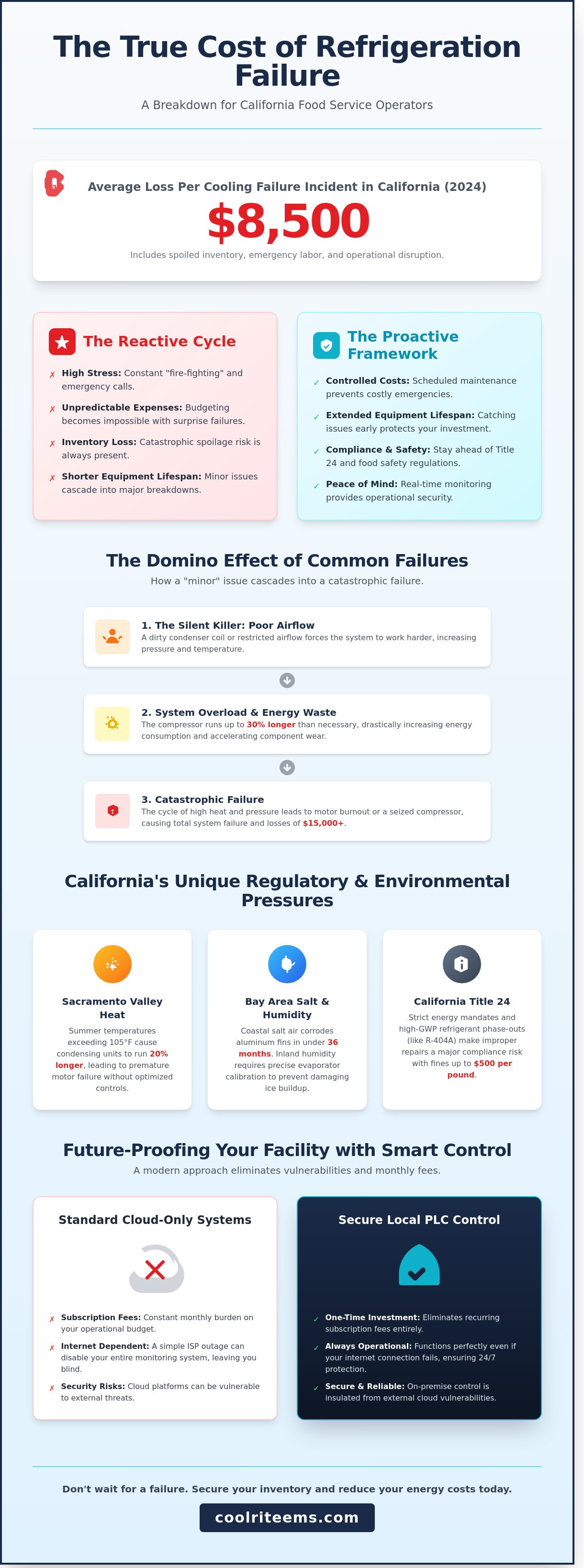
In 2024, California food service operators lost an average of $8,500 per incident due to preventable cooling failures. When a system goes down, the immediate cost of a commercial fridge repair is often eclipsed by the price of spoiled inventory and emergency labor rates.
You understand that reactive maintenance is a cycle of high stress and unpredictable expenses. It's frustrating to manage aging equipment while trying to meet strict California Title 24 energy standards in the Bay Area.
This guide provides the technical roadmap to diagnose common failures, calculate the 15% hidden cost of equipment downtime, and transition your facility to intelligent management. We'll explore how local PLC control and real-time monitoring can eliminate subscription fees and ensure your infrastructure remains a long-term investment. By the end, you'll have a clear strategy to reduce energy bills and maintain compliance without the need for constant technician visits.
Key Takeaways
- Identify the critical mechanical and electrical warning signs that distinguish minor wear from imminent system failure to streamline your commercial fridge repair strategy.
- Calculate the true financial impact of equipment downtime, including inventory loss valuation and operational disruptions, to protect your bottom line.
- Implement a structured preventative maintenance framework designed to catch early signs of refrigeration distress and extend the lifespan of your cooling infrastructure.
- Discover the security and reliability of local PLC control systems that offer real-time monitoring and energy optimization without the vulnerabilities of cloud-only platforms.
The High Stakes of Commercial Fridge Repair in California
Commercial refrigeration repair in 2026 has evolved from simple mechanical fixes into a complex intersection of energy management and regulatory compliance. For a California business owner, a failing compressor is no longer just a service call. It's a risk to your operating permit and a potential drain on your bottom line. Modern commercial fridge repair requires a deep understanding of the vapor-compression refrigeration cycle alongside the digital controls that now govern system efficiency. If your technician doesn't understand both, your repair is likely a temporary band-aid on a permanent problem.
The shift from a reactive break-fix model to a total solution approach is now mandatory for survival. In cities like San Francisco and Sacramento, the cost of downtime has increased by 25% since 2022 due to rising labor rates and stricter food safety audits. We focus on stabilizing your critical infrastructure through local PLC control, ensuring your systems remain operational even if the internet fails. This premium approach eliminates the risk of product loss while removing the burden of monthly subscription fees often found in lower-tier controllers.
California Regulatory Climate: Title 24 and Beyond
The 2022 update to California Title 24, Part 6, set a high bar for energy efficiency that directly impacts every commercial fridge repair decision. When a system fails, the technician must determine if a repair is even legal under current mandates. Older systems using high-GWP refrigerants like R-404A face expensive phase-outs, making simple leaks a 500 dollar per pound liability. Our diagnostic process prioritizes long-term viability by evaluating:
- Energy efficiency ratios that meet or exceed current Title 24 standards.
- Transition paths for systems using phased-out refrigerants to avoid future compliance fines.
- Integration of smart refrigeration controllers that provide real-time SMS alerts to prevent catastrophic stock loss.
Local Environmental Factors in Northern California
Geography dictates the failure points of your refrigeration equipment. In the Sacramento Valley, summer temperatures frequently exceed 105 degrees, placing immense pressure on roof-mounted condensing units. Without optimized control logic, these units run 20% longer than necessary, leading to premature motor failure. In contrast, coastal San Francisco and Oakland facilities face salt air corrosion that can eat through aluminum fins in less than 36 months.
Managing humidity in warehouse facilities in Fremont requires precise calibration of the evaporator coils to prevent ice buildup. We address these local challenges by deploying bespoke control solutions that adapt to your specific microclimate. By focusing on energy management systems that function without a constant cloud connection, we provide secure, reliable cooling that withstands both the California heat and the unique atmospheric conditions of the Bay Area.
Don't wait for a total system failure to address your refrigeration needs. Contact Coolrite EMS today to schedule a professional consultation and see how our local PLC controls can secure your inventory and reduce your energy costs.
Decoding Common Failure Points in Industrial Refrigeration
Your cooling system relies on a delicate balance between mechanical pressure and electrical logic. While a worn door gasket is a minor maintenance task, a seized compressor constitutes a catastrophic failure that can cost a supermarket upwards of $15,000 in lost inventory and emergency labor. Many owners opt for "quick fixes" like topping off refrigerant levels without finding the source. This approach often masks underlying leaks, leading to acidic oil contamination and eventual motor burnout. Poor airflow is a primary silent killer; restricted condensers force the system to run 30% longer than necessary, drastically shortening the equipment's lifespan.
Professional commercial fridge repair requires more than a simple parts replacement. It demands a holistic understanding of how each component interacts. When one part fails, it places undue stress on the rest of the chain. For instance, a dirty condenser coil increases discharge pressure, which forces the compressor to work harder and consume more electricity. This cycle continues until the high-limit switch trips or the motor windings melt. Addressing these issues early prevents the "domino effect" that leads to total facility downtime.
Compressor and Evaporator Coil Issues
Compressor slugging occurs when liquid refrigerant enters the suction line, often caused by overcharging or failed evaporator fans. It's a mechanical death sentence for the unit. You'll often see ice buildup on coils, which usually stems from a faulty defrost timer or a clogged drain line rather than just a refrigerant leak. The thermal expansion valve (TXV) acts as the system's regulator, maintaining the correct superheat. If the TXV loses its charge, the entire balance shifts, causing inefficient cooling and skyrocketing energy bills. Modern California commercial refrigeration regulations now mandate specific efficiency standards for these components to reduce grid strain and environmental impact.
Electrical and Control Logic Failures
Outdated mechanical thermostats are responsible for 40% of temperature swings in older walk-in units. These analog devices lack the precision required for modern food safety standards. Sensor drift, where a probe misreads the internal temperature by as little as 2 or 3 degrees, can lead to product spoilage or unnecessary cooling cycles. Short-cycling, where the compressor turns on and off too frequently, is the fastest way to double your energy costs and fry your start capacitors. This often signals a failing pressure switch or a misconfigured control board. Implementing a total solution for refrigeration control ensures these logic errors are caught via real-time alerts before they lead to a total system shutdown. Reliable commercial fridge repair should always include a calibration check of these critical sensors to ensure long-term stability.
The Business Impact: Calculating the Real Cost of Downtime
A breakdown in your cooling system represents a direct threat to your bottom line. While the invoice for a commercial fridge repair is the most visible expense, it's often the smallest part of the total financial hit. For a California grocery store, a six-hour cooling failure can result in $15,000 of spoiled inventory. This figure doesn't account for the labor costs of four employees spending their entire shift moving products to backup storage instead of serving customers.
- Inventory Valuation: High-end restaurants risk losing $8,000 to $12,000 in dry-aged meats and fresh seafood during a single temperature excursion.
- Labor Redirection: Emergency relocation of stock pulls staff away from revenue-generating activities, creating a secondary loss in service quality.
- Regulatory Risk: Health code violations stay on public record. A single documented failure can decrease foot traffic by 22% over the following quarter due to lost consumer trust.
The "Repair vs. Replace" Decision Framework
Determining whether to fix an old unit or invest in new hardware requires a cold look at the numbers. We recommend the 50% rule. If the quote for a commercial fridge repair exceeds 50% of the unit's replacement value, investing in new hardware is the logical choice. Modern industrial walk-in coolers offer 24/7 reliability that older models simply cannot match. Upgrading allows you to leverage high-efficiency energy management solutions that often provide a full return on investment within 14 to 18 months. Staying informed on sustainable refrigeration advancements ensures your new equipment meets strict 2026 California environmental mandates and avoids future compliance fines.
Energy Efficiency as a Cost Recovery Tool
A malfunctioning fridge is an invisible drain on your bank account. Worn door gaskets or failing fan motors force compressors to run 40% longer than necessary to maintain temperatures. This inefficiency can spike monthly utility bills by 30% or more. Coolrite EMS utilizes local PLC control to provide real-time monitoring without requiring a constant internet connection or monthly subscription fees. Our system identifies energy spikes before a total mechanical failure occurs. By catching a failing motor early, you avoid the $5,000 emergency repair bill and the subsequent product loss. We provide secure remote monitoring with real-time SMS and email alerts, ensuring you're the first to know when a unit drifts outside its set parameters. This proactive approach transforms refrigeration from a liability into a controlled, predictable asset.
From Reactive to Proactive: A Preventative Maintenance Framework
Waiting for a system failure to call for commercial fridge repair is a strategy that leads to 30% higher operational costs over the life of the equipment. A proactive framework ensures your facility remains compliant with California health standards while protecting your bottom line. By shifting to a scheduled maintenance model, you can extend the lifespan of your units by 5 to 7 years.
Staff training is the first line of defense. Employees should be taught to identify early warning signs like unusual vibrations, excessive condensation, or slight temperature fluctuations. Identifying these issues before they trigger a high-temperature alarm prevents the total loss of inventory, which can cost a mid-sized restaurant upwards of $5,000 in a single night.
Professional partners focused on sam refrigeration standards emphasize that longevity isn't accidental. It's the result of technical precision and consistent monitoring. Coolrite EMS enhances this by providing local PLC control that works without internet, ensuring your 24/7 monitoring and real-time SMS alerts never fail due to a lost connection.
The Essential Maintenance Checklist
- Clean condenser coils monthly: Dust and grease buildup forces the compressor to work 20% harder, leading to premature motor failure.
- Inspect and lubricate fan motors: Dry bearings increase friction and heat. Regular lubrication ensures the blade assemblies maintain optimal airflow for heat rejection.
- Test door seals and hinges: Use the dollar bill test to check for airtight integrity. A leaking gasket can increase energy consumption by 15% as the unit struggles to maintain setpoints.
Troubleshooting Common Issues In-House
Before requesting an emergency technician, perform a basic diagnostic check. Verify the power supply first. Roughly 5% of service calls are the result of a tripped circuit breaker or a disconnected plug. If the unit has power but isn't cooling, check the evaporator coils for ice buildup.
Managing defrost cycles is critical to preventing evaporator freeze-ups. If you notice ice, ensure the defrost heaters are functioning and that staff aren't leaving doors open during peak hours. Modern commercial refrigeration control systems from Coolrite EMS allow you to customize defrost logic, ensuring cycles only run when necessary to maximize energy efficiency.
Stop reacting to equipment failures and start optimizing your facility's performance with a bespoke energy management system.
Contact Coolrite EMS today for a professional maintenance and control demo.Future-Proofing with Smart Monitoring and High-End Hardware
Modern California businesses are rapidly abandoning mechanical thermostats in favor of digital precision. Traditional systems often fail silently, which can lead to $15,000 in spoiled inventory before a technician even arrives on-site. Integrating smart hardware into your commercial fridge repair strategy transforms maintenance from a reactive headache into a predictive asset.
The shift toward advanced energy management systems is driven by the need for absolute reliability. High-end hardware allows operators to monitor discharge temperatures and compressor cycles with 99.9% accuracy. This technical oversight ensures that minor fluctuations don't escalate into catastrophic equipment failures during a heatwave.
The CoolriteEMS Advantage: Security and Savings
Most smart controllers rely entirely on external cloud servers to function. If your internet connection drops, your cooling logic might fail or become inaccessible. CoolriteEMS utilizes local PLC logic, which means the system operates independently of your Wi-Fi status. This setup ensures 100% operational uptime for critical cooling cycles regardless of connectivity issues.
- Zero monthly subscription fees: We eliminate the $60 to $120 monthly "SaaS" fees that many competitors charge for basic data access.
- Local PLC control: Your data stays on your premises, providing a secure environment that's immune to cloud-based hacks or server outages.
- Customizable logic: Our engineers program bespoke sequences for specialized industrial applications, such as blast chillers or pharmaceutical storage.
A mid-sized supermarket in San Jose recently reduced its emergency commercial fridge repair costs by 35% within the first year of installing our controller. They stopped paying for "no-fault-found" service calls because the system accurately diagnosed a faulty expansion valve before the temperature moved out of the safe zone.
Upgrading Your Infrastructure
Integrating new walk-in freezers and reach-in units with a smart refrigeration controller is a one-time investment that typically pays for itself through energy savings within 14 months. Multi-site managers can oversee 20 different locations from a single secure dashboard. This visibility allows for centralized management without compromising the security of individual local networks.
- Monitor real-time energy consumption to identify failing gaskets or clogged condenser coils before they cause a spike in utility bills.
- Secure remote monitoring allows our team to perform off-site diagnostics, often resolving issues without an expensive truck roll.
- Automated SMS and email alerts notify your staff the moment a door is left open or a defrost cycle fails.
Our total solution approach focuses on the entire equipment lifecycle. We don't just fix parts; we optimize the environment to ensure your hardware lasts years longer than the industry average. This commitment to efficiency and sustainability marks the difference between a simple fix and a long-term investment.
Don't wait for a breakdown to modernize your facility. Contact us today for a professional demo of the CoolriteEMS system and see how our hardware secures your operational continuity.
Securing Your Cold Chain for 2026 and Beyond
California businesses can't afford the $10,000 average loss associated with a single night of inventory spoilage. Transitioning from reactive commercial fridge repair to a proactive, data-driven strategy is the only way to protect your bottom line. By implementing local PLC controls, you eliminate the risks of cloud dependency while ensuring 24/7 operational continuity for your supermarket or warehouse.
Coolrite EMS has provided specialized California-based expertise since 1995. Our system offers a total solution with zero monthly subscription fees and maximum security through offline-capable hardware. You get real-time SMS alerts and customizable logic that adapts to your specific facility needs. It's time to stop worrying about equipment failure and start optimizing your energy efficiency with a partner who values long-term reliability. We've spent nearly three decades perfecting refrigeration management so you can focus on growth.
Request a Demo of the CoolriteEMS Controller to see how we can future-proof your facility today. Your infrastructure is the backbone of your business, and we're here to keep it running at peak performance.
Frequently Asked Questions
How much does commercial fridge repair typically cost in the Bay Area?
Commercial fridge repair costs in the Bay Area typically range from $250 to $1,200 depending on the specific component failure. In 2026, average labor rates for certified technicians hover around $150 per hour. While a simple thermostat replacement might cost $350, a full compressor swap on a large walk-in unit can exceed $2,500 when you factor in parts and specialized labor.
Is it worth repairing a commercial refrigerator that is over 10 years old?
It's generally not cost-effective to repair a unit if the quote exceeds 50% of the replacement cost. Equipment older than 10 years often operates at 30% lower efficiency than modern standards. Upgrading to a new system managed by a CoolriteEMS controller can reduce energy consumption by 25% immediately; this makes replacement a better long-term investment than fixing an obsolete model.
What are the most common causes of temperature fluctuations in walk-ins?
Dirty condenser coils and compromised door gaskets cause 60% of temperature stability issues in commercial settings. If you don't clean your coils every 90 days, the system struggles to reject heat, which leads to 15% higher energy bills. These fluctuations put unnecessary strain on the compressor and eventually lead to a total system collapse during peak operating hours.
How often should I have my commercial refrigeration equipment serviced?
You should schedule a professional commercial fridge repair and maintenance visit at least four times per year. Quarterly inspections prevent 80% of emergency breakdowns by identifying worn parts before they fail. Technicians focus on refrigerant levels, electrical connections, and sensor calibration to ensure your inventory stays safe throughout the intense California summer heat.
Can a smart controller really reduce my energy bills in California?
Yes, installing a smart refrigeration controller can lower your monthly energy costs by 20% to 40%. The CoolriteEMS system uses local PLC logic to optimize defrost cycles and manage fan run times based on actual demand. This precision prevents power spikes during expensive peak utility hours and operates entirely without the burden of monthly subscription fees.
What happens if my refrigeration system fails after hours in Sacramento?
You must have a 24/7 emergency response plan to prevent total product loss when a failure occurs at night. CoolriteEMS provides secure remote monitoring that sends real-time SMS and email alerts the moment temperatures deviate from your set points. This allows a technician to reach your Sacramento facility before the internal temperature rises above 40 degrees Fahrenheit.
Does the CoolriteEMS controller work with existing refrigeration brands?
The CoolriteEMS system is brand-agnostic and integrates seamlessly with all major refrigeration manufacturers found in California businesses. It replaces outdated mechanical controls with bespoke logic tailored to your specific hardware. This provides a premium upgrade path that improves reliability and adds remote monitoring capabilities without the high cost of replacing your entire equipment line.
What are the legal requirements for refrigerant disposal in California?
The California Air Resources Board (CARB) requires 100% recovery of all regulated refrigerants during any repair or decommissioning process. Technicians must use EPA-certified recovery equipment and maintain detailed service records for at least 3 years. In 2026, business owners face fines exceeding $25,000 per occurrence for improper venting or failure to document the disposal of hazardous refrigerants.
Related: See our transparent pricing for refrigeration repair, browse customer success stories, or get a quote at your local service area.