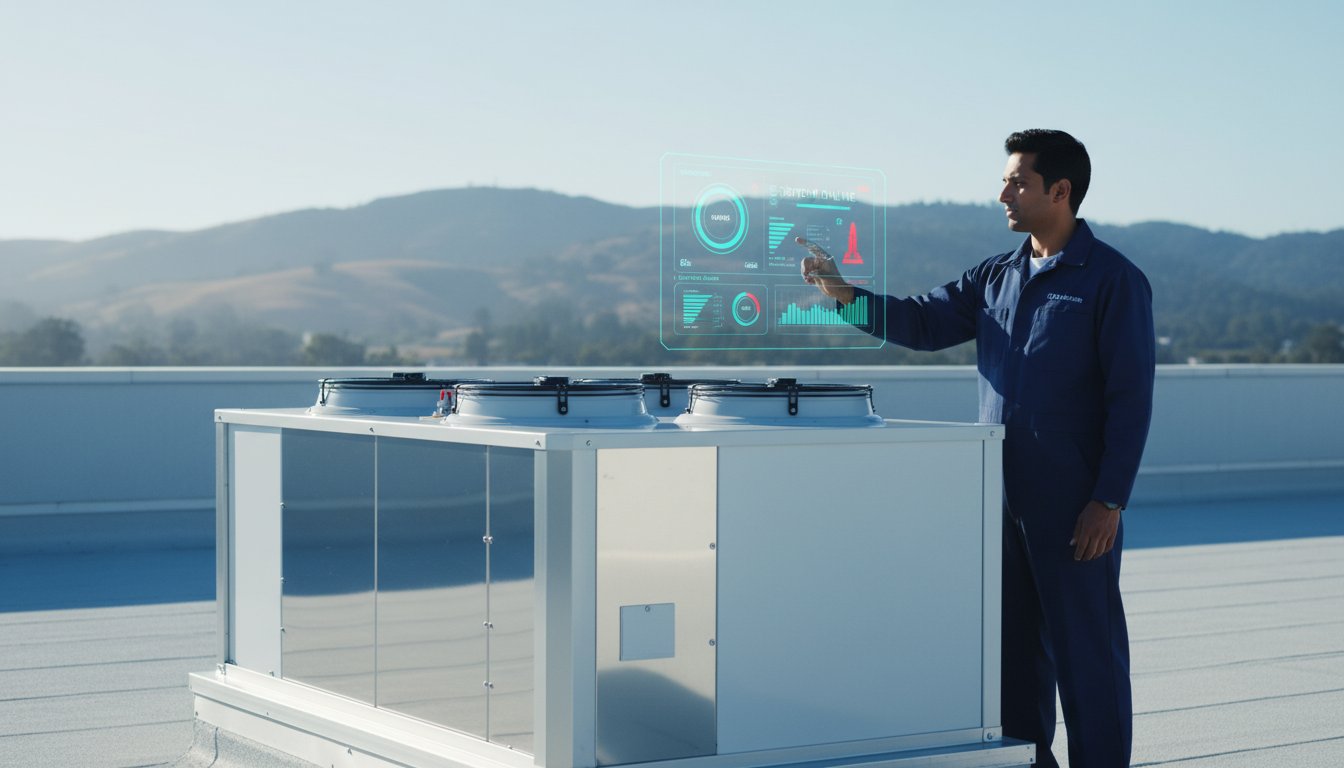
According to recent industry data, commercial refrigeration accounts for up to 40% of total energy use in California retail spaces during a 105-degree heatwave. Maintaining high-performance Condensing Units isn't just a technical requirement in cities like Sacramento or San Jose. It's a critical strategy for business continuity and long-term profitability.
You likely feel the pressure of rising utility rates and the constant threat of equipment failure during peak summer months. We'll show you how to optimize your cooling infrastructure to withstand extreme temperatures while slashing energy costs through advanced EMS integration. This guide provides a clear roadmap for achieving Title 24 compliance and ensuring zero product loss.
It's about moving beyond reactive repairs to a proactive, total solution approach that protects your investment. You'll learn how modern, local PLC controls provide a secure, subscription-free way to manage your facility's reliability. We'll examine the specific hardware configurations and maintenance protocols that keep systems running at peak efficiency while eliminating the downtime that threatens your inventory.
Key Takeaways
- Identify the specific hardware configurations for commercial Condensing Units that ensure reliable heat rejection and operational continuity during intense California heat waves.
- Compare microchannel and tube-and-fin coil technologies to select the most durable and efficient components for high-ambient commercial environments.
- Navigate complex Title 24 refrigeration requirements with a clear understanding of mandatory fan speed controls and floating head pressure optimization.
- Discover how to integrate the CoolriteEMS Controller to achieve total system visibility and energy savings through custom logic without relying on an internet connection or recurring fees.
Understanding Commercial Condensing Units in the California Landscape
California businesses face a unique set of operational challenges. Extreme temperature swings and strict energy mandates mean your refrigeration hardware must be resilient. A condensing unit serves as the high-pressure side of your system, acting as the primary vehicle for heat rejection. Without efficient heat transfer, your walk-in coolers or display cases can't maintain the strict food safety standards required by state health inspectors.
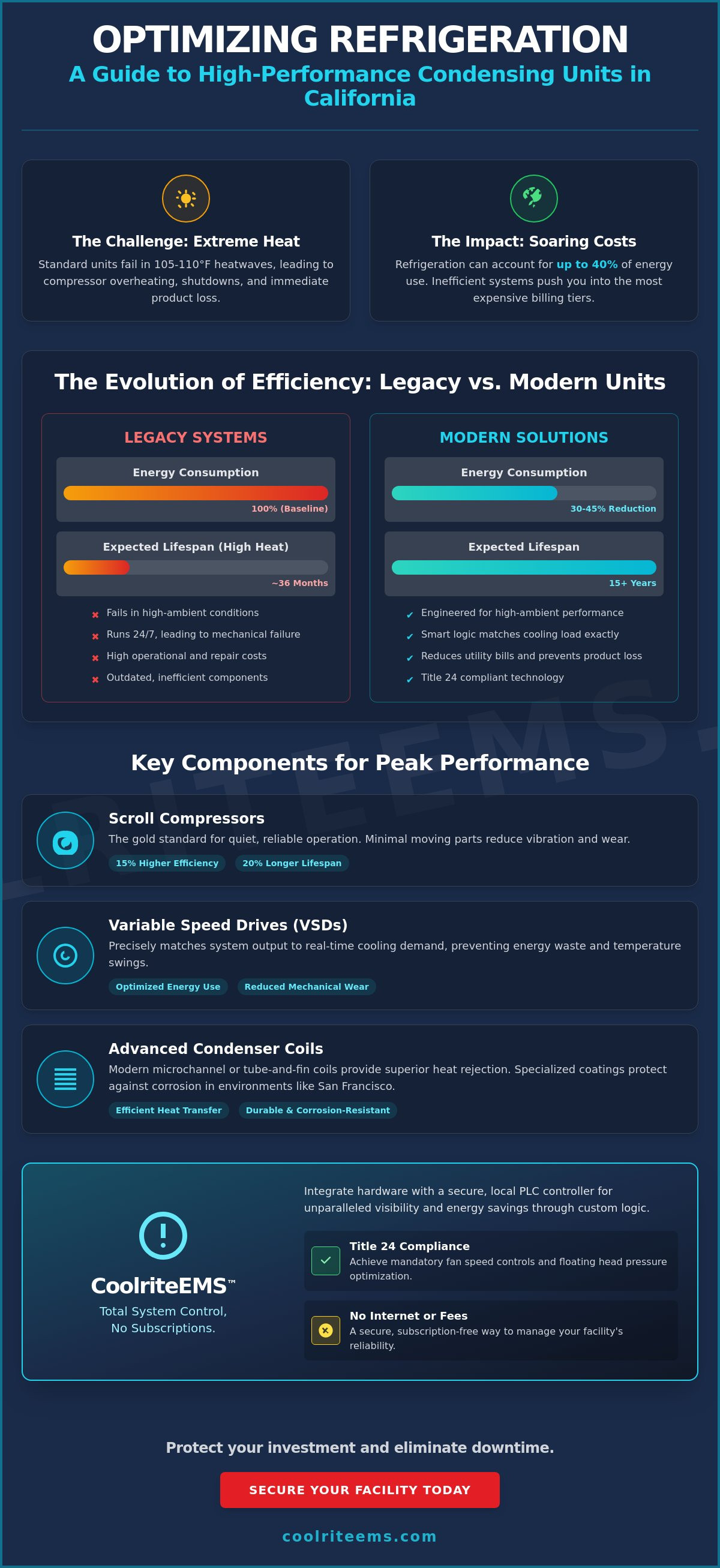
Standard units often fail during Sacramento or Fresno heatwaves because they aren't engineered for 110°F ambient conditions. When the outside air temperature rises, the pressure within the system climbs. If the unit isn't designed for high-ambient performance, the compressor overheats and shuts down to prevent a total meltdown. This downtime leads to immediate product loss and expensive emergency repair calls.
Core Functions of a Condensing System
The system works by compressing refrigerant vapor and converting it back into a liquid state. This process relies on the synchronized performance of the compressor, the condenser coil, and the fan motor. Understanding foundational condenser principles is vital because any inefficiency in these components forces the entire system to struggle.
- The Compressor: The heart of the unit that moves refrigerant through the cycle.
- The Condenser Coil: The heat exchanger where thermal energy is released.
- The Fan Motor: Pulls ambient air across the coils to facilitate cooling.
Proper sizing is the most critical factor in preventing premature system death. An undersized unit in a high-heat environment will run 24/7 without reaching its set point. This constant operation typically results in mechanical failure within 36 months, whereas a correctly sized unit can last 15 years or more. Modern Condensing Units differ from legacy systems by utilizing smart logic and variable speeds to match the cooling load exactly.
The California Context: Heat and Energy Prices
Energy costs in the Golden State are a major operational hurdle for any facility manager. With commercial electricity rates frequently exceeding 20 cents per kWh, the ROI on high-efficiency hardware is realized much faster than in other regions. California’s tiered pricing means that inefficient systems don't just use more power; they push your business into the most expensive billing brackets during peak hours.
Geography also dictates your hardware requirements. A unit installed in the San Francisco fog faces constant salt-air corrosion, requiring specialized coil coatings to prevent leaks. Conversely, a system in the Stockton heat needs high-ambient head pressure controls to maintain stability. For a California business owner, a condensing unit is the outdoor mechanical assembly that exhausts heat from your building to ensure your indoor inventory stays at the required temperature.
Transitioning from a 10-year-old system to a modern solution can reduce refrigeration energy consumption by 30% to 45%. These savings are achieved through better heat exchange surfaces and electronic expansion valves that didn't exist in older generations of equipment.
Key Components that Drive High-Performance Refrigeration
Modern Condensing Units are precision engineered systems where every component must work in harmony to ensure operational continuity. For California businesses, the choice of hardware directly impacts both the monthly utility bill and the longevity of the inventory. Selecting high-performance components ensures your facility meets the rigorous demands of 2026 energy regulations while maintaining stable temperatures during peak summer loads.
Scroll Compressors and Variable Speed Drives
Scroll technology has become the gold standard for San Jose restaurants and retail spaces due to its minimal moving parts and quiet operation. These compressors offer a 15% increase in efficiency over traditional reciprocating models. When paired with variable speed drives, the system matches its output to the actual cooling demand rather than running at 100% capacity. This precision prevents temperature swings and reduces mechanical wear. Integrating an electronically commutated motor within the fan assembly further optimizes these savings by adjusting airflow based on real-time pressure requirements.
- Reduced mechanical vibration leads to a 20% longer equipment lifespan compared to older piston models.
- Variable speed technology eliminates the high-amp draws associated with frequent start-stop cycles.
- Local PLC controls from Coolrite EMS ensure these components operate efficiently without the need for expensive monthly cloud subscriptions.
Advanced Coil Technologies
The choice between microchannel and tube-and-fin coils depends heavily on your specific California microclimate. Aluminum microchannel coils offer superior heat transfer and can reduce the total refrigerant charge by up to 40%. This reduction is vital for meeting Title 24 compliance standards, which strictly regulate environmental impact and energy use in commercial settings. However, for facilities located near the San Francisco Bay, salt air corrosion is a primary concern. In these high-salinity environments, specialized e-coatings or heavy-duty tube-and-fin designs provide the durability needed to prevent premature refrigerant leaks.
Reliability also depends on the physical protection of these components. Weather-resistant, heavy-gauge galvanized steel housing is non-negotiable for outdoor installations in the Central Valley or coastal regions. These enclosures protect sensitive electronics and copper piping from UV degradation and extreme temperature fluctuations. To ensure your facility utilizes the most efficient configuration, consider a professional system assessment to identify potential energy leaks in your current setup.
- Microchannel coils are 30% lighter than traditional coils, reducing the structural load on commercial rooftops.
- ECM fans maintain consistent head pressure even during 100-degree California heat waves.
- Customizable control logic prevents unnecessary ice buildup and optimizes defrost cycles automatically to save power.
Air-Cooled vs. Water-Cooled: Choosing for Your CA Facility
Selecting the right cooling medium for your facility determines your long-term energy profile and maintenance schedule. California’s strict environmental mandates and varying microclimates make this choice more complex than a simple price comparison. While air-cooled Condensing Units offer mechanical simplicity, water-cooled systems often provide superior heat transfer in specific industrial applications.
The decision usually hinges on the balance between water scarcity and electrical demand. In regions like the Central Valley, where summer temperatures regularly exceed 100°F, air-cooled systems must be oversized to maintain capacity. Conversely, water-cooled setups provide consistent performance regardless of ambient air temperatures. This makes them a reliable choice for energy-efficient electric chillers used in large-scale food processing and bulk storage.
Air-Cooled Units: The California Workhorse
Air-cooled systems remain the standard for 75% of Bay Area retail and restaurant installations. Their primary advantage is the lack of water consumption, which simplifies compliance with local drought restrictions. In dense urban areas like San Francisco, these units are typically installed on rooftops to manage space constraints. This placement requires strict adherence to local noise ordinances, as many municipalities limit sound levels to 60 decibels at the property line during night hours.
- Low Infrastructure Costs: No need for cooling towers or complex water piping.
- Drought Resilience: Zero water usage protects you from rising utility rates and usage caps.
- Simplified Maintenance: Routine service focuses on coil cleaning and fan motor checks.
Coolrite EMS optimizes these Condensing Units with custom control logic that adjusts fan speeds based on real-time load. Our local PLC-based controllers ensure your equipment stays online without relying on an internet connection. You get full visibility through SMS alerts and remote monitoring without the burden of monthly subscription fees.
Water-Cooled Units and Glycol Systems
Industrial cold storage facilities often opt for water-cooled configurations to achieve maximum thermal efficiency. These systems are particularly effective when paired with glycol systems, which act as a secondary coolant to distribute refrigeration throughout a large warehouse. This setup reduces the overall refrigerant charge, a critical factor for meeting California’s GWP regulations by 2026.
Maintenance for these units involves managing mineral buildup and water treatment. In Northern California, water hardness varies significantly by county, requiring bespoke filtration to prevent scaling in heat exchangers. By utilizing our total solution approach, we integrate smart monitoring to track water flow and pressure. This prevents product loss by identifying potential clogs before they cause a system shutdown. If you're ready to modernize your facility with a secure, subscription-free control system, contact us today for a professional site assessment.
Title 24 Compliance and Energy Optimization in the Bay Area
California Title 24, Part 6, establishes the most rigorous energy standards in the United States. For 2026, these regulations mandate that Condensing Units in commercial settings must meet specific efficiency thresholds to operate legally. Compliance focuses on reducing the electrical load during peak hours through hardware and software integration. If your facility exceeds 3,000 square feet, you're likely required to implement specific controls for fan speed and pressure management.
Meeting these standards does more than just satisfy state inspectors. Optimized systems contribute directly to LEED certification points under the Energy and Atmosphere category. High-efficiency installations often qualify for significant financial incentives. Utility providers like PG&E offer rebates that can offset up to 30% of the upgrade costs for compliant equipment. This makes the transition to modern hardware a strategic financial move rather than a regulatory burden.
- Mandatory variable speed drives for all condenser fans.
- Required implementation of floating head pressure logic.
- Documented energy savings for LEED and local building permits.
- Access to thousands of dollars in utility-sponsored rebates.
Floating Head Pressure Control
Traditional fixed-pressure controls are obsolete in the 2026 market. These older systems maintain a high discharge pressure even when outdoor temperatures drop, wasting immense amounts of electricity. Floating head pressure allows the system to lower the discharge pressure during cool Bay Area nights. This simple adjustment reduces compressor work and saves 20% on total energy consumption. We implement smart logic to automate these adjustments, ensuring your Condensing Units operate at peak efficiency regardless of the weather.
Local PLC Control vs. Cloud-Based Jargon
Many providers push cloud-based platforms that require constant internet connectivity and monthly subscription fees. We view the internet as a liability for critical refrigeration. Our systems utilize local PLC (Programmable Logic Controller) technology. This hardware processes all control logic on-site, meaning your refrigeration stays online even if your ISP goes down. It provides a secure, closed-loop environment that protects your data and your inventory.
Security doesn't mean a lack of visibility. Our local controllers provide real-time SMS and email alerts directly to your team. If a temperature deviation occurs in a supermarket or a medical warehouse, you'll know instantly. This approach prevents product loss without the recurring costs or security risks associated with third-party cloud servers. You own the hardware, you own the data, and you maintain total control over your facility's climate.
Ready to secure your facility with a compliant, high-efficiency solution? Explore our bespoke energy management systems today.
The Coolrite Difference: Integrating Hardware with CoolriteEMS
Selecting premium Condensing Units is only the first step toward a reliable cold chain. True operational excellence stems from how that hardware is managed. Coolrite positions itself as the premier provider of total refrigeration solutions by bridging the gap between mechanical power and intelligent control. Our approach ensures that your equipment doesn't just run; it performs with precision.
The CoolriteEMS Controller serves as a brand-agnostic brain for your facility. It optimizes the performance of any Condensing Units, regardless of the manufacturer. By integrating this advanced energy management system, you gain granular control over suction pressures and discharge temperatures. This level of oversight transforms standard hardware into a high-efficiency asset that responds to real-time environmental changes.
Customizable Control Logic
Every facility has unique demands. A warehouse storing frozen poultry requires different thermal dynamics than a retail walk-in for fresh produce. Our customizable control logic allows us to tailor refrigeration cycles to your specific inventory needs. We move beyond generic factory settings to implement smarter defrost and fan cycles that reflect your actual usage patterns.
- Reduced Operational Costs: Smart fan management prevents unnecessary motor wear and lowers kilowatt consumption.
- Product Integrity: Precise temperature stabilization eliminates the fluctuations that lead to food spoilage.
- The "No Subscription" Promise: We believe you should own your data. Our remote monitoring tools come without monthly subscription fees, ensuring your long-term savings aren't eroded by recurring costs.
California-Based Support and Expertise
Operating in California presents specific challenges, from strict Title 24 compliance to the extreme heat of the Central Valley. In 2024, a mid-sized Sacramento grocery store partnered with Coolrite to overhaul their aging system. By replacing legacy controls with CoolriteEMS, they cut energy consumption by 30% within the first six months. This was achieved through optimized floating head pressure and demand-based defrosting, proving that smart logic pays for itself.
We provide 24/7 emergency support across the Bay Area and the Central Valley. Working with a dedicated cold storage contractor who understands California law is essential for maintaining compliance and avoiding heavy fines. Our team handles everything from initial design to ongoing maintenance, ensuring your facility remains an industry leader in efficiency. If you're ready to modernize your infrastructure, contact us for a demo of the CoolriteEMS platform today.
Future-Proof Your California Refrigeration Infrastructure
Navigating the transition to 2026 efficiency standards requires more than just high-quality hardware. It demands a deep understanding of how air-cooled and water-cooled Condensing Units perform under California’s specific climate demands and Title 24 mandates. By prioritizing energy-optimized components and smart integration, you protect your bottom line against rising utility costs and equipment failure.
Coolrite EMS has served as a dependable partner for California businesses since 1995. We provide a total solution that combines expert hardware selection with our subscription-free controller. Our California-based team offers 24/7 support to ensure your facility maintains 100% uptime, regardless of external temperatures or grid fluctuations. You don't have to manage these technical transitions alone.
Take control of your energy management and eliminate the risk of product loss with a system designed for the modern era. Request a Free Demo of the CoolriteEMS Controller to see how we can optimize your facility. We're ready to help you build a more resilient and cost-effective cooling operation today.
Frequently Asked Questions
What is the average lifespan of a condensing unit in California?
Most commercial condensing units in California operate reliably for 12 to 15 years. Systems located within 5 miles of the coast often see a 20% reduction in this lifespan due to salt-induced corrosion. Regular preventative maintenance and modern control logic ensure these units reach their full operational potential even in high-ambient environments like the Central Valley.
Do I need a permit to replace a condensing unit in San Francisco?
You must obtain a mechanical permit from the San Francisco Department of Building Inspection (DBI) for all condensing unit replacements. The 2022 California Mechanical Code requires this to ensure safety, proper refrigerant handling, and structural integrity. Our team manages the technical documentation required for these filings to ensure your project remains compliant with local municipal codes.
How much can a CoolriteEMS controller save on refrigeration energy bills?
A CoolriteEMS controller typically reduces refrigeration energy bills by 20% to 30% through precision floating head pressure control and optimized defrost cycles. By managing the runtime of your condensing units more effectively, the system eliminates unnecessary energy draw during off-peak hours. These savings come without monthly subscription fees, maximizing your long-term return on investment.
What is the difference between a condensing unit and an evaporator coil?
The condensing unit is the outdoor component that rejects heat and compresses refrigerant, while the evaporator coil sits inside the refrigerated space to absorb heat. Think of them as the two halves of a continuous heat transfer loop. The outdoor unit uses a compressor and fan to turn gas back into liquid. The indoor coil uses that liquid to cool the air, maintaining precise temperatures for your inventory.
How often should I clean the coils on my outdoor unit in Sacramento?
You should clean your outdoor unit coils in Sacramento at least 4 times per year. High levels of agricultural dust and seasonal pollen in the region can reduce heat transfer efficiency by 15% in just 90 days. Quarterly cleanings prevent the compressor from overheating during 100 degree summer days. This proactive schedule ensures your condensing units maintain peak performance and avoid emergency shutdowns.
Is Title 24 compliance mandatory for existing refrigeration systems?
Title 24 compliance is mandatory for existing systems when you replace more than 50% of the refrigeration system's total capacity or add new refrigerated space. The 2022 Building Energy Efficiency Standards require specific controls for walk-in coolers and warehouses to reduce state-wide energy demand. Implementing a CoolriteEMS controller helps facilities meet these California requirements by providing automated energy management and precise temperature logging.
Can I use a CoolriteEMS controller with a Copeland or York unit?
You can use a CoolriteEMS controller with any major brand, including Copeland, York, or Bitzer units. Our system uses a local PLC with customizable control logic that integrates seamlessly with existing mechanical hardware. This bespoke approach allows you to upgrade your control infrastructure without replacing your entire equipment line. It provides secure, remote monitoring for legacy systems, bringing modern efficiency to reliable older units.
What happens if my condensing unit fails during a power outage?
If a condensing unit fails during a power outage, your inventory is at immediate risk of spoilage once the thermal mass warms up. CoolriteEMS mitigates this risk by sending real-time SMS and email alerts the moment power is lost or temperatures drift. Since our controller operates via a local PLC, it retains all settings and resumes optimized operations immediately when power returns, preventing the surge issues that often damage standard controllers.
Related: See our transparent pricing for refrigeration repair, browse customer success stories, or get a quote at your local service area.