
What if your refrigeration system could cut energy consumption by 22% while simultaneously eliminating the risk of catastrophic inventory loss? Selecting the right cold storage contractor is the first step in navigating Northern California's utility rates, which surged by 12.8% in 2023. You know that even a two-degree deviation in a large-scale warehouse can result in thousands of dollars in wasted product and immediate regulatory scrutiny.
This guide reveals how to design, build, and optimize temperature-controlled environments that exceed California's rigorous Title 24 energy standards while maximizing operational uptime. We'll examine high-performance industrial solutions, including local PLC controls that function without internet and advanced monitoring systems designed to protect your investment every hour of the day. You'll learn how a total solution approach ensures your facility remains compliant, efficient, and secure for the long term.
Key Takeaways
- Learn how Northern California’s diverse microclimates demand bespoke engineering to maintain precision temperature control and facility longevity.
- Identify the critical differences between modern distributed refrigeration and traditional systems to optimize your infrastructure for long-term performance.
- Navigate California’s complex energy mandates with smart management strategies that reduce operational expenses while preventing product loss.
- Use our strategic framework to select a cold storage contractor based on safety performance, technical expertise, and efficient project delivery models.
- Discover the benefits of a total solution partnership that provides 24/7 emergency response to guarantee maximum uptime for your critical operations.
The Evolving Landscape of Cold Storage Construction in Northern California
The role of a modern cold storage contractor in 2026 has transitioned from basic mechanical installation to high-level systems integration. Facilities no longer compete on footprint alone. They compete on energy density and thermal precision. In Northern California, a one-size-fits-all approach leads to 20% higher operational costs and premature equipment failure. Protecting millions of dollars in perishable food or life-saving pharmaceuticals requires a total solution that prioritizes uptime and local control.
Bespoke engineering is mandatory when moving between regional microclimates. A facility in the Bay Area deals with constant 90% humidity and salt air, which accelerates corrosion on condenser coils. In contrast, a Sacramento warehouse must withstand 108°F peak summer temperatures while maintaining a steady -10°F internal environment. We design systems that account for these specific thermal loads, ensuring your refrigeration plant doesn't overwork itself into a breakdown. Modern facilities prioritize intelligent layouts that maximize pallet positions while minimizing the refrigerated cubic volume.
Why Local California Expertise is Non-Negotiable
California's regulatory environment is the strictest in the nation. Compliance with Title 24, Part 6 requires advanced refrigeration logic that many out-of-state firms overlook. We integrate local PLC controls that manage these energy requirements without relying on unstable internet connections or monthly subscription fees. This ensures your facility remains compliant and operational regardless of external connectivity.
- Seismic Engineering: High-density rack systems in the Bay Area must meet specific R-factor requirements to withstand 7.0 magnitude events.
- Grid Integration: We coordinate with PG&E and SMUD to leverage automated demand response, reducing peak-time energy costs by up to 15%.
- Code Compliance: Every installation adheres to strict refrigeration energy codes and safety mandates specific to the California Building Code.
From Food Service to Life Sciences: Diverse Industry Needs
The demand for "Speculative Cold" in the Central Valley has increased by 25% since 2022. These facilities require flexible layouts for third-party logistics (3PL) providers who switch between frozen and chilled inventory. As an experienced cold storage contractor, we understand that flexibility shouldn't compromise efficiency. We implement customizable control logic that allows operators to shift temperature zones with a few clicks.
Northern California's biotech corridor in South San Francisco demands even more precision. We install ultra-low temperature systems capable of maintaining -80°C for sensitive biological samples. These high-stakes environments rely on real-time SMS alerts and secure remote monitoring to prevent catastrophic product loss. Whether it's a grocery distribution center in Tracy or a lab in Emeryville, our focus remains on reducing operational costs through superior engineering.
Critical Infrastructure: Engineering High-Performance Refrigeration Systems
Building a cold storage facility involves more than just assembling an insulated box. A professional cold storage contractor understands that the synergy between mechanical design and structural integrity determines the 20 year lifecycle of the asset. Modern industrial builds focus on the anatomy of the entire thermal envelope, ensuring that every component from the compressor to the door seal works in unison to protect millions of dollars in inventory.
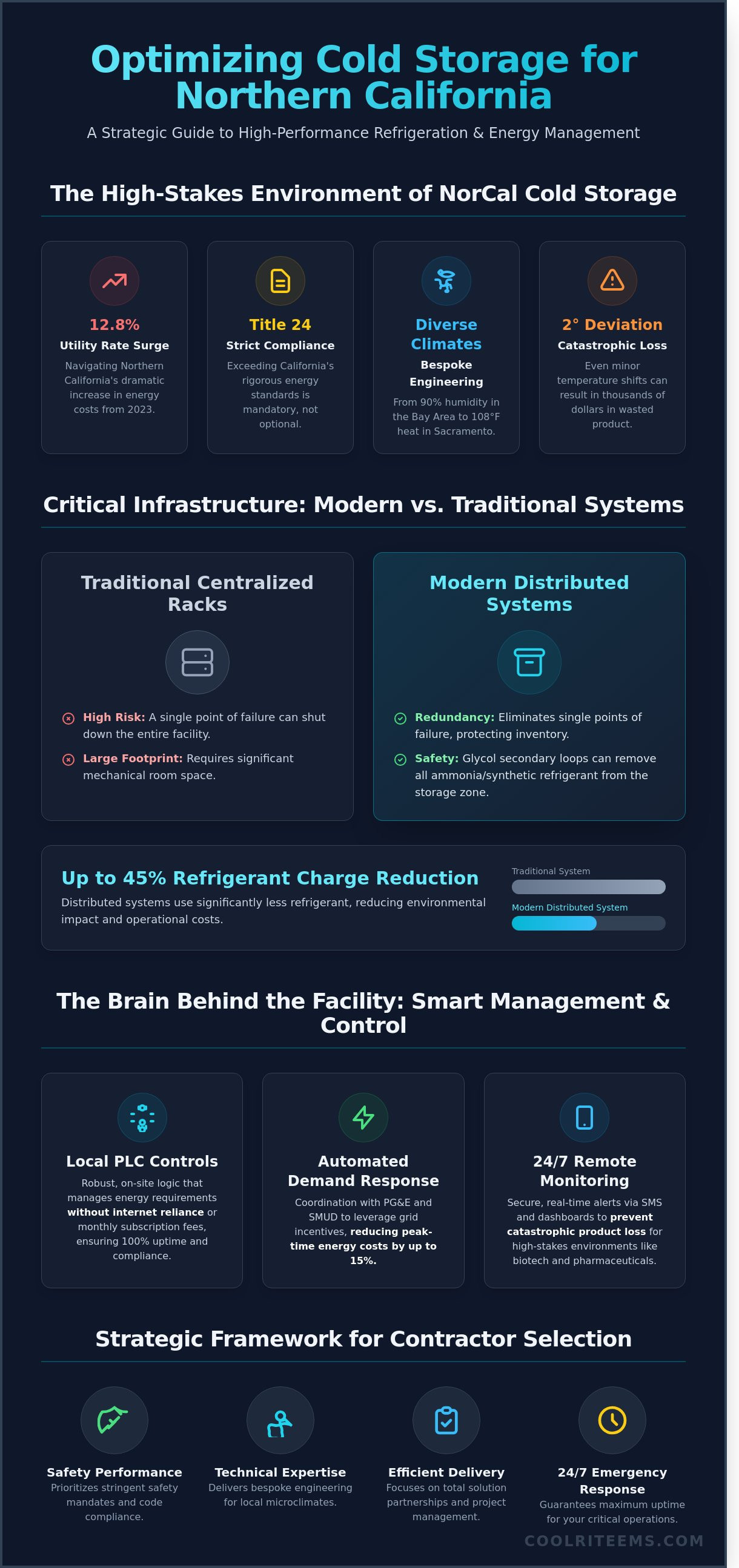
Traditional centralized rack systems have long been the industry standard for high capacity cooling. However, many Northern California facilities are shifting toward distributed refrigeration. This approach places smaller units closer to the load, which can reduce refrigerant charges by up to 45% and minimize the risk of a single point of failure. For facilities prioritizing safety and precision, glycol secondary loops offer a superior solution. These systems use a water and glycol mixture to transfer heat, eliminating the risk of ammonia or synthetic refrigerant leaks within the product storage zone.
Selecting the right condensing units and evaporator coils is essential for maximum heat rejection. In the high ambient temperatures of the Central Valley, units must be sized for peak loads while maintaining energy efficiency. Optimizing these systems requires the precision of a smart refrigeration controller to manage real-time data and hardware without relying on external internet connections.
Insulated Metal Panels (IMP) and Thermal Envelopes
While R-values are a baseline metric, vapor barrier integrity is the true measure of a thermal envelope. Even a microscopic breach in the seal allows moisture to migrate into the insulation, leading to ice buildup and structural degradation. Effective designs include 6 inch extruded polystyrene floor insulation paired with sub-floor heating loops. These loops prevent frost heave, a condition that can crack a 50,000 square foot concrete slab within months. High speed cold storage doors with cycle times under 3 seconds are also critical to minimize thermal infiltration during heavy loading periods.
Advanced Refrigeration Components
Custom engineered rack systems provide the backbone for large scale distribution centers, allowing for multi stage compression that scales with demand. To further reduce operational costs, we utilize electronically commutated motors (ECM) in evaporator coils, which consume 40% less energy than standard motors. A Total Solution approach integrates bespoke mechanical engineering with local PLC control to ensure every component operates as a unified, high efficiency system. This technical precision is why choosing an experienced cold storage contractor is the most important decision in the pre-construction phase.
Energy Management & Compliance: The Brain Behind the Facility
Energy accounts for roughly 60% of total operational costs for industrial cold storage facilities in Northern California. With PG&E commercial rates increasing by 12.8% in early 2024, facility managers must treat energy as a controllable variable rather than a fixed expense. A professional cold storage contractor transforms a standard warehouse into a high-performance asset by installing advanced energy management systems. We implement real-time monitoring to maintain investment-grade temperature control, which protects high-value inventory from micro-fluctuations. Our predictive maintenance approach stops catastrophic compressor failures by monitoring:
- Motor vibration levels and temperature spikes
- Refrigerant flow irregularities
- Electrical current imbalances in the rack system
By integrating refrigeration controls with building automation, your facility operates as a single, efficient organism. This proactive strategy prevents product loss and ensures that your hardware doesn't work harder than necessary to maintain setpoints.
The CoolriteEMS Advantage: Real-Time Optimization
The CoolriteEMS Controller utilizes proprietary logic to manage floating head pressure based on ambient outdoor conditions. This optimization allows the system to lower discharge pressure during cooler periods, which reduces compressor energy draw by approximately 1.5% for every degree the pressure is lowered. Our system offers secure remote monitoring with real-time SMS and email alerts. It functions via local PLC control, so it doesn't rely on an active internet connection to maintain safety parameters. This setup is essential for FSMA and pharmaceutical compliance, as it creates automated, unalterable data logs required for 2024 regulatory inspections.
Sustainability and the Bottom Line
Sustainable design is a direct path to improved profit margins. By implementing automated load shedding during peak demand hours, facilities in San Francisco and Oakland can access utility incentive programs that often offset up to 35% of the control system's installation cost. Modern energy management controllers provide a rapid ROI, typically delivering a 20% reduction in annual electricity consumption. As your cold storage contractor, we focus on these technical efficiencies to ensure your facility remains competitive in a high-cost market. Our bespoke control logic eliminates unnecessary equipment cycles, which extends the lifespan of your mechanical hardware by years.
Selecting a Cold Storage Contractor: A Strategic Evaluation Framework
Choosing a cold storage contractor determines whether your facility operates as a high-performance asset or a constant maintenance burden. The delivery method you select dictates your financial risk. Design-build contracts often reduce project schedules by 12% compared to traditional plan-spec methods. This approach creates a single point of accountability, ensuring that the engineering team and the construction crew work from the same blueprint from day one. It eliminates the friction between designers and builders that often leads to budget overruns.
Safety metrics provide a transparent window into a contractor's operational discipline. Always request an Experience Modification Rate (EMR) document. A rating below 1.0 indicates a safer than average workplace; leading firms in Northern California often maintain a 0.82 EMR or lower. This isn't just about compliance. It directly impacts your insurance premiums and site liability during the construction phase. High safety standards correlate with high-quality technical execution.
In-house engineering capabilities are a non-negotiable requirement for complex industrial builds. Outsourced design often leads to gaps in technical coordination, resulting in 20% more change orders on average. A contractor with an internal design team can pivot quickly when site conditions change, keeping the project on track. This integration ensures that the refrigeration logic and structural components work in harmony to maximize thermal efficiency.
Key Questions for Potential Cold Storage Builders
Your evaluation should prioritize local regulatory expertise. Ask if they have handled Title 24 refrigeration compliance for projects over 50,000 square feet in the last 24 months. Inquire about their strategy for phased expansions; a 4-stage construction plan can keep 90% of your facility operational during growth. Finally, confirm they offer 24/7 emergency support with a guaranteed 4-hour response time to prevent product loss.
Red Flags in Industrial Refrigeration Bids
Low-ball bids frequently hide long-term costs. A bid that is 15% lower than the market average often ignores the lifecycle energy consumption of the equipment. Look closely at the vapor barrier detailing; generic architectural drawings without specific thermal break points lead to ice buildup and structural decay within 3 years. Ensure the bid includes a 14-day commissioning phase to verify that the local PLC control logic operates perfectly without needing a constant internet connection.
Protect your investment with a total solution that prioritizes uptime and energy efficiency. Work with a cold storage contractor that understands the Northern California landscape.
Coolrite Refrigeration: Your Northern California Partner for Total Solutions
Coolrite Refrigeration Inc. brings over 30 years of specialized expertise to the San Francisco, Sacramento, and Oakland markets. We've built a reputation as a leading cold storage contractor by prioritizing operational continuity above all else. Our 24/7 emergency response team ensures that your critical inventory remains protected, regardless of the hour.
We bridge the gap between a traditional mechanical contractor and a strategic energy partner. Our approach combines high-end industrial hardware with proprietary CoolriteEMS technology. This integration allows us to offer a total solution that manages everything from initial design to long term maintenance and energy optimization.
Our systems provide a modern, secure alternative to outdated refrigeration controls. By utilizing local PLC control, CoolriteEMS works reliably without an internet connection. We've eliminated monthly subscription fees while providing secure remote monitoring and real-time SMS alerts to prevent product loss and costly downtime.
A Local Legacy of Reliability
Strategically located at 1110 Quesada Ave, San Francisco, we serve the entire Bay Area with a dedicated 'boots on the ground' philosophy. We don't just consult from a distance; we manage the full lifecycle of your industrial infrastructure. This local presence allows us to respond to service calls faster than national competitors.
- San Francisco: Specialized in high-density urban cold storage and seafood distribution hubs.
- Sacramento: Focused on large scale agricultural cooling and bulk processing facilities.
- Oakland: Experts in port-side logistics and temperature-controlled pharmaceutical warehousing.
We recently helped an Oakland-based distribution center reduce their peak energy demand by 18% within six months. By replacing their legacy thermostats with our smart refrigeration controllers, they achieved a full return on investment in under two years. These real-world results demonstrate our commitment to your bottom line.
Ready to Build or Upgrade?
The Coolrite Refrigeration Inc. consultation process is methodical and transparent. We guide you from the initial conceptual design through to the final commissioning of the system. Our engineers ensure every component meets the highest standards of efficiency and technical precision. We focus on reducing operational costs while maximizing equipment longevity.
If you need a comprehensive quote for a new build or a system upgrade, our team provides detailed roadmaps tailored to your specific facility requirements. We analyze your current energy usage and thermal loads to design a bespoke system that grows with your business. Our goal is to provide a seamless transition that minimizes interference with your daily operations.
Contact our expert cold storage contractors today to schedule a technical consultation or request a demo of our energy management systems. We're ready to help you optimize your cold chain and secure your facility's future.
Future-Proof Your Cold Chain Infrastructure
Building a resilient facility requires more than just basic insulation and fans. It demands a technical partner who understands the specific climate challenges of the region. Since 1995, Coolrite EMS has delivered total solutions that prioritize energy efficiency and structural integrity. Our proprietary CoolriteEMS technology eliminates the burden of monthly fees while offering precise, local PLC control that works reliably even if your internet connection drops.
Selecting an experienced cold storage contractor ensures your refrigeration systems aren't just functional; they're optimized for maximum longevity. We provide 24/7 emergency support to protect your critical infrastructure from unexpected downtime and product loss. This proactive engineering approach turns your mechanical systems into a strategic asset that directly lowers your bottom line. You don't have to settle for outdated controls when modern, secure alternatives are available today.
Take the first step toward a more efficient operation. Request a Consultation with Our Northern California Cold Storage Experts. We're ready to build a system that supports your long-term growth.
Frequently Asked Questions
What is the difference between a general contractor and a specialized cold storage contractor?
A specialized cold storage contractor focuses exclusively on thermal envelope integrity and vapor barrier continuity, whereas a general contractor manages broad construction scopes. We prioritize airtight seals and specialized insulation R-values of 30 or higher to prevent moisture infiltration. Our team understands the precise physics of sub-zero environments, ensuring your facility maintains consistent temperatures without the 15% energy loss common in poorly sealed structures.
How does Title 24 impact my new cold storage construction in California?
California Title 24 mandates strict energy efficiency requirements that dictate everything from insulation thickness to automated lighting controls in your facility. The 2022 Building Energy Efficiency Standards require specific fan speed controls and high-efficiency compressors to reduce total energy consumption by at least 10%. We design systems that meet these mandates, ensuring your project secures permits faster and qualifies for utility rebates.
What are the average costs per square foot for industrial cold storage in 2026?
Projected costs for industrial cold storage in 2026 range from $165 to $215 per square foot depending on temperature requirements and automation levels. This estimate accounts for a 4.5% annual increase in material costs for insulated metal panels and refrigeration components. High-density automated storage systems can push these figures higher, but they often yield a 20% better return on investment through optimized space utilization.
Can Coolrite upgrade an existing facility with a new energy management system?
Yes, Coolrite can retrofit your existing facility with a custom energy management system that operates via local PLC control. This upgrade does not require an active internet connection to maintain 24/7 operations, which eliminates monthly subscription fees. Clients typically see a 25% reduction in operational costs and gain the ability to monitor equipment health through secure remote access and real-time alerts.
How long does a typical walk-in freezer installation take for a commercial facility?
A standard commercial walk-in freezer installation typically takes between 4 and 7 business days from the moment materials arrive on site. This timeline includes the assembly of insulated floor panels, wall structures, and the final commissioning of the refrigeration unit. Larger industrial warehouses require a more complex schedule, often spanning 12 to 24 weeks for full-scale construction and system integration.
What happens if my refrigeration system fails in the middle of the night?
Our 24/7 emergency response team guarantees a technician will be on-site within 120 minutes of a critical system failure notification. The Coolrite EMS provides immediate SMS and email alerts the moment a temperature deviation occurs, allowing us to intervene before product loss happens. This proactive monitoring saves our clients an average of $50,000 in potential inventory damage per major incident.
Do you provide cold storage solutions for the pharmaceutical industry in the Bay Area?
We provide specialized cold storage solutions for pharmaceutical companies across the Bay Area, focusing on precise temperature stability and regulatory compliance. Our systems maintain strict +/- 0.5 degree Celsius tolerances to protect sensitive vaccines and biological samples. We integrate redundant cooling circuits and backup power systems to ensure 100% uptime for high-value medical inventory.
What are the benefits of a glycol cooling system over traditional DX systems?
Glycol cooling systems offer superior temperature stability and a 70% reduction in refrigerant charge compared to traditional direct expansion (DX) systems. By using a secondary fluid like propylene glycol, we eliminate the risk of refrigerant leaks inside your storage area, which protects your product and the environment. These systems are easier to maintain and provide more uniform cooling across large-scale industrial floor plans.
Related: See our transparent pricing for refrigeration repair, browse customer success stories, or get a quote at your local service area.