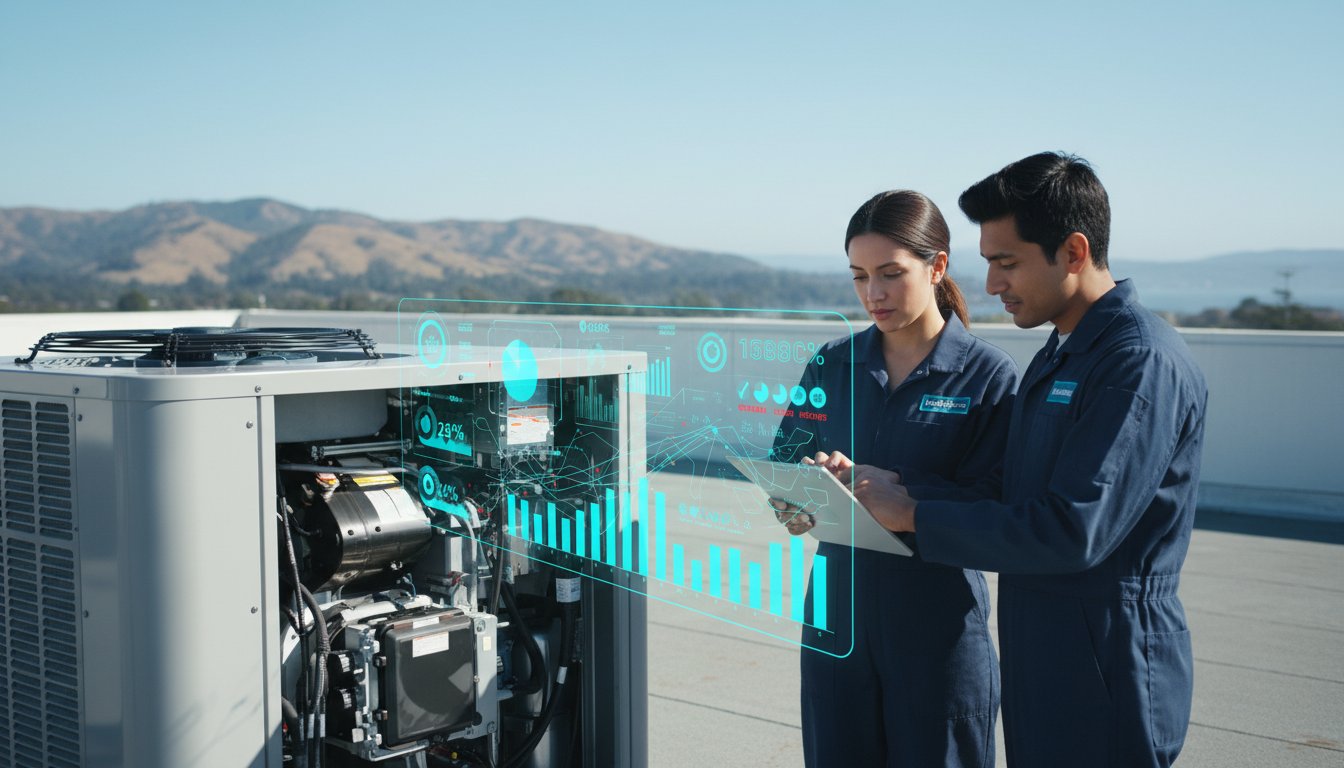
Commercial electricity rates in California reached 21.64 cents per kilowatt-hour in early 2024, which is nearly double the national average. You've likely watched your utility bills spike during summer heat waves while wondering if your critical hvac components can handle the load. It's frustrating to manage these rising costs while trying to decode complex Title 24 regulations.
Mastering the technical side of your system is the first step toward reclaiming control over your facility's overhead. We'll show you how to use advanced control logic to slash energy costs in California's demanding climate. You'll learn how to extend your equipment's lifespan and ensure your cooling system remains a reliable asset rather than a financial drain.
This guide provides a clear breakdown of essential industrial hardware and the smart logic required to automate efficiency. We'll explore how modern energy management systems offer a total solution for your specific facility needs.
Key Takeaways
- Understand the critical role of interconnected hardware in maintaining precise thermal regulation and air quality for large-scale California facilities.
- Identify how the mechanical core—including compressors, evaporators, and condensing units—functions as the "heart and lungs" of your hvac components to drive industrial-grade cooling.
- Learn how to navigate California’s Title 24 energy codes and implement preventative maintenance strategies tailored to the unique climate of the Bay Area and Sacramento.
- Discover how to transition from basic hardware to intelligent control with local PLC logic that eliminates subscription fees while maximizing energy savings.
- Gain strategic insights into the differences between standard residential units and high-performance commercial rack systems to ensure your infrastructure meets industrial demands.
Essential HVAC Components for California Commercial Facilities
Operating a successful commercial facility in California requires more than just basic temperature control. Technical Heating, ventilation, and air conditioning systems serve as the foundation for industrial productivity and safety. We define hvac components as the interconnected hardware responsible for thermal regulation, air quality, and precise humidity control within a professional environment.
Commercial systems in the Bay Area and Sacramento require significantly higher-grade components than standard residential units. These industrial-strength parts must endure 24/7 duty cycles and higher static pressures. Our "Total Solution" approach integrates expert design, rugged hardware, and ongoing energy management to ensure your facility operates at peak efficiency.
The efficiency of every individual component directly impacts your ability to meet California’s strict Title 24 energy compliance standards. Upgrading to high-performance hardware can reduce energy consumption by 20% to 30% in typical commercial applications. This focus on precision prevents the costly downtime that often plagues facilities using undersized or residential-grade equipment.
The Role of HVAC in Commercial Operations
In grocery stores and cold storage warehouses, hardware failure leads to immediate product loss. Precise climate control maintains inventory integrity by preventing temperature fluctuations that spoil perishables. For San Francisco office high-rises, the system manages massive air volumes to ensure occupant comfort and cognitive productivity.
- Protects sensitive electronic equipment in server rooms from thermal stress.
- Removes airborne contaminants to maintain high indoor air quality standards.
- Regulates moisture levels to prevent mold growth in coastal properties.
Why California Climate Demands More from Your Hardware
California presents unique geographical challenges that test the limits of standard mechanical systems. In Fresno and Sacramento, summer temperatures frequently exceed 100 degrees for consecutive weeks. These extreme heat loads require "over-built" hvac components, such as oversized condenser coils and high-torque motors, to prevent system crashes during peak demand.
Coastal regions like Oakland and San Jose face different stressors. Salt-air corrosion can degrade standard aluminum fins in less than five years. We utilize specialized coatings and corrosion-resistant alloys to extend equipment lifespan in these environments. Managing the 70% humidity levels common in coastal mornings requires advanced dehumidification logic that simpler systems cannot provide.
- High-ambient kits allow compressors to operate safely in Central Valley heatwaves.
- Marine-grade housings protect internal electronics from Pacific salt spray.
- Variable frequency drives (VFDs) adjust motor speeds to handle shifting coastal winds and pressures.
The Mechanical Core: Compressors, Evaporators, and Condensing Units
Understanding how your facility stays cool begins with the refrigeration cycle. It's a continuous loop where a refrigerant absorbs heat from inside your building and moves it outdoors. Think of this process not as "creating cold," but as the strategic relocation of heat. This cycle relies on high-performance hvac components that must work in perfect synchronization to maintain tight temperature tolerances, especially during California's intense summer heatwaves.
Forward-thinking facility managers are adopting next-generation HVAC solutions to combat rising utility rates and meet strict California Title 24 requirements. While standard residential units focus on basic comfort, industrial condensing units are built for 24/7 duty cycles. These heavy-duty systems utilize larger surface areas and variable-speed technology to manage the massive thermal loads found in warehouses and retail environments.
The Compressor: The Engine of the System
The compressor acts as the heart of your mechanical infrastructure. It pressurizes the refrigerant, driving it through the system to facilitate heat transfer. For commercial applications, three primary types dominate the market:
- Scroll Compressors: Preferred for their quiet operation and fewer moving parts, making them highly reliable for small-to-medium retail spaces.
- Reciprocating Compressors: These use pistons to compress gas and are known for their durability in high-pressure environments.
- Screw Compressors: The workhorse of large industrial plants, capable of handling massive volumes of refrigerant with high efficiency.
In California, compressor health is a critical business metric. Data from 2023 industry reports indicates that compressor failure accounts for approximately 75% of emergency maintenance costs and product loss in supermarkets. When a compressor struggles, it draws excessive amperage, directly inflating your monthly utility bill. Monitoring this component is essential for preventing the catastrophic downtime that leads to spoiled inventory. Optimizing these hvac components requires a bespoke control strategy to ensure longevity and efficiency.
Heat Exchange Components: Coils and Condensers
If the compressor is the heart, the evaporator and condenser are the lungs. Evaporator coils sit inside your conditioned space. Their primary job is to remove heat from the air as it passes over the cold fins. Precision is vital here; if the evaporator doesn't maintain the exact setpoint, humidity levels can spike, leading to ice buildup or compromised product quality in cold storage.
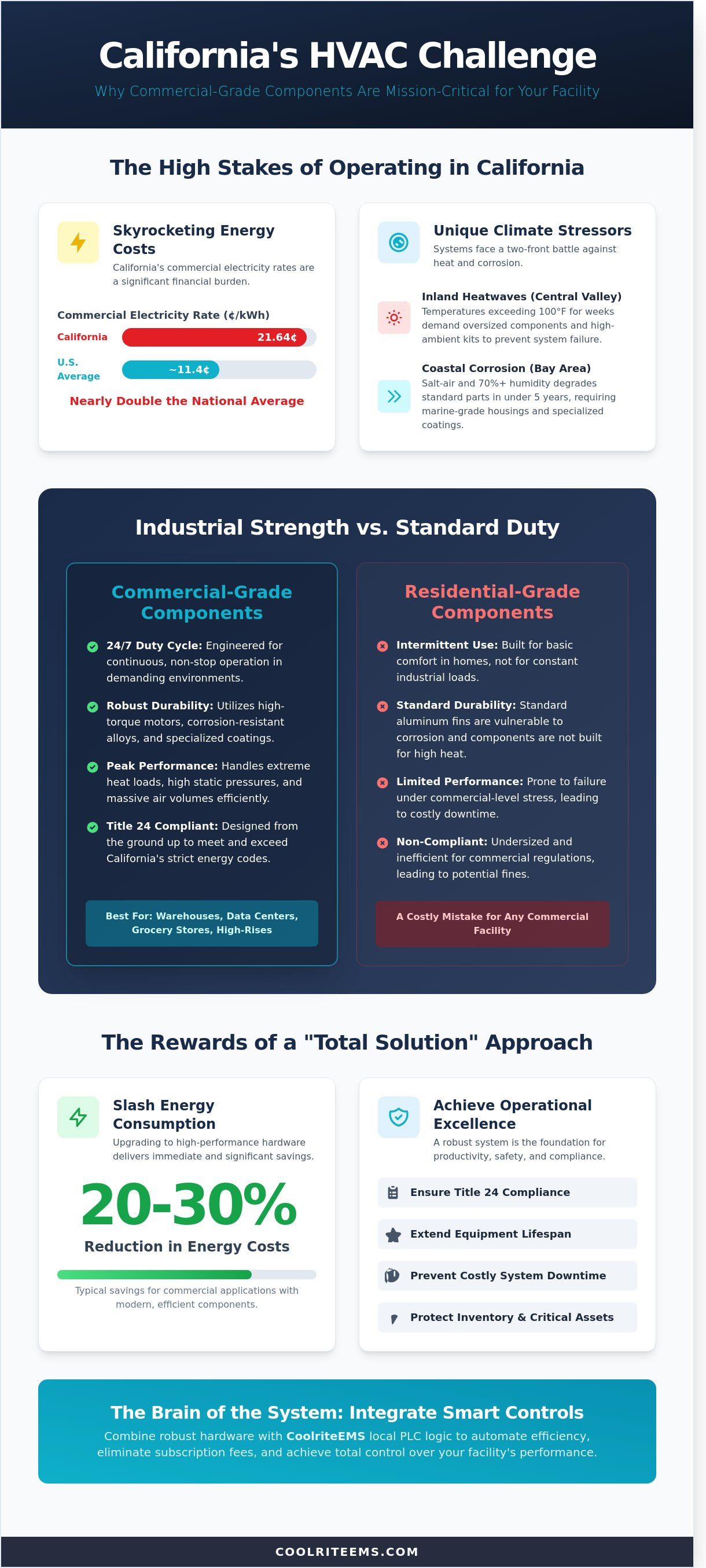
Commercial vs. Residential HVAC Components: A Strategic Comparison
Large Palo Alto tech campuses utilize massive air handling units (AHU) that move over 150,000 cubic feet of air per minute. This dwarfs the 1,500 CFM capacity found in a typical California home. These industrial systems use specialized hvac components designed for 24/7 operation and extreme thermal loads that residential hardware simply cannot handle.
Rack Systems and Multi-Stage Cooling
A refrigeration rack is a centralized assembly of multiple compressors working in parallel to provide cooling. This setup is the gold standard for grocery stores because it manages dozens of display cases from a single mechanical room. Managing these hvac components involves complex piping networks and sophisticated refrigerant management to ensure balanced pressure across the entire facility.
- Redundancy: If a residential compressor fails, the building loses cooling. In a commercial rack, if one unit fails, the others ramp up to maintain the load.
- Efficiency: Multi-stage cooling allows the system to match the exact cooling demand, reducing energy waste by up to 30% during low-traffic hours.
- Scalability: Centralized racks allow technicians to add or remove cooling capacity without redesigning the entire infrastructure.
Industrial Glycol Systems
A glycol system utilizes a mixture of water and food-grade antifreeze to transfer heat. This is essential in food processing and craft brewing where temperatures must stay consistently below freezing. These systems rely on heavy-duty glycol pumps to circulate the secondary coolant through a closed loop, providing precise temperature control that air-based systems can't match.
Maximizing Component Lifespan in the California Climate
California’s environmental conditions and strict regulatory landscape demand a proactive approach to equipment care. Industrial systems in Northern California face unique challenges, from salt air corrosion near the coast to seasonal wildfire smoke that clogs intake systems. Maintaining your hvac components is not just about avoiding a breakdown; it is about ensuring your facility remains compliant with state law while minimizing energy waste.
Title 24 Compliance and Energy Efficiency
California's Title 24 Building Energy Efficiency Standards mandate specific hardware, including air-side economizers and high-efficiency motors. In San Jose, where summer temperatures often exceed 90 degrees, these hvac components reduce cooling costs by approximately 30% by utilizing "free cooling" from outdoor air. High SEER and EER ratings are now mandatory for new industrial installations to meet 2022 code updates.
Choosing cheaper, non-compliant parts often leads to significant financial penalties and inflated utility bills. High-efficiency variable frequency drives (VFDs) allow motors to adjust speed based on demand rather than running at 100% capacity constantly. This precision reduces mechanical wear and extends the interval between major overhauls, providing a much higher return on investment over a 10 year period.
Preventative Maintenance for Peak Performance
Quarterly inspections are the baseline for industrial reliability in the Bay Area. A cold storage contractor focuses on critical indicators like refrigerant charge and coil cleanliness. A 10% refrigerant leak can increase energy consumption by 20% and lead to "short-cycling," which reduces the lifespan of a compressor by nearly 40%.
- Inspect contactors for pitting or carbon buildup to prevent electrical fires.
- Perform vibration analysis on heavy-duty compressors to detect bearing wear 3 to 6 months before failure.
- Clear condensate lines to prevent biological growth and water damage to electrical housings.
- Calibrate thermostats and sensors to ensure the Energy Management System receives accurate data.
Filtration serves as the first line of defense for internal parts. Utilizing MERV 13 filters is essential for protecting sensitive coils from Bay Area pollutants and particulate matter. Clean filters ensure optimal heat transfer and prevent the blower motor from overworking, which is a primary cause of premature motor burnout in industrial settings.
The Brain of the System: Integrating CoolriteEMS with Your HVAC Hardware
Mechanical hvac components like compressors and evaporators represent the muscle of your facility, but they require a sophisticated mind to operate with true industrial efficiency. Basic thermostats and manual controls often lead to energy waste and unnecessary mechanical strain. CoolriteEMS transforms these individual parts into a cohesive, intelligent network that responds to real-world demands in real-time.
From Dumb Hardware to Smart Logic
Customizable control logic allows you to tailor your climate and refrigeration settings to your specific business hours. You can program the system to ramp down during off-peak times or adjust for California's intense seasonal heat waves. This precision reduces the workload on your hvac components, often extending the functional lifespan of expensive machinery by 20% or more.
- Direct management of multi-compressor rack systems for balanced wear.
- Automated defrost cycles based on actual frost buildup rather than simple timers.
- Load shedding capabilities to lower peak demand charges from utility providers.
Zero Monthly Fees and Secure Remote Monitoring
Most energy management systems on the market today trap business owners in perpetual subscription models. CoolriteEMS operates on a different philosophy. You own the hardware and the data. There are no monthly fees, which significantly improves the long-term return on investment for your facility upgrades.
Security is a primary concern for modern industrial facilities. Because our controller utilizes local logic, it doesn't require a constant internet connection to function. This "No Internet Required" feature protects your facility from external cyber threats while ensuring that your cooling logic remains active during ISP outages. Your data stays on your premises, under your control.
Even with local control, you still benefit from secure remote monitoring. The system provides real-time SMS and email alerts the moment a parameter drifts out of range. This proactive approach prevents the hidden costs of refrigerant leaks and catastrophic product loss. For a large-scale cold storage facility, an early alert can save $50,000 in perishable inventory by allowing for repairs before temperatures reach critical levels.
Optimize Your Infrastructure Today
Don't let outdated controls bottleneck your facility's performance. Book a demo with our team to see how the CoolriteEMS Controller integrates with your existing hardware to drive down costs and maximize uptime.
Future-Proof Your Facility with Advanced Climate Control
Maximizing industrial efficiency in California requires a strategic approach to maintaining your hvac components. By prioritizing the health of your compressors and evaporators, you ensure your facility meets the rigorous demands of Title 24 compliance while reducing the risk of sudden equipment failure. Reliable hardware is only half the battle; the real value lies in how you manage that equipment to prevent product loss and lower monthly utility bills.
Coolrite EMS offers a premium, no-subscription energy management system that puts total control back in your hands. Our local PLC technology ensures your refrigeration and climate systems function perfectly without an internet connection, providing a secure alternative to cloud-dependent platforms. We provide 24/7 emergency support across Northern California, ensuring that grocery store operators and warehouse managers have a dependable partner available 365 days a year to maintain uptime.
Don't let outdated controls or inefficient hardware drain your profits. Request a Demo of the CoolriteEMS Controller Today to see our bespoke solutions in action. We're ready to help you build a more resilient, cost-effective infrastructure that lasts for years to come.
Frequently Asked Questions
What are the most critical HVAC components for a commercial building in California?
The most critical hvac components for California facilities include high-efficiency compressors, industrial condensers, and air-side economizers. Economizers are vital because they utilize the state's cool evening air to provide free cooling, which reduces the mechanical load on your system by 30% during shoulder seasons. These parts ensure your building handles 100 degree temperatures while maintaining strict indoor air quality standards.
How does Title 24 affect which HVAC parts I can install in my facility?
California's Title 24 Building Energy Efficiency Standards mandate specific performance ratings for replacement hvac components, including minimum SEER2 and EER2 values. Since the 2022 update, facility managers must install demand-responsive controls and high-efficiency motors that meet state-defined kilowatt-per-ton metrics. Compliance ensures your building avoids regulatory fines and qualifies for utility rebates available through local power providers.
What is the difference between a standard thermostat and an energy management system (EMS)?
A standard thermostat only regulates temperature at a single point, while an Energy Management System (EMS) provides a total solution for facility-wide optimization. Our EMS controllers monitor real-time data across all cooling units to prevent expensive peak demand charges. Unlike basic thermostats, these systems use custom logic to manage humidity, lighting, and refrigeration simultaneously to maximize efficiency.
How often should commercial refrigeration components be serviced in the Bay Area?
Commercial refrigeration components in the Bay Area require professional servicing at least 4 times per year to combat salt-air corrosion and high humidity. Quarterly inspections focus on specific tasks:
- Cleaning condenser coils to maintain heat transfer efficiency.
- Checking refrigerant levels to prevent compressor strain.
- Testing electrical connections for wear and voltage drops.
Can an EMS controller work if my facility's internet goes down?
Our EMS controllers continue to operate your facility's climate and refrigeration systems even if your internet connection fails. We utilize local PLC (Programmable Logic Controller) technology to maintain your custom control logic on-site without relying on a cloud connection. This ensures 100% uptime and protects your inventory from loss, regardless of your local network stability or subscription status.
Why is my commercial HVAC system short-cycling during Sacramento summers?
Short-cycling during Sacramento's 100 degree summers often stems from oversized equipment or restricted airflow in condenser coils. When outdoor temperatures exceed design limits, safety switches trigger frequently to protect the compressor from overheating. Replacing clogged filters and cleaning heat exchangers can restore proper cycle times and prevent the premature failure of expensive internal parts.
What is a refrigeration rack system and does my grocery store need one?
A refrigeration rack system is a centralized assembly of multiple compressors that power several refrigerated cases from a single location. Grocery stores larger than 5,000 square feet typically need these systems to achieve better energy efficiency and easier maintenance access. This centralized approach allows for floating head pressure control, which can lower energy consumption by 25% compared to using individual condensing units.
How do high-efficiency motors (ECM) reduce my monthly commercial energy bill?
Electronically Commutated Motors (ECM) reduce energy bills by adjusting their speed to match the actual demand of the HVAC system rather than running at full power. While standard permanent split capacitor motors operate at a fixed speed with roughly 45% efficiency, ECMs reach up to 80% efficiency levels. This precision reduces fan energy usage by 30% to 50% in most commercial applications, leading to immediate monthly savings.
Related: See our transparent pricing for refrigeration repair, browse customer success stories, or get a quote at your local service area.