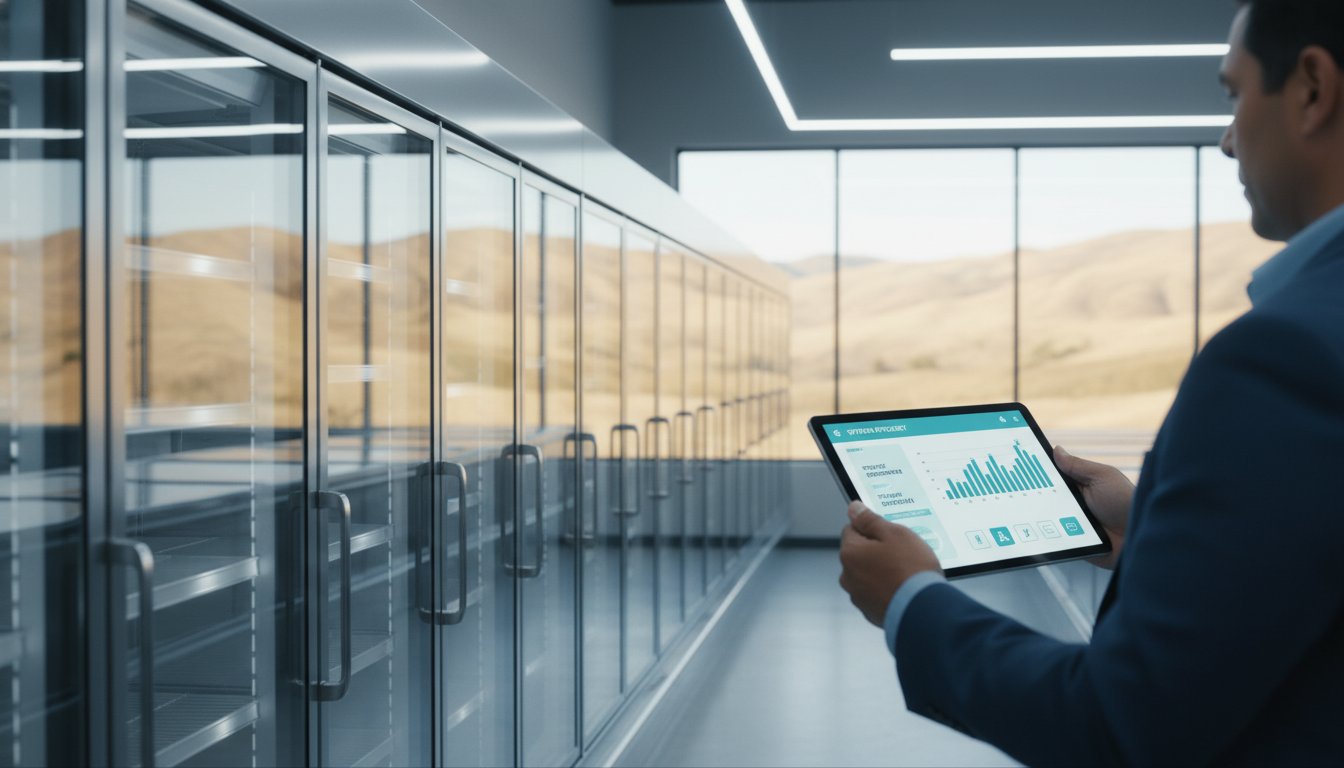
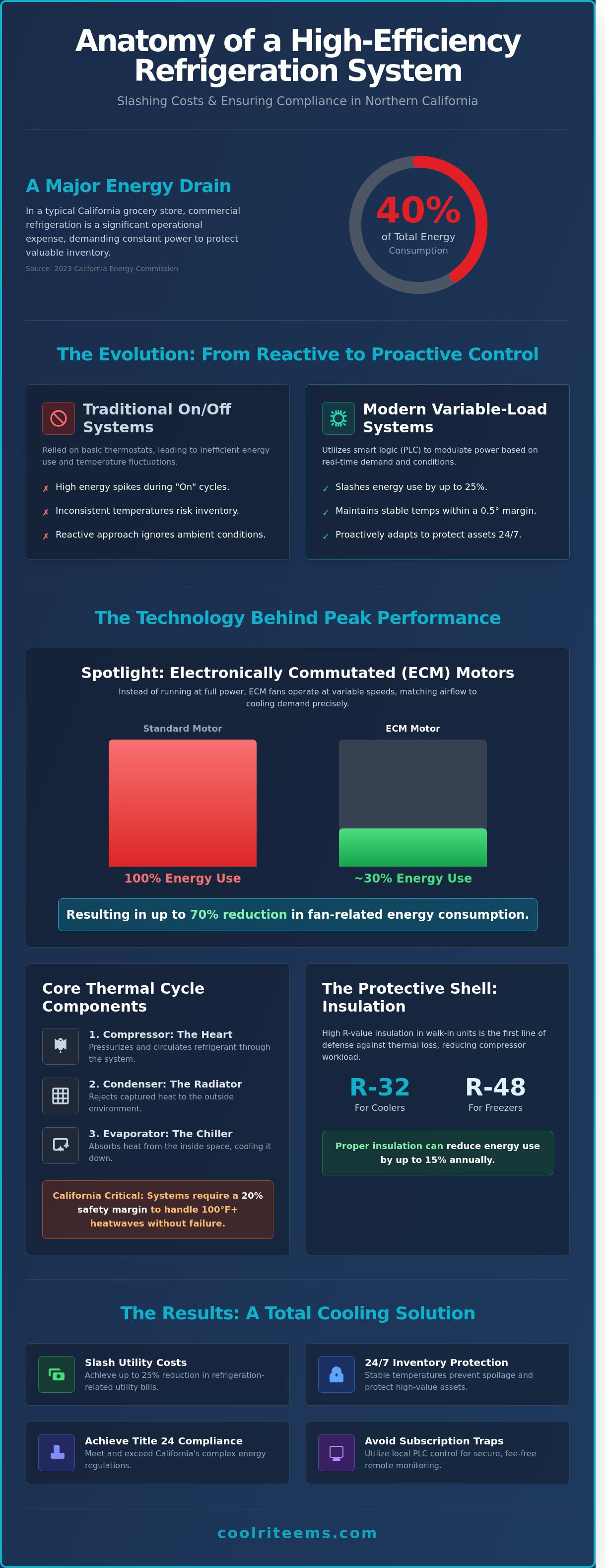
Commercial refrigeration accounts for up to 40% of the total energy consumption in a typical California grocery store, according to 2023 California Energy Commission data. You likely understand that maintaining a high-efficiency cool sys during a 105 degree Sacramento heatwave is non-negotiable. It's frustrating to watch your PG&E bill climb while paying monthly subscription fees for smart controllers that should be working for you. You need a reliable solution that prioritizes uptime and technical precision.
This guide explains how modern refrigeration integrated with local PLC logic can slash your utility costs by 25% while ensuring 24/7 inventory protection. You'll learn how to achieve California Title 24 compliance and gain total remote visibility without being tethered to a cloud-based contract. We'll break down the transition from reactive maintenance to a proactive energy management strategy that keeps your facility running efficiently through every Northern California season.
Key Takeaways
- Understand how transitioning from basic on/off cooling to variable-load logic creates a more resilient and energy-efficient refrigeration infrastructure.
- Navigate complex California Title 24 regulations to ensure your facility remains compliant while significantly reducing monthly utility overhead.
- Discover how the right combination of high-performance compressors and evaporators in a modern cool sys protects your inventory from costly temperature fluctuations.
- Learn how to avoid the "subscription trap" by utilizing local PLC control for secure, fee-free remote monitoring and real-time system alerts.
- Identify immediate opportunities for cost reduction through professional energy audits and a structured approach to implementing a total cooling solution.
What is a Commercial Cool System? Defining Modern Refrigeration
A modern commercial cool system is far more than a simple collection of compressors and evaporators. It represents a sophisticated, integrated network where mechanical hardware meets advanced digital control logic to maintain precise thermal environments. For businesses across Northern California, this technology serves as the backbone of operational continuity, ensuring that perishable inventory remains safe and energy costs stay manageable.
The industry has moved away from the era of reactive cooling. Historically, refrigeration relied on basic "on/off" cycles that ignored the nuances of ambient temperature or internal load fluctuations. Today, a high-efficiency cool sys utilizes variable-load management to adjust performance in real time. This shift is vital for enterprises in San Francisco and Oakland, where 99.9% uptime is a non-negotiable requirement for protecting high-value assets and maintaining regulatory compliance.
Coolrite EMS approaches refrigeration as a total solution. This methodology covers every phase of the equipment lifecycle, including:
- Bespoke system design tailored to specific facility layouts.
- Precision installation of high-grade mechanical components.
- Integrated digital monitoring to prevent mechanical drift.
- Proactive maintenance schedules that extend asset life by 25% or more.
The Shift from Basic Cooling to Energy Management
Standard refrigeration focuses solely on maintaining a set temperature point, often at the expense of extreme energy draw. Modern Energy Management Systems (EMS) prioritize efficiency by modulating power based on actual demand. We measure the success of a cool sys by its ability to reduce kilowatt-hour consumption while keeping temperatures stable within a 0.5-degree margin.
A significant driver of this efficiency is the implementation of Electronically Commutated Motors (ECM). These motors allow fans to operate at variable speeds rather than full power at all times. By switching to ECM technology, many commercial facilities reduce their fan-related energy consumption by up to 70%, directly impacting the bottom line without compromising cooling capacity.
Why Northern California Businesses Need Specialized Systems
The microclimates of the Bay Area present unique challenges for refrigeration engineers. A condenser unit operating in the foggy, high-humidity environment of San Francisco faces different atmospheric pressures and salt-air corrosion risks than a unit in the dry heat of a San Jose warehouse. These environmental variables dictate how a system must be tuned to dissipate heat effectively.
Generic equipment often fails to account for these local factors, leading to a 15% increase in operational costs due to overworking components. For comprehensive strategies on optimizing these setups, explore our guide on energy management solutions for the 2026 regulatory landscape. Customizing the control logic to suit the specific ZIP code of a facility ensures that the equipment runs at peak performance regardless of external weather shifts.
Core Components of a High-Performance Cool System
A high-efficiency cool sys relies on three primary components working in a continuous thermal cycle. The compressor acts as the heart, pressurizing refrigerant to move it through the circuit. Next, the condenser rejects heat to the outside environment, while the evaporator coil absorbs heat from the storage space. In California's Central Valley, where summer temperatures frequently exceed 100°F, these components must be sized with a 20% safety margin. This ensures consistent performance during peak thermal loads without risking equipment burnout.
- Compressors: The mechanical driver that circulates refrigerant under high pressure.
- Condensers: Heat exchangers that dissipate thermal energy to the outdoors.
- Evaporators: Units located inside the storage area that remove heat from the air.
Walk-In Units and Cold Storage Hardware
Sacramento restaurant owners often choose between reach-in and walk-in configurations based on inventory volume. While reach-ins work for line prep, walk-ins provide 40% more storage efficiency for bulk inventory. To combat California’s intense heat, we utilize panels with R-values of R-32 for coolers and R-48 for freezers. High-performance insulation prevents the compressor from overworking, which can reduce energy consumption by up to 15% annually. Coolrite distributes a full suite of hardware, including display cases and high-capacity ice machines, ensuring every piece of equipment meets strict Title 24 energy standards.
Advanced Industrial Components
Condensing units and evaporator coils facilitate the critical heat exchange process. In large-scale operations, rack systems represent the gold standard because they offer superior redundancy. Unlike standalone units that risk total product loss during a single component failure, a parallel rack system distributes the load across multiple compressors. This setup is essential for supermarkets managing over $500,000 in perishable goods at any given time. It ensures that if one compressor fails, the others pick up the slack to maintain the setpoint.
For specialized industrial applications like wineries or food processing, glycol systems provide precise temperature control without the risks associated with large refrigerant charges. Working with an experienced cold storage contractor ensures these complex systems are calibrated for maximum uptime. These installations often integrate bespoke control logic to optimize the cool sys for specific humidity and temperature setpoints. If you're planning a facility upgrade, you can request a custom efficiency audit to identify potential savings and performance gaps.
Navigating California Regulations and Local Energy Costs
California's commercial electricity rates are currently 80% higher than the national average. With PG&E implementing a 12.8% rate hike in January 2024, energy costs represent the largest controllable expense for Bay Area and Central Valley facilities. Investing in a high-efficiency cool sys isn't just an environmental choice; it's a strategic move to protect your profit margins from escalating utility overhead.
Modern refrigeration controls provide the technical framework to reduce kilowatt-hour consumption by 25% through precision load management. By optimizing defrost cycles and compressor run times, businesses can offset the impact of SMUD and PG&E peak pricing. This transition moves refrigeration from a fixed cost to a managed asset that responds to the specific economic pressures of the California market.
Title 24 and Environmental Compliance in 2026
Effective January 1, 2026, California Title 24 regulations mandate that new commercial refrigeration installations utilize refrigerants with a Global Warming Potential (GWP) of less than 150. This shift requires hardware that can safely manage the higher pressures and unique thermodynamic properties of CO2 or hydrocarbon systems. Smart controllers automate the complex leak detection and energy reporting required by the California Air Resources Board (CARB). This automation ensures your facility remains compliant without requiring constant manual oversight from your maintenance team.
- Automated data logging satisfies CARB record-keeping requirements for 2,000+ pound systems.
- Precision electronic expansion valve (EEV) control supports the move toward low-GWP refrigerants.
- Local PLC logic ensures compliance even if your facility experiences an internet outage.
Combating the Sacramento and San Jose Heat
Maintaining a consistent 34°F internal temperature becomes a mechanical struggle when external temperatures in Sacramento or San Jose reach 105°F. High ambient heat causes head pressure to spike, which leads to compressor failure or "short cycling" if the system isn't properly optimized. Our cool sys solutions utilize floating head pressure control to stabilize equipment during peak summer hours, preventing the catastrophic inventory loss that occurs during a system crash.
Real-time monitoring provides a critical safety net during California's frequent grid strain events. When the state issues a Flex Alert, smart systems can automatically adjust setpoints to reduce load without compromising food safety. This proactive approach prevents equipment burnout and ensures that 24/7 emergency support calls are a last resort rather than a weekly occurrence. Reliable refrigeration in Northern California requires a system that anticipates heat waves rather than simply reacting to them.
- Floating suction and head pressure control reduces stress on compressors during 100°F+ days.
- SMS and email alerts provide immediate notification if temperatures drift more than 2 degrees from the setpoint.
- Customizable control logic allows for pre-cooling inventory before peak utility pricing periods begin.
The CoolriteEMS Advantage: Control Without the Subscription Trap
The CoolriteEMS Controller acts as the central brain of your refrigeration infrastructure. It's built to solve a common industry frustration known as the subscription trap. Many providers force businesses into monthly contracts just to access their own equipment data. We provide a premium, bespoke alternative that puts you back in charge of your facility.
This controller manages every aspect of your refrigeration cycle with precision. By eliminating recurring software costs, we prioritize your long-term bottom line. You gain a high-performance energy management system without the burden of "software as a service" overhead.
Local Control vs. Cloud Reliance
Your refrigeration shouldn't stop working just because your internet service provider has an outage. Most national "cool sys" providers rely entirely on cloud-based logic. If the connection fails, your ability to monitor or adjust the system vanishes. CoolriteEMS uses local PLC hardware to ensure your cooling logic stays on-site and active 24/7.
This local-first approach offers three distinct advantages:
- Data Security: Your operational data stays within your network, reducing the risk of external cyber threats.
- Operational Uptime: The controller functions independently of the internet, preventing system-wide lockouts during outages.
- Custom Logic: We program bespoke energy-saving strategies directly into the hardware rather than using generic cloud templates.
Local PLC control means your system is faster and more reliable. It processes sensor data in milliseconds, allowing for immediate adjustments to expansion valves and compressor speeds. This level of responsiveness is rarely possible when signals must travel to a remote server and back.
Real-Time Alerts and Inventory Protection
Inventory loss is the most expensive failure a business can face. For a mid-sized supermarket, a single walk-in freezer failure can result in over $12,000 in lost product. The CoolriteEMS system prevents these disasters through an integrated SMS and email alert system. It identifies temperature excursions the moment they happen.
Our remote monitoring tools allow our team to diagnose 40% of system issues without sending a van to your location. This reduction in "truck rolls" significantly lowers your annual maintenance spend. Because we don't charge monthly subscription fees, every dollar you save on energy and repairs stays in your business. This model typically improves the ROI of a new "cool sys" installation by 22% compared to subscription-heavy competitors.
Our technicians specialize in creating seamless, high-efficiency environments for California businesses. We focus on long-term reliability rather than recurring revenue from software fees. This ensures your equipment remains an asset rather than a liability.
Implementing a Total Cooling Solution in Northern California
Upgrading your commercial refrigeration requires a methodical approach to ensure maximum ROI. Most California businesses see energy bills drop by 22% to 38% after optimizing their cool sys architecture. The process begins with a rigorous energy audit to pinpoint low-hanging fruit such as failing door seals, clogged condenser coils, or inefficient fan motors. These small mechanical issues often account for 15% of total energy waste before any major equipment is even replaced.
Once you address the basics, follow these steps to modernize your facility:
- Baseline Analysis: Track current energy consumption against utility benchmarks to identify peak demand charges.
- System Selection: Choose high-efficiency components that meet the specific thermal loads of your Northern California microclimate.
- Control Integration: Deploy a cool sys management platform that offers local PLC control to ensure uptime even if your internet connection fails.
- Continuous Monitoring: Use real-time SMS and email alerts to catch temperature excursions before they lead to product loss.
Assessing Your Facility Needs
Facility requirements vary wildly across the Bay Area. A 3,500-square-foot high-volume restaurant in Palo Alto requires rapid temperature recovery for walk-ins during lunch rushes. Conversely, a 25,000-square-foot pharmaceutical lab in Sunnyvale demands precision climate control within 0.5 degrees Celsius to protect sensitive research materials. We analyze your existing rack systems to determine if an EMS retrofit is viable. This path often saves facility managers 45% on capital expenditures compared to a full system replacement. Consistent preventative maintenance remains the final piece; it extends equipment life by an average of seven years and prevents mid-summer breakdowns.
Why Local Expertise Matters
Choosing a partner with deep Northern California roots ensures your infrastructure stays online during heatwaves or power events. Our San Francisco-based team provides 24/7 emergency support, typically responding to critical alerts within two hours. Coolrite’s total solution philosophy means we handle the entire lifecycle of your equipment. We manage initial design, professional installation, and eventual decommissioning. This comprehensive oversight eliminates the communication gaps common with national contractors who outsource their labor. You gain a dedicated energy partner focused on your bottom line and operational continuity.
Don't leave your inventory to chance with outdated controls. Contact Coolrite Refrigeration for a CoolriteEMS Demo today to see how our bespoke control logic and secure remote monitoring can optimize your facility.
Future-Proof Your California Refrigeration Infrastructure
Operating a profitable grocery store or warehouse in California requires more than just standard equipment. You need a cool sys that balances strict state regulations with rising energy costs. By moving away from subscription-based models and adopting proprietary local PLC technology, you eliminate monthly fees while maintaining total control over your inventory. Since 1995, we've helped Northern California businesses protect their bottom line with systems that don't rely on a constant internet connection to function.
Reliability is non-negotiable for critical infrastructure. Our team provides 24/7 emergency support to ensure your operations never skip a beat. Whether you're managing a single retail location or a large-scale cold storage facility, implementing a total cooling solution is the most effective way to reduce energy waste and prevent costly product loss. Professional oversight and smart automation turn your refrigeration from a massive overhead expense into a streamlined, high-performance asset.
Take the first step toward significant energy savings and operational security. Request a Professional CoolriteEMS Demo & Energy Audit to see how our 29 years of local expertise can optimize your facility. It's time to invest in a partnership that prioritizes your uptime and long-term growth.
Frequently Asked Questions
What is the difference between a standard thermostat and a CoolriteEMS cool system controller?
A CoolriteEMS controller is a programmable logic controller (PLC) that manages the entire refrigeration cycle, while a standard thermostat only monitors air temperature. Our system optimizes compressor run times and defrost cycles based on real-time demand rather than simple setpoints. This precision reduces energy consumption by 20% to 30% compared to traditional mechanical controls that often cause unnecessary equipment wear.
How much can a commercial energy management system actually save on California utility bills?
California businesses typically see a reduction of 15% to 25% on their monthly utility statements after installing a commercial energy management system. For a mid-sized grocery store spending $5,000 monthly on electricity, this translates to $750 to $1,250 in direct savings every month. These results are achieved through peak demand shaving and optimized load shedding during high-tariff periods in the afternoon.
Does the CoolriteEMS controller require a monthly subscription fee?
No, the CoolriteEMS controller doesn't require a monthly subscription or recurring software fees to operate. We provide a total solution where you own the hardware and the control logic outright from the day of installation. This ownership model eliminates the $50 to $100 monthly overhead costs per site that are common with many cloud-based refrigeration platforms currently on the market.
Can I retrofit my existing walk-in cooler with a modern "cool sys" controller?
You can easily retrofit your existing walk-in coolers with a modern cool sys controller to improve efficiency and monitoring. Our technicians integrate the PLC with your current compressor and evaporator setup, often completing the installation in under 4 hours. This upgrade extends the lifespan of older equipment by reducing unnecessary cycling and mechanical stress on the motor and contactors.
What happens to my refrigeration system if the internet goes out?
Your refrigeration system continues to operate normally because our controllers use local PLC logic rather than relying on a cloud connection for basic functions. While remote monitoring and SMS alerts pause during a network outage, the cooling cycle remains 100% functional to protect your inventory. Once the connection is restored, the system automatically syncs 24 hours of stored performance data back to your dashboard.
Are Coolrite refrigeration systems compliant with California Title 24 regulations?
Coolrite refrigeration systems are fully compliant with California Title 24, Part 6 requirements for commercial buildings. Our controllers meet the 2022 standards for mandatory demand-responsive controls and automated defrost scheduling for large walk-in units. By implementing these high-efficiency protocols, businesses ensure they meet state mandates while qualifying for utility-sponsored energy rebates that can cover 10% of project costs.
What industries in the Bay Area benefit most from industrial glycol systems?
Craft breweries, wineries, and pharmaceutical labs in the Bay Area benefit most from industrial glycol systems due to their precise temperature stability. These systems use a food-grade antifreeze mixture to maintain consistent 34-degree environments without the risk of product freezing or temperature spikes. Over 40% of Northern California's specialized food processing facilities have transitioned to glycol to minimize refrigerant leak risks and maintenance costs.
How does real-time SMS alerting prevent product loss in grocery stores?
Real-time SMS alerts notify managers within 60 seconds if a walk-in temperature exceeds a pre-set threshold, such as 41 degrees Fahrenheit. This immediate warning allows staff to move inventory or call for 24/7 emergency service before the product reaches the spoilage point. For a supermarket carrying $50,000 in perishable inventory, one prevented failure pays for the entire cool sys installation twice over.
Related: See our transparent pricing for refrigeration repair, browse customer success stories, or get a quote at your local service area.