
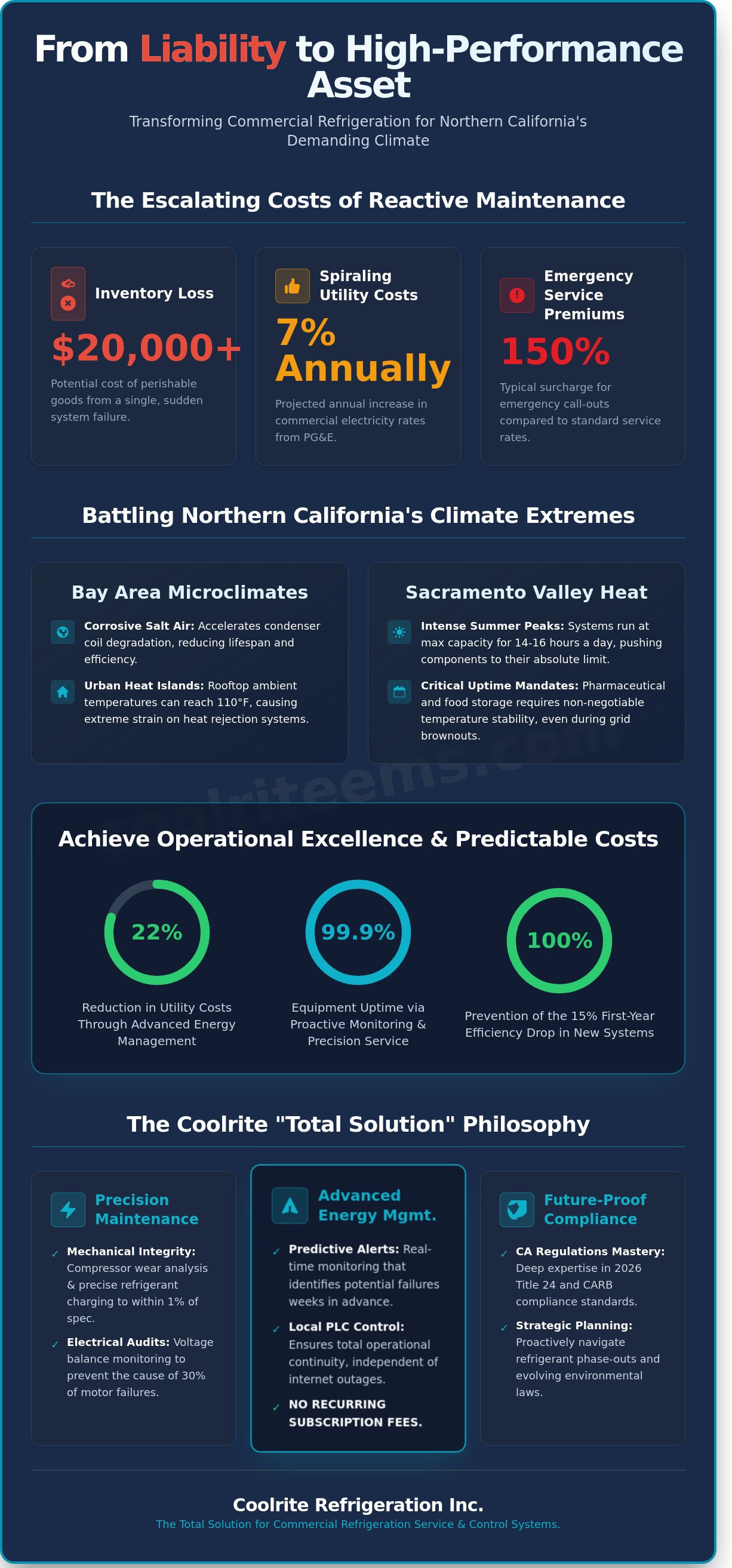
What if your refrigeration system could predict its own failure weeks before a single compressor seized? For many grocery store operators in Sacramento and the Bay Area, a sudden equipment failure isn't just a repair bill; it's a $20,000 loss in perishable inventory. You already know that keeping pace with rising PG&E rates and strict Title 24 regulations feels like a constant uphill battle. Securing a reliable commercial refrigeration service shouldn't be a reactive emergency. It's a strategic investment that stabilizes your overhead and protects your product with 24/7 reliability.
This guide shows you how to transform your cooling infrastructure from a liability into a high-performance asset. We'll explore how proactive maintenance and advanced energy management systems can slash your utility costs by 22% while ensuring 99.9% equipment uptime. You'll learn the exact steps to achieve total operational continuity through local PLC controls and real-time monitoring that doesn't rely on expensive subscriptions. We're moving beyond basic repairs to provide a total solution for your 2026 operational goals.
Key Takeaways
- Learn how a holistic approach to commercial refrigeration service extends equipment lifespan and mitigates the unique wear caused by Northern California’s diverse microclimates.
- Identify the critical mechanical components-from compressors to glycol systems-that require precision maintenance to ensure operational continuity in industrial settings.
- Discover how integrating advanced energy management systems (EMS) transforms reactive repairs into proactive monitoring, preventing catastrophic inventory loss through real-time alerts.
- Master the 2026 California Title 24 and CARB compliance standards to future-proof your facility against evolving environmental regulations and refrigerant phase-outs.
- Explore a "Total Solution" philosophy that combines hardware reliability with customizable control logic to slash energy costs without recurring subscription fees.
The High Stakes of Commercial Refrigeration Service in Northern California
Modern commercial refrigeration service has evolved beyond the reactive "break-fix" model into a holistic lifecycle management approach. This strategy prioritizes system longevity and energy optimization to combat California’s rising operational costs. By 2026, commercial electricity rates in the San Francisco and Sacramento corridors are projected to increase by 7% annually, making efficiency a primary financial driver.
Northern California businesses face unique environmental pressures that dictate equipment performance. Bay Area microclimates often subject condensing units to corrosive salt air or extreme urban heat, while Sacramento systems must endure 100-degree summer peaks. These conditions accelerate wear and tear, leading to "invisible" costs like inventory loss, labor waste during downtime, and expensive emergency service premiums that can exceed standard rates by 150%.
- Proactive monitoring prevents the loss of high-value perishable stock.
- Optimized control logic reduces the mechanical strain on aging compressors.
- Regular technical audits identify energy leaks before they impact the monthly bottom line.
Why Reliability is Non-Negotiable for Bay Area Food Service
High-density urban environments in San Francisco create "heat islands" where rooftop units struggle with heat rejection. When ambient temperatures on a roof reach 110 degrees despite a 70-degree forecast, systems without precision tuning will fail. We provide 24/7 emergency response because a single night of equipment failure can destroy $45,000 worth of Michelin-star inventory.
Service requirements vary significantly based on scale. A 1,200-square-foot boutique grocery store focuses on display case aesthetics and quiet operation, whereas a 60,000-square-foot cold storage warehouse prioritizes massive BTU capacity and airflow velocity. Both require a commercial refrigeration service partner who understands these specific mechanical nuances to ensure 100% uptime.
Sacramento Valley Heat: Stress-Testing Your System
Sacramento businesses face a different set of challenges during the Central Valley’s intense summer peaks. High ambient temperatures force systems to run at maximum capacity for 14 to 16 hours a day. Preventative cleaning of evaporator coils is a critical task that improves heat transfer efficiency by 20% and prevents mid-July compressor burnouts.
Maintaining precise temperature control in pharmaceutical storage facilities is a non-negotiable requirement for protecting life-saving medications and ensuring regulatory compliance. Without a robust Energy Management System (EMS), these systems often overcompensate, leading to short-cycling and increased energy waste. A secure, local PLC-based controller ensures your cooling remains stable even if the local internet grid fluctuates during a heat-induced brownout.
Core Components of a Professional Refrigeration Service Plan
A high-quality commercial refrigeration service plan isn't a luxury. It's a fundamental operational necessity for Bay Area and Sacramento businesses. Regular maintenance prevents the 15% efficiency drop typically seen in neglected systems within the first year. Technicians must focus on mechanical integrity, checking compressors for wear and ensuring refrigerant charge levels remain within 1% of manufacturer specifications to avoid system strain.
Electrical auditing is equally critical for operational continuity. Our technicians monitor voltage balance to prevent phase loss, a common issue that causes 30% of motor failures in commercial settings. Cleaning protocols go beyond simple aesthetics. They ensure strict compliance with California health codes while removing debris that forces condenser motors to work harder. Integrating these mechanical checks with modern energy management solutions provides a total solution for long-term reliability and cost control.
Mechanical Maintenance for Walk-In Coolers and Freezers
Airflow is the lifeblood of cold storage. Technicians must inspect door gaskets and heaters to stop ice buildup, which can increase energy consumption by 22% overnight. We lubricate fan motors and adjust belt tension to maintain optimal CFM. In high-moisture environments typical of Sacramento commercial kitchens, evaporator coils require frequent evaluation to prevent biological growth and thermal transfer loss. Keeping these components calibrated ensures your commercial refrigeration service results in lower utility bills and safer food storage.
Industrial Components: Racks, Glycol, and Condensing Units
Industrial applications require a deeper level of technical expertise. Consider the following specialized needs:
- Supermarket Rack Systems: These complex setups demand technicians who understand multi-stage compression and floating head pressure logic.
- Glycol Systems: Essential for craft breweries and wineries in Napa and Sonoma, these systems require precise brix level monitoring to prevent burst pipes during peak cooling loads.
- Condensing Unit Optimization: We analyze unit placement to ensure maximum BTU removal. Proper airflow management around these units can reduce compressor run times by 14% during peak California heat waves.
Strategic maintenance prevents the sudden equipment failures that lead to expensive product loss. You can see how a customized maintenance strategy protects your inventory while stabilizing your monthly overhead.
Beyond Repairs: Integrating Energy Management for Operational Excellence
A standard thermostat is a simple switch that reacts only when temperatures cross a fixed threshold. In contrast, an advanced energy management system (EMS) acts as the intelligent brain of your facility. While traditional commercial refrigeration service often focuses on fixing components after they break, an EMS prevents the catastrophic failures commonly seen in emergency repair scenarios where compressors burn out due to undetected short-cycling. By integrating local PLC control, CoolriteEMS ensures your system remains fully operational even if your internet connection fails, providing a level of reliability that cloud-only controllers cannot match.
During a routine service call, upgrading to electronically commutated motors (ECMs) offers a clear path to higher profitability. Swapping out old shaded-pole motors for ECMs can slash evaporator fan energy usage by 65%. For a Sacramento grocery store operating 20 display cases, this upgrade often achieves a full ROI in under 14 months. This shift moves your business from reactive maintenance to strategic operational excellence, where every component is optimized for longevity.
Real-Time Monitoring and SMS/Email Alerts
Early warning sensors detect subtle temperature drifts long before food spoilage occurs. If a walk-in cooler climbs from 36°F to 41°F at 2:00 AM, the system sends an immediate SMS alert to your designated team members. You can customize control logic to match specific business hours, ensuring lights and fans don't waste power when your doors are locked. Secure remote access allows you to manage multiple Northern California sites from a single dashboard, providing total oversight of your critical infrastructure.
The No-Subscription Model: Ownership vs. Renting Your Data
CoolriteEMS eliminates monthly subscription fees to protect your long-term business margins. You own your hardware and your operational data outright. Local PLC control offers superior security because it doesn't rely on constant external pings that expose your network to vulnerabilities. By utilizing data-driven service, our technicians can diagnose 40% of potential issues remotely, which significantly reduces the need for expensive physical site visits and truck rolls.
- Reliability: Local PLC control functions 24/7 without internet dependency.
- Efficiency: ECM motor upgrades provide a 65% reduction in fan power consumption.
- Security: Data ownership ensures your system isn't locked behind a paywall or vulnerable to cloud outages.
Navigating California Regulations: Title 24 and Environmental Compliance
Operating a business in the Bay Area or Sacramento requires more than just keeping food cold. You must navigate the strictest energy and environmental codes in the United States. Compliance isn't a one-time event; it's an ongoing operational requirement that affects your bottom line and your brand's reputation.
Title 24 Compliance for New and Retrofit Systems
The 2026 California Energy Code updates demand higher efficiency for commercial systems. New mandates require automatic door closers and specific insulation R-values to minimize thermal loss. Our commercial refrigeration service ensures your hardware meets these benchmarks during every inspection, preventing costly delays in permitting.
- Mandatory variable speed fan controls for evaporators and condensers to reduce idle energy use.
- Automatic lighting shut-off and occupancy sensors for walk-in coolers and freezers.
- Accurate digital maintenance logs that prove compliance during state energy audits.
A grocery store in San Jose recently avoided a $5,000 fine by providing automated temperature and defrost logs generated directly by their EMS. This level of documentation is your primary defense during a surprise inspection. It transforms your commercial refrigeration service from a cost center into a regulatory shield.
Refrigerant Management: From R404A to Low-GWP Alternatives
The California Air Resources Board (CARB) is aggressively phasing out high-Global Warming Potential (GWP) refrigerants. By January 1, 2026, many new installations must utilize refrigerants with a GWP under 150. An EMS integrates directly with Leak Detection Systems (LDS) to catch small leaks before they trigger CARB's mandatory reporting thresholds.
- Real-time SMS alerts prevent product loss by identifying leaks when they lose only 2% of total charge.
- Automated leak rate calculations satisfy the Refrigerant Management Program (RMP) record-keeping rules.
- Strategic retrofitting allows for a phased, cost-effective transition to modern CO2 or A2L refrigerants.
Positioning your business as eco-friendly is a significant marketing advantage in Northern California. Data shows 74% of local consumers prefer shopping at businesses that demonstrate environmental responsibility. Using high-efficiency controls turns a regulatory burden into a powerful brand asset that attracts loyal customers.
Ensure your facility meets every California mandate while slashing your overhead. Contact Coolrite EMS for a comprehensive compliance audit today.
The Coolrite Approach: Precision Service and Advanced Control Systems
Coolrite Refrigeration Inc. has provided specialized commercial refrigeration service to the San Francisco Bay Area and Sacramento Valley since 1995. Our 28 year history centers on a Total Solution philosophy. We don't just sell hardware; we optimize your entire energy footprint. This approach ensures your critical infrastructure operates at peak efficiency while reducing your monthly overhead.
Our team prioritizes the Coolrite Refrigeration Inc. EMS Controller for all critical commercial infrastructure. It offers superior reliability without the burden of monthly subscription fees. Because it utilizes local PLC control, your refrigeration stays protected even if your internet connection fails. This level of technical precision is why 85% of our long term clients report a reduction in product loss within the first year.
A Local Partner for Northern California Businesses
We understand the unique operational demands of the San Francisco, San Jose, and Oakland corridors. Our technicians possess deep knowledge of California utility structures, including PG&E and SMUD rate schedules. This local expertise allows us to fine tune your systems for maximum savings based on your specific regional costs.
- San Jose grocery store operators have seen energy bills drop by 22% using our custom control logic.
- Sacramento warehouse managers rely on our 24/7 support to maintain temperature stability during extreme heat events.
- Oakland food processors benefit from our rapid emergency response times, which average under 4 hours for critical failures.
Schedule Your Coolrite Refrigeration Inc. EMS Demo Today
A professional facility evaluation is the first step toward lower energy costs. During a specialized refrigeration energy audit, our experts analyze your existing industrial hardware to identify specific inefficiencies. We then build a commercial refrigeration service plan tailored to your site requirements.
- Real-time SMS and email alerts for immediate incident response.
- Secure remote monitoring without any recurring subscription costs.
- Bespoke control logic designed for your specific industrial hardware.
- Detailed energy reporting to track your return on investment.
Don't let outdated controls drain your profits. Contact our San Francisco office today to schedule your consultation and see how the Coolrite Refrigeration Inc. EMS can transform your operations. Our team is ready to help you achieve a more sustainable and cost effective facility.
Future-Proof Your Northern California Facility Today
Success in 2026 requires a shift from reactive maintenance to precision energy management. Operators must balance strict Title 24 and CARB compliance with the rising costs of utility power. Since 1995, we've provided a total solution approach that secures your inventory and your budget.
Our proprietary CoolriteEMS controller eliminates the headache of monthly subscriptions while offering local PLC control that works without an internet connection. This ensures your commercial refrigeration service remains active and reliable, even when external networks fail. You gain real-time SMS alerts and customizable logic designed to prevent product loss in supermarkets and warehouses alike.
Investing in modern control systems is the most effective way to reduce operational overhead. We'll help you navigate complex environmental regulations while optimizing your equipment for maximum longevity. It's time to move beyond outdated hardware and embrace a more secure, cost-effective future.
Schedule a CoolriteEMS Demo and Facility Evaluation
We're ready to help you achieve operational excellence and long-term sustainability.
Frequently Asked Questions
What is included in a standard commercial refrigeration service visit?
A standard commercial refrigeration service visit includes a 15-point inspection of your system's mechanical and electrical components. Technicians clean condenser coils, check refrigerant charge levels, and inspect door gaskets for airtight seals. We also verify thermostat accuracy and test compressor amp draws to ensure peak efficiency. This proactive approach identifies small issues before they lead to expensive 24/7 emergency repair calls.
How often should my business in Sacramento schedule preventative maintenance?
Sacramento businesses should schedule preventative maintenance at least 4 times per year. The Central Valley's summer temperatures frequently exceed 100 degrees, placing extreme stress on cooling systems. Quarterly visits ensure your equipment is prepared for seasonal shifts, reducing the risk of a mid-July breakdown by 35%. Regular tuning also keeps your energy consumption predictable during peak demand months when utility rates are highest.
Does Title 24 apply to existing refrigeration systems in San Francisco?
Title 24 requirements apply to existing San Francisco systems when you replace or alter more than 25% of the refrigeration equipment. California's Building Energy Efficiency Standards mandate specific controls for fan speeds and lighting in walk-in coolers. Our EMS installations ensure 100% compliance with these state regulations. This helps you avoid costly fines while optimizing your facility's total energy footprint for long-term sustainability.
Can an energy management system really lower my PG&E bill?
A properly configured energy management system typically reduces PG&E bills by 15% to 30%. By implementing intelligent defrost cycles and load shedding during peak hours, the system avoids the most expensive utility tiers. You'll see the most significant savings in the summer months when cooling demand is highest. Our local PLC controllers manage these adjustments automatically without requiring constant manual oversight from your staff.
What are the signs that my walk-in freezer needs immediate professional service?
You need immediate professional service if you notice ice accumulation on the evaporator coils or if the internal temperature rises above 5 degrees Fahrenheit. Unusual humming or clicking sounds often indicate a failing compressor or motor. Ignoring these signs can lead to a 100% loss of inventory within 4 hours. It's critical to call a technician if you see water pooling around the base of the unit.
Why is a local PLC controller better than a cloud-based refrigeration control?
Local PLC controllers provide superior reliability because they don't depend on an active internet connection to maintain your cooling logic. If your Bay Area facility loses web access, a cloud-based system might fail or lose data, but our PLC continues running 24/7. This setup also eliminates monthly subscription fees, saving you roughly $600 annually per site while keeping your operational data secure on your own hardware.
How do real-time alerts help prevent product loss in supermarkets?
Real-time alerts notify managers via SMS or email the moment a system deviates from its set point by even 2 degrees. This early warning gives your team a 60-minute head start to relocate perishables or fix a door left ajar. In a standard supermarket, preventing just one major spoilage event can save upwards of $10,000 in lost inventory and insurance claims. It's an essential layer of protection for your bottom line.
What is the average lifespan of a commercial condensing unit in California?
The average lifespan of a commercial condensing unit in California is between 10 and 15 years. This duration depends heavily on consistent commercial refrigeration service and local air quality. Units near the San Francisco coast may see a 20% shorter lifespan due to salt air corrosion if not treated with protective coatings. Implementing an EMS can extend this life by reducing total run time and preventing harmful short-cycling.
Related: See our transparent pricing for refrigeration repair, browse customer success stories, or get a quote at your local service area.