Waiting for your walk-in cooler to fail before calling for a technician is the most expensive way to run a commercial kitchen or grocery store in 2026. While many Bay Area operators accept 15% annual energy price hikes as an unavoidable reality, the hidden cost of reactive maintenance often exceeds the repair bill itself. Relying solely on a traditional refrigeration service to fix broken parts keeps you trapped in a cycle of emergency fees and preventable product loss.
We understand that maintaining critical infrastructure in California is increasingly complex due to strict Title 24 requirements and rising overhead. You deserve a system that works for you rather than one that demands constant attention. This guide shows you how to break that cycle by transitioning to a proactive energy management strategy that slashes utility costs by up to 30% and extends equipment life. We'll explore how local PLC control and real-time monitoring eliminate the need for expensive subscription fees while providing total security for your inventory through a modern, automated approach.
Key Takeaways
- Transition from a reactive "break-fix" mentality to a data-driven refrigeration service strategy that prioritizes mechanical integrity and inventory safety.
- Reduce your total cost of ownership by implementing planned maintenance schedules that eliminate the need for costly emergency repairs in the Bay Area.
- Upgrade from mechanical thermostats to intelligent PLC-based controllers to achieve precise thermal efficiency without the burden of recurring subscription fees.
- Ensure full compliance with 2026 California Title 24 requirements and EPA leak detection standards through systematic performance monitoring.
- Identify the technical benchmarks required to select a reliable partner for 24/7 support of critical commercial infrastructure.
What Does Modern Refrigeration Service Include in 2026?
The traditional break-fix model of commercial maintenance is officially obsolete. In 2026, professional refrigeration service is defined by a holistic commitment to mechanical integrity and thermal efficiency. It's no longer just about fixing a leak; it's about ensuring the entire system operates at its peak thermodynamic potential to protect your bottom line.
California businesses face unique pressures. In Northern California climate zones like the Central Valley, summer temperatures now frequently exceed 105°F for extended periods. Data from 2025 shows that facilities using reactive maintenance saw a 22% increase in emergency call-outs compared to those utilizing data-driven performance monitoring. Modern service intervals must account for these extreme thermal loads on specialized hardware like centralized rack systems and secondary glycol loops.
Core Mechanical Components of a Service Call
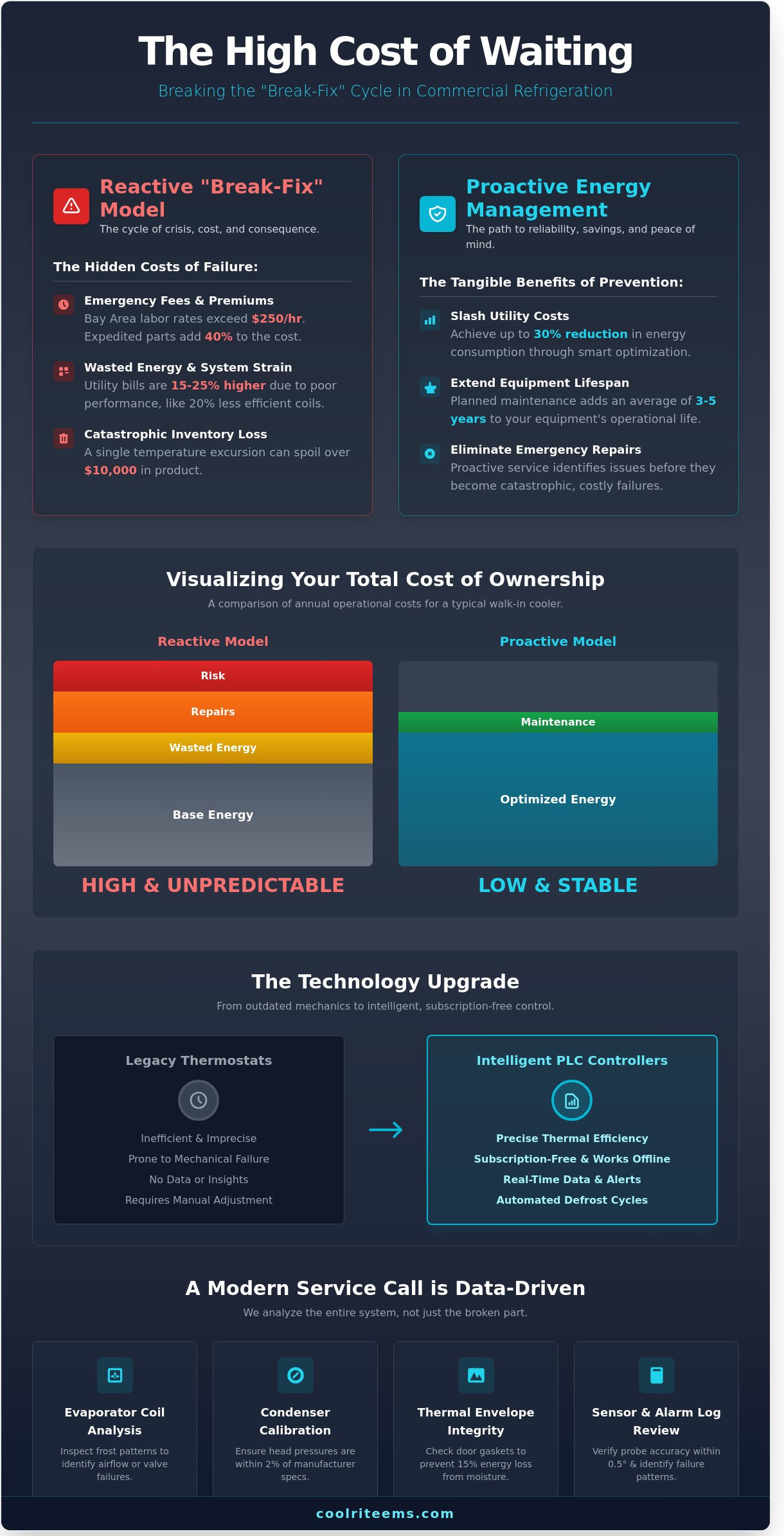
- Evaporator Coil Analysis: Technicians inspect coils for specific frost patterns that indicate airflow obstructions or valve failures. Debris removal is essential to maintain heat transfer efficiency.
- Condensing Unit Calibration: Testing the vapor-compression refrigeration cycle ensures the refrigerant charge and head pressures are within 2% of manufacturer specifications.
- Thermal Envelope Integrity: Checking door gaskets and seals on walk-in coolers prevents moisture ingress, which can increase energy consumption by 15% if left unaddressed.
The Digital Layer: Monitoring and Controllers
A modern service call extends beyond the wrench. Technicians now verify the calibration of temperature probes to ensure accuracy within 0.5 degrees. Reviewing alarm logs helps identify intermittent power fluctuations that often precede a total compressor failure.
At Coolrite EMS, we prioritize local PLC controls over purely cloud-based systems. This ensures your refrigeration service remains functional even during internet outages, a critical requirement for grocery stores and warehouses managing high-value inventory. We analyze local control logic to optimize defrost cycles, often reducing daily run times by 90 minutes or more. This total solution approach transforms your cooling system from a liability into a high-performing asset.
Is your current service provider looking at your data or just your hardware?
Don't wait for an alarm to signal a total loss. Contact Coolrite EMS today for a comprehensive system audit and see how our bespoke control logic can stabilize your operations.
Comparing Reactive Repair vs. Preventative Maintenance
Running a commercial kitchen in San Francisco or Oakland requires precision. Relying on a reactive refrigeration service model creates a cycle of crisis management that drains capital. When a walk-in freezer fails at 9:00 PM on a Friday, the immediate bill is only the beginning. Emergency labor rates in the Bay Area often exceed $250 per hour; while expedited shipping for a replacement compressor can add 40% to the part's base cost. This "break-fix" mentality ignores the long-term health of your infrastructure.
Reactive repairs often hide the fact that your system is bleeding money. A technician might swap a fan motor but miss the fact that the evaporator coils are 20% less efficient due to lack of cleaning. Using ENERGY STAR certified commercial refrigerators helps set a high efficiency baseline, but without a strategy, that performance degrades quickly. This systemic waste results in utility bills that are 15% to 25% higher than necessary for 85% of Bay Area grocery and restaurant operators.
The Hidden Costs of the Reactive Model
The financial impact of waiting for equipment to break extends beyond the repair invoice. Consider these common burdens:
- Inventory Loss: A single temperature excursion can lead to the disposal of $10,000 in premium inventory.
- Staff Stress: When employees spend their shift moving stock to a working unit, they aren't serving customers. This leads to turnover in a tight labor market.
- Regulatory Risk: Health department fines for improper storage temperatures can reach thousands of dollars per violation.
Benefits of a Scheduled Service Strategy
Planned maintenance reduces the total cost of ownership by extending equipment life by 3 to 5 years. Facility managers can move from unpredictable emergency expenses to a fixed monthly budget. This approach identifies "dying" components, like worn contactors or leaking seals, before they cause a total system failure. It ensures that your refrigeration service is an investment rather than a penalty.
Maintaining manufacturer warranties is another critical factor. Most industrial brands require documented maintenance logs to honor parts replacements. Our total solution approach integrates local PLC control and real-time alerts. This ensures your reach-in and walk-in units operate at peak performance without the burden of monthly subscription fees. You get secure, remote monitoring that prevents product loss before it starts, giving your staff the confidence that the system will hold temperature through every peak shift.
Refrigeration Service vs. Energy Management Systems (EMS)
Traditional refrigeration service focuses primarily on maintaining a set temperature. If the compressor runs and the storage box stays at 38 degrees, most technicians consider the job done. This mechanical approach often ignores the hidden costs of inefficient cycling and high energy consumption that drain California business profits.
Moving from mechanical thermostats to intelligent CoolriteEMS controllers changes the objective from "keeping it cold" to "keeping it optimized." While a monthly inspection catches visible leaks, second-by-second oversight identifies subtle performance drifts. This transition allows operators to move from reactive repairs to predictive maintenance, ensuring equipment longevity.
In June 2022, a 45,000-square-foot Sacramento supermarket integrated CoolriteEMS across its walk-ins and display cases. By replacing legacy controls with intelligent logic, the facility reduced its monthly utility bill by 21% within the first 90 days. This proves that modern efficiency is just as vital as raw cooling capacity for the bottom line.
Beyond the Wrench: What EMS Adds to Service
An Energy Management System provides tools that a standard wrench simply cannot offer. California businesses face some of the highest peak-hour rates in the country. Our systems use automated load shedding to reduce power draw when utility prices spike, protecting your margins without manual intervention.
- Automated load shedding during 4 PM to 9 PM peak utility windows to lower demand charges.
- Instant SMS and email alerts for temperature deviations exceeding 3 degrees Fahrenheit, preventing product loss.
- Customizable control logic designed for specific industrial cooling requirements and varied product types.
Why Local Control Beats Subscription Models
Many modern systems lock your data behind a monthly paywall. CoolriteEMS utilizes local PLC control, meaning the hardware operates independently of an internet connection. You own your data and your hardware. This eliminates the recurring fees that often plague cloud-based refrigeration service contracts.
This setup provides a layer of security that cloud-dependent systems lack. If your internet goes down, your refrigeration logic remains intact and operational. It's a reliable, long-term solution for businesses that value operational continuity and data privacy above all else.
- Zero monthly subscription fees associated with traditional cloud-based monitoring platforms.
- Enhanced security via local PLC logic that doesn't require a constant web connection to function.
- Full ownership of historical performance data for long-term facility auditing and health checks.
Navigating California Regulations and Local Service Needs
California's regulatory environment is shifting rapidly as we approach 2026. Compliance is no longer just about avoiding fines; it's a critical component of operational survival. Effective refrigeration service ensures your facility meets the strict mandates set by the California Energy Commission while protecting your hardware from local environmental stressors. Business owners who ignore these updates risk mandatory shutdowns or significant financial penalties during state-level energy audits.
Title 24 Compliance and Your Bottom Line
By January 1, 2026, Title 24 requirements for commercial refrigeration will demand higher efficiency standards for both new installs and major retrofits. Mandatory requirements now include automatic door closers on all walk-in units and minimum insulation levels of R-25 for coolers and R-32 for freezers. Transitioning to Electronically Commutated Motors (ECM) is now the service standard because they reduce energy draw by up to 70% compared to older shaded-pole motors.
- Audit Readiness: Maintain digital logs of all maintenance to prove compliance during state inspections.
- Leak Detection: EPA Section 608 requires strict tracking for systems with over 50 lbs of refrigerant charge.
- Automated Alerts: Coolrite EMS utilizes local PLC control to provide real-time SMS alerts without the need for monthly subscription fees.
Professional technicians who are NATE-certified understand these Northern California codes intimately. They help you leverage utility rebates from PG&E and SMUD, which often cover 30% to 50% of the cost for energy-efficient upgrades. These incentives make it easier to transition to a modern energy management system that functions independently of the internet for maximum security.
Local Environmental Factors in the Bay Area and Central Valley
Geography dictates your maintenance schedule. Coastal facilities in San Francisco or Oakland face constant salt-air corrosion that eats through condenser coils. Without specialized coatings and frequent cleaning, these units fail 40% faster than inland systems. In contrast, warehouses in Sacramento and Fresno must combat ambient heat loads that regularly exceed 100°F. These high temperatures force compressors to run longer, increasing the risk of catastrophic failure during peak summer months.
Finding a reliable commercial refrigerator repair partner with local response capabilities is vital for uptime. A local partner understands that a Central Valley facility needs a different head pressure control strategy than a Bay Area restaurant. Our systems offer fully customizable control logic to handle these specific regional demands. This bespoke approach prevents product loss and keeps your energy bills predictable regardless of the weather outside.
Don't wait for a compliance audit to find out your equipment is outdated. Secure your facility's future with a customized energy management solution today.
Choosing the Right Refrigeration Service Partner
Selecting a refrigeration service partner is a strategic decision that dictates your operational uptime for the next decade. You need a team that understands the mechanical nuances of walk-in freezers, reach-in coolers, and commercial ice machines while mastering digital energy controls. A simple repair shop might fix a broken compressor, but they often ignore the underlying efficiency issues that inflate your utility bills by 18% or more.
Reliability is non-negotiable for businesses storing $50,000 in temperature-sensitive inventory. If a system fails at 2:00 AM, you need 24/7 support that arrives before product loss occurs. Total solution providers offer more value than traditional contractors because they address the equipment lifecycle, from initial installation to continuous optimization. The Coolrite approach integrates high-grade hardware, advanced control logic, and ongoing support to keep your facility running without interruption.
Questions to Ask Your Refrigeration Contractor
- "Do you specialize in energy management solutions or just mechanical repair?"
- "How do you handle remote monitoring and emergency alerts?"
- "Are you familiar with the latest California Title 24 updates?"
A contractor who cannot answer these questions clearly may leave you vulnerable to rising energy costs and regulatory fines. Ensure they provide specific data on how they reduce kilowatt-hour consumption across your entire fleet. Modern providers should offer more than just a wrench; they should offer a digital roadmap for your facility.
The Coolrite Advantage for California Businesses
Coolrite EMS delivers a premium service model designed for the modern California market. We provide proprietary technology that allows for zero-subscription monitoring, giving you full ownership of your data without recurring monthly fees. Our technicians possess deep expertise in both traditional mechanical refrigeration service and advanced digital controls.
- Zero-Subscription Monitoring: Access your system data via local PLC control without the burden of monthly contracts.
- Regional Expertise: Dedicated support teams serve San Francisco, Sacramento, and the entire Bay Area.
- Secure Alerts: Receive real-time SMS and email notifications the moment a temperature deviation is detected.
- Operational Continuity: Our systems work without an internet connection, ensuring your controls remain secure and functional during network outages.
Your refrigeration system is the heart of your operation. Don't wait for an equipment failure to evaluate your service needs. Contact Coolrite today for a comprehensive facility energy and service audit to secure your infrastructure for 2026.
Future-Proof Your California Operations
California businesses face electricity rates that are 80% higher than the national average. Traditional refrigeration service alone isn't enough to protect your bottom line in 2026. You need a total solution that merges mechanical maintenance with precision energy management. By shifting from reactive repairs to a data-driven strategy, supermarkets and cold storage facilities can reduce energy consumption by up to 25% annually.
CoolriteEMS provides the security your infrastructure demands. Our system utilizes local PLC control, which means your cooling stays online even when the internet goes down. You won't deal with recurring monthly subscription fees or hidden costs. You get 24/7 peace of mind with real-time SMS and email alerts that trigger the moment a temperature variance is detected. It's about protecting your inventory and your profits through superior technology.
Schedule a Demo of the CoolriteEMS Controller to see how we help you maintain operational continuity without the overhead.
Take control of your facility's future today.
Frequently Asked Questions
How often should a commercial refrigeration system be serviced?
You should schedule a professional refrigeration service at least four times per year to maintain peak operational efficiency. Quarterly maintenance allows technicians to clean condenser coils and check refrigerant levels before small leaks become $2,000 repair bills. For high-volume California supermarkets operating 24/7, monthly inspections are often necessary to prevent the 15% increase in energy consumption caused by dirty components.
What is the average cost of a refrigeration service call in California?
The average cost for a commercial service call in California ranges from $150 to $350 per hour, depending on your specific region and the time of day. Most reputable contractors also charge a flat trip fee between $75 and $125. Since 2024, labor rates in the Bay Area and Los Angeles have remained 20% higher than the national average due to specialized certification requirements and high overhead costs.
Can an Energy Management System (EMS) really lower my refrigeration repair costs?
Yes, an Energy Management System can reduce your annual repair expenses by up to 25% through predictive maintenance and real-time alerts. Instead of waiting for a total compressor failure, the Coolrite EMS monitors temperature fluctuations and triggers an SMS alert the moment a deviation occurs. This proactive approach eliminates emergency weekend service rates and prevents the loss of $5,000 or more in perishable inventory.
Does California Title 24 apply to my small restaurant refrigeration?
California Title 24, Part 6, applies to any walk-in cooler or freezer over 3,000 square feet, but smaller restaurant units must still comply with specific insulation and lighting standards. As of the 2022 update, all new installations require high-efficiency motors and automatic door closers. Failure to meet these energy standards can result in significant fines and delays during your annual health or building inspections.
What are the most common causes of commercial refrigeration failure?
Dirty condenser coils account for 60% of all commercial refrigeration failures because they force the compressor to work harder and overheat. Other frequent issues include clogged drain lines and refrigerant leaks, which often go unnoticed without a smart controller. Implementing a robust refrigeration service plan ensures these minor mechanical issues are addressed before they lead to a complete system shutdown.
Is remote monitoring necessary if I have staff on-site 24/7?
Remote monitoring is essential because human error or oversight causes 30% of product loss incidents, even with 24/7 staffing. Sensors detect micro-fluctuations in temperature that a staff member walking by might miss. Coolrite EMS provides a secure, local PLC control that works without internet, ensuring your data stays private while sending immediate alerts if a walk-in door is left ajar for more than 10 minutes.
What is the difference between a glycol system and a standard DX system?
A standard Direct Expansion (DX) system circulates refrigerant directly to the evaporator, while a glycol system uses a secondary loop of chilled water and antifreeze. Glycol setups are often preferred in large-scale California breweries and warehouses because they offer more precise temperature control and reduce the total refrigerant charge by up to 50%. This lower charge helps businesses comply with tightening environmental regulations and reduces potential leak repair costs.
How do I know if my refrigeration system needs a repair or a full replacement?
You should consider a full replacement if the cost of a single repair exceeds 50% of the unit's total value or if the system is over 12 years old. Older units typically lose 5% of their efficiency every year, leading to higher utility bills. If your equipment requires more than three major service calls in a 12 month period, upgrading to a modern system with integrated energy management is the more cost-effective long-term investment.
Related: See our transparent pricing for refrigeration repair, browse customer success stories, or get a quote at your local service area.