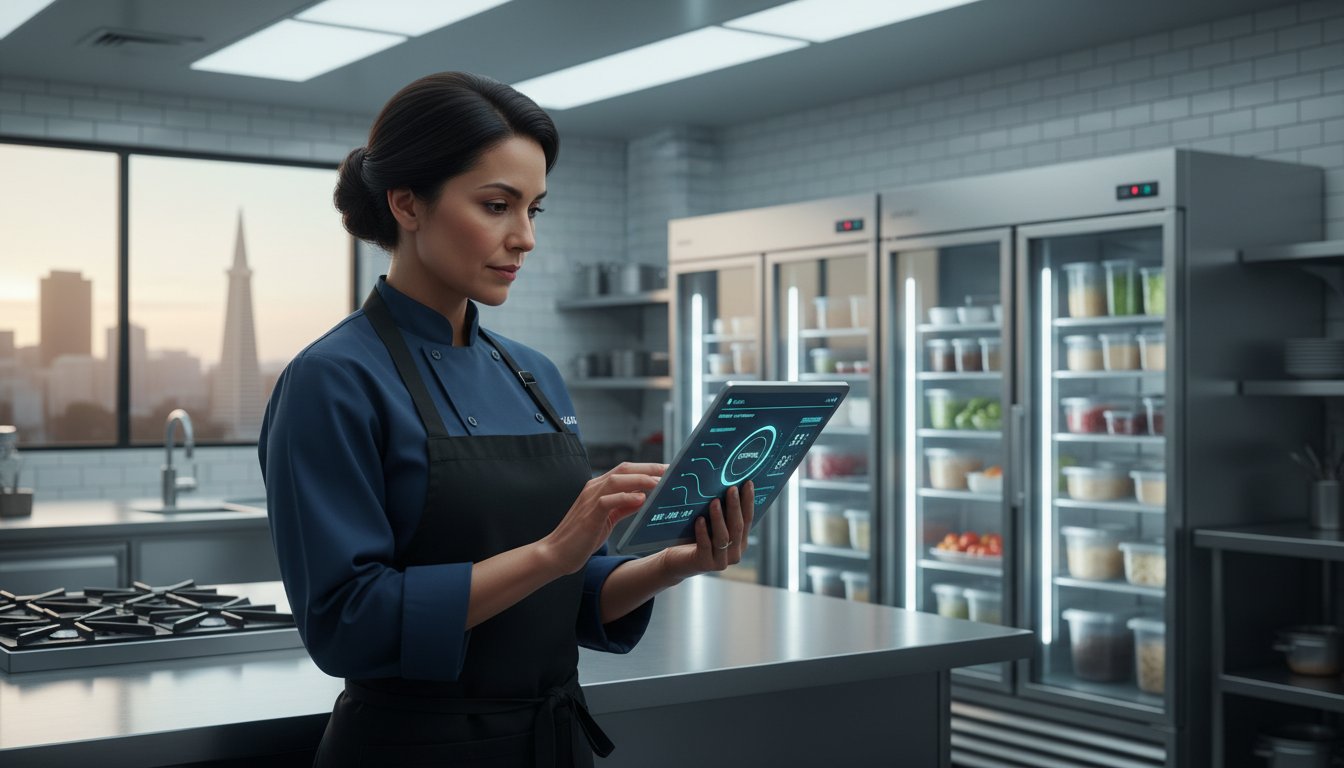
At 5:45 AM last Tuesday, a San Francisco bistro owner discovered $8,200 of spoiled inventory because a walk-in compressor failed overnight. This isn't just a maintenance headache; it's a direct hit to your bottom line. When you're facing a crisis, finding expert commercial refrigerator repair becomes the only priority to save your stock and your reputation.
You know that consistent cooling is the heartbeat of your operation. Yet, aging equipment and high emergency service fees in the Bay Area make maintenance feel like a gamble. It's frustrating to pay premium rates for temporary fixes that fail to address underlying energy waste or California Title 24 compliance standards.
We promise to teach you how to handle refrigeration emergencies with professional precision. You'll learn to evaluate repair costs versus long-term replacement value and how to prevent 90% of future failures using advanced, internet-independent controls.
This guide provides a total solution approach to uptime. We'll cover everything from immediate restoration tactics to the implementation of secure remote monitoring that protects your investment 24/7.
Key Takeaways
- Learn the immediate diagnostic steps and inventory protection strategies needed to minimize financial losses during a sudden equipment breakdown.
- Apply the "Rule of 50" decision framework to evaluate whether a commercial refrigerator repair or a high-efficiency replacement is the best long-term investment.
- Discover how local PLC controls eliminate internet dependency and subscription fees while providing secure, real-time alerts to prevent product loss.
- Understand the impact of California Title 24 compliance on your energy bills and how smart management systems optimize equipment longevity.
- Identify the essential certifications and service guarantees required to select a dependable refrigeration partner for 24/7 support in Northern California.
Immediate Steps for Commercial Refrigeration Failure
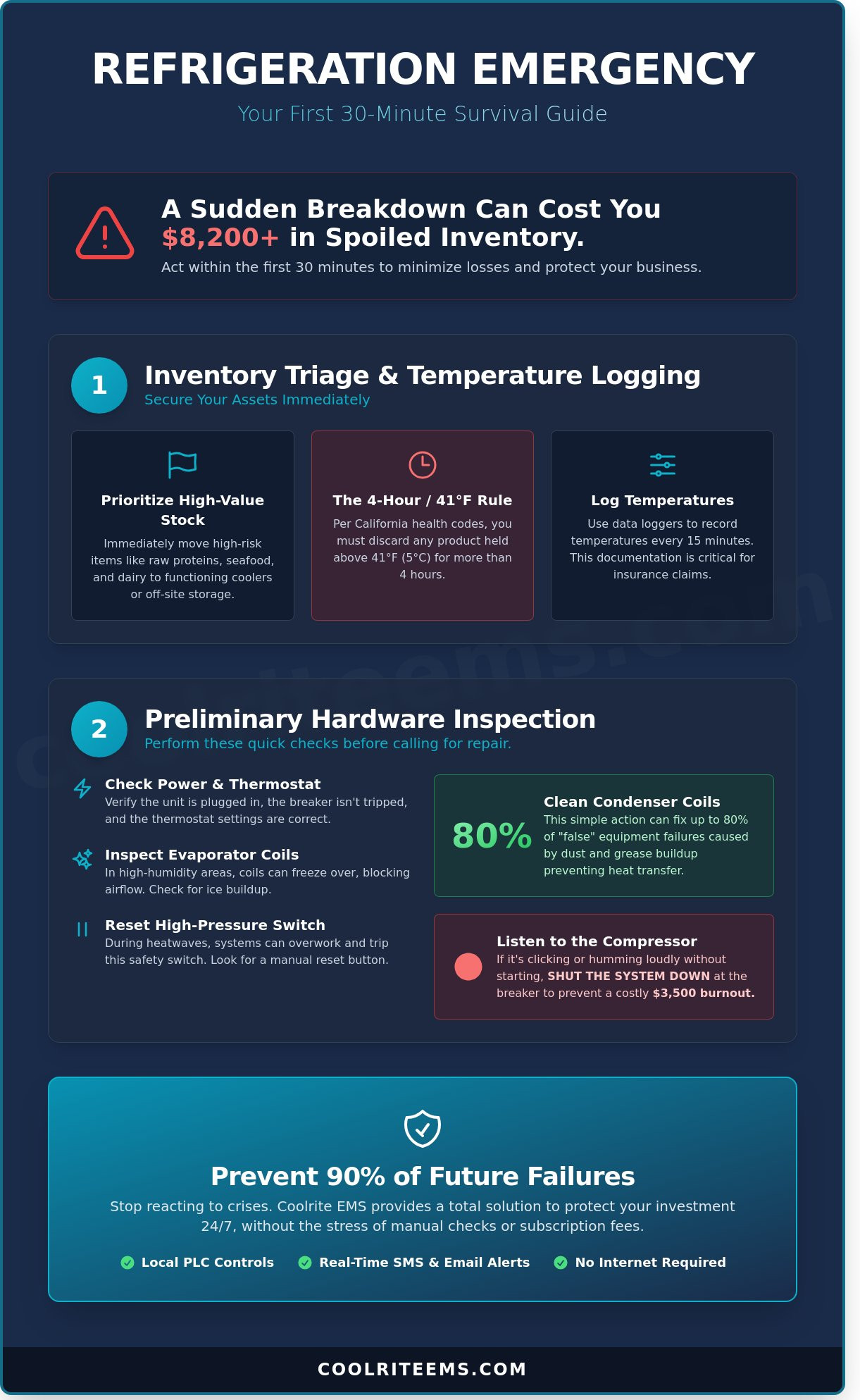
A sudden equipment breakdown can jeopardize $10,000 or more in perishable stock within hours. When a system fails, your first priority is containment. You must act within the first 30 minutes to stabilize temperatures and protect your bottom line. Professional commercial refrigerator repair often begins with these critical onsite steps to prevent permanent hardware damage and massive inventory loss.
Inventory Triage and Temperature Logging
Prioritize your most expensive perishables. Move high-risk items like raw proteins and seafood to functional reach-in coolers or off-site storage immediately. California health codes strictly enforce a 4-hour rule for cold storage. If food temperatures exceed 41°F for more than four hours, you're legally required to discard the product. Use portable data loggers to record temperatures at 15-minute intervals to provide the "chain of custody" proof required for insurance claims.
- Identify high-value inventory: Move meats and dairy products first to stable environments.
- Deploy backup cooling: Utilize dry ice or refrigerated trucks if off-site transport isn't an option.
- Maintain digital logs: Document the exact time the failure was noticed and subsequent temperature spikes.
Preliminary Hardware Inspection
Before calling for commercial refrigerator repair, perform a rapid diagnostic check. Verify that the power supply is active and the thermostat hasn't been accidentally adjusted by staff. Understanding how refrigeration works is helpful here, as most systems rely on steady airflow to move heat. In high-humidity environments like San Francisco, evaporator coils often freeze over, blocking this airflow and causing the system to struggle.
Check the condenser coils for dust or grease buildup. Dirty coils account for roughly 80% of "false" equipment failures because they prevent the system from shedding heat effectively. If the compressor is clicking or humming loudly without starting, shut the system down at the breaker. This prevents a $3,500 compressor burnout while you wait for a technician. Finally, check for a tripped high-pressure switch, which often occurs during heatwaves when the system overworks.
- Clear obstructions: Ensure at least 12 inches of clearance around all intake vents.
- Clean the condenser: Use a vacuum or stiff brush to remove surface debris from the fins.
- Reset switches: Toggle the manual reset button on the pressure control if the system has stalled.
Coolrite EMS provides a total solution to these emergencies through real-time SMS and email alerts. Our local PLC control systems monitor your equipment 24/7, often detecting a failing component before temperatures even begin to rise. This proactive approach eliminates the stress of manual logging and provides the security your business deserves without the burden of monthly subscription fees.
Common Refrigeration Issues in Bay Area Facilities
Operational downtime in a San Francisco restaurant or a San Jose grocery store can lead to inventory losses exceeding $5,000 in a single afternoon. Maintaining peak performance requires more than just reacting to a warm cabinet; it demands a technical understanding of how high-demand systems fail. Professional commercial refrigerator repair often uncovers issues that began weeks before a total system shutdown occurred.
Compressor failure remains the most significant threat to operational continuity. Technicians distinguish between mechanical wear, characterized by rhythmic knocking or metallic grinding, and electrical faults like grounded windings. While a mechanical failure often stems from age or poor lubrication, electrical issues frequently arise from fluctuating voltage or overheating. These problems are often compounded by fan motor malfunctions.
If evaporator or condenser fans fail to move air effectively, system pressure skyrockets. This puts immense strain on the entire cooling loop. Traditional mechanical thermostats also contribute to inefficiency. These older controls often suffer from sensor drift, losing accuracy by as much as 5 degrees over a 12-month period. This inaccuracy leads to short-cycling, which increases energy consumption by 15% and accelerates component fatigue.
Compressor and Motor Diagnostics
Technicians listen for short-cycling patterns where the system engages and disengages every few minutes. This behavior usually points to a burnt-out start capacitor or a pump that has begun to seize. To prevent these recurring failures, many facilities are upgrading to electronically commutated motors (ECMs).
- ECMs offer up to 70% higher energy efficiency than traditional shaded-pole motors.
- They generate less heat, reducing the internal load on the refrigeration cycle.
- Integrated electronics allow for variable speed control, which minimizes mechanical stress during startup.
Refrigerant Management and Compliance
California maintains some of the nation's most stringent leak detection and reporting requirements. Relying on "gas-and-go" tactics, where a technician simply tops off a system without finding the leak, is a costly mistake. In the 100-degree heat of a Sacramento summer, a low refrigerant charge causes the compressor to run indefinitely, leading to a catastrophic burnout within days.
Compliance involves understanding the specific types of commercial refrigeration systems in your facility and their respective GWP (Global Warming Potential) ratings. During a major commercial refrigerator repair, it is often more cost-effective to transition to low-GWP refrigerants. This proactive approach ensures your equipment meets 2024 environmental standards while reducing the financial risk of future leaks. You can consult with our team to evaluate if your current refrigerant levels meet local compliance mandates.
The Repair vs. Replace Dilemma: A California Decision Framework
Deciding between a commercial refrigerator repair and a total system replacement is a critical financial inflection point for facility managers. We utilize the "Rule of 50" to remove the guesswork from this process. If the age of your unit in years multiplied by the repair cost as a percentage of a new unit's price exceeds 50, the investment is no longer sound. For instance, a 10 year old freezer requiring a repair that costs 15% of a new unit scores a 150; this indicates that replacement is the more cost-effective path forward.
Beyond the immediate invoice, you must consider the hidden toll of equipment failure. A single afternoon of downtime in a high volume San Jose kitchen can result in $4,000 of lost inventory and lasting damage to your brand reputation. Reliability is the cornerstone of customer trust. When a system fails repeatedly, it's a signal that the mechanical integrity of the asset is compromised, necessitating a move toward modern, dependable infrastructure.
- Rule of 50: Age of unit (years) x Repair cost (% of new) = Decision Score.
- Threshold: Any score over 50 suggests replacement is the superior financial move.
- Risk Factor: Frequent repairs increase the probability of catastrophic product loss.
Analyzing Total Cost of Ownership (TCO)
A $2,000 compressor repair might seem like a bargain compared to a $12,000 new condensing unit, but the math changes when you factor in operational overhead. Modern systems integrated with energy management solutions typically reduce monthly utility bills by 30%. These savings often recoup the initial capital expenditure within 24 months. While reach-in units have a standard lifespan of 10 years, walk-in components can last 15 to 20 years if the control logic is optimized to prevent short-cycling.
California Regulatory Pressures
California Title 24 standards now mandate rigorous efficiency ratings for all walk-in coolers and freezers. Upgrading your equipment isn't just about performance; it's a matter of legal compliance and future-proofing. Local utility programs in Oakland and San Jose currently offer rebates reaching $1,200 per unit for high-efficiency motor and controller upgrades. These incentives significantly offset installation costs. Furthermore, moving to newer equipment allows you to transition away from high-GWP refrigerants before the 2025 phase-out deadlines, ensuring your commercial refrigerator repair needs don't become obsolete due to unavailable parts or gases.
Coolrite EMS provides the technical expertise to navigate these complex decisions. We don't just fix machines; we optimize your entire cold chain to ensure maximum uptime and minimum energy waste.
Beyond the Quick Fix: Preventing Breakdowns with Smart Controls
Reactive maintenance is a drain on your bottom line. Traditional commercial refrigerator repair often happens only after a compressor has seized or inventory has spoiled. Smart controls change this dynamic by providing a total solution for system health that prioritizes prevention over reaction.
- Catching temperature drifts: Monitoring software identifies fluctuations as small as 0.2 degrees Celsius before they escalate into critical failures.
- Local PLC control: Systems operate independently of external web servers to ensure 100% uptime, even during network outages.
- 24/7 connectivity: Automated SMS alerts reach your team within 15 seconds of a set-point violation, allowing for immediate intervention.
- Stress reduction: Custom logic reduces defrost frequency by 22% on average, extending the life of your mechanical components.
The Role of the CoolriteEMS Controller
Security is a non-negotiable priority for modern facilities. Most smart controllers rely on cloud-based servers that demand monthly subscription fees and constant internet access. CoolriteEMS utilizes local PLC control. This means your system logic lives on-site. It stays secure and functional even if your provider's server goes offline.
In a 2022 case study, a San Francisco supermarket saved $42,000 in perishable stock during a regional internet outage because their Coolrite system continued its cooling cycles without needing a cloud handshake. You own your hardware and your data. This architecture eliminates recurring subscription costs while providing superior reliability for critical infrastructure.
Predictive Maintenance Strategies
Data is the most effective tool for lowering your operational costs. Our smart refrigeration controller logs every cycle. Advanced analytics allow technicians to spot a failing fan motor or a clogged condenser coil up to 14 days before a total breakdown occurs.
This level of insight transforms how you handle commercial refrigerator repair by moving the work into scheduled hours rather than midnight emergencies. By balancing rack systems and glycol loops, users typically see a 30% reduction in emergency service call frequency. A structured maintenance schedule ensures your equipment operates at peak efficiency for its entire lifecycle.
Don't wait for your next equipment failure to modernize your facility. Request a custom control demo today to see how we protect your inventory and your budget.
Finding Reliable Refrigeration Support in Northern California
Securing professional commercial refrigerator repair in Northern California requires more than a quick search for the nearest technician. Business owners in the Bay Area and Central Valley face unique challenges, from fluctuating energy costs to strict environmental regulations. You need a partner who understands the high stakes of a 24/7 operation where a four-hour delay can result in a $15,000 inventory loss.
Verify that any contractor you hire holds a valid C-38 refrigeration license and EPA 608 certification. These credentials ensure the technician is legally authorized and technically trained to handle high-pressure refrigerants and complex industrial systems. In cities like Sacramento and Fremont, local references from similar facilities provide the best evidence of a contractor's reliability and response times during peak summer heatwaves.
Coolrite focuses on building long-term relationships through a network of certified installers. We prioritize technicians who demonstrate a commitment to preventative maintenance rather than just reactive fixes. This approach reduces the frequency of emergency calls and extends the lifespan of your equipment by up to 30 percent through optimized performance.
Evaluating Commercial HVAC-R Contractors
Ask prospective technicians about their experience with industrial rack systems and centralized cooling plants. It's vital that your team understands modern EMS and PLC integration. Refrigeration systems aren't just mechanical anymore; they're digital environments. A technician who can't troubleshoot a logic controller might recommend a $2,000 part replacement when a simple code adjustment was all that was needed.
- Do they offer a guaranteed response time for 24/7 emergency commercial refrigerator repair?
- Are they familiar with local PLC control that functions without an active internet connection?
- Can they provide data logs from previous jobs to prove efficiency gains?
Partnering with Coolrite for a Total Solution
Coolrite supports a robust network of certified installers across Northern California by providing proprietary hardware and custom control logic. Our total solution approach means we don't just sell parts; we provide the brain for your entire cooling infrastructure. The CoolriteEMS system eliminates monthly subscription fees, saving average grocery stores $1,200 annually in recurring software costs while providing secure remote monitoring.
Our local PLC controllers ensure your facility stays online even if the building's internet fails. This level of autonomy is a core advantage for high-volume warehouses and supermarkets that cannot afford downtime. We invite you to see the difference in person. You can request a demo of the CoolriteEMS to see how our real-time SMS alerts prevent product loss before it starts.
The first step toward a more reliable facility is a professional assessment. Contact Coolrite today for a comprehensive equipment and energy audit to identify hidden vulnerabilities in your system and start saving on operational costs.
Secure Your Uptime with Smarter Refrigeration Management
Maintaining operational continuity in California's high-stakes food and medical sectors requires more than just reactive maintenance. You've learned that immediate response to failure saves thousands in inventory, while smart controllers eliminate the guesswork of equipment health. Relying solely on emergency commercial refrigerator repair is a costly strategy that drains your bottom line through high energy bills and frequent technician call-outs.
Since 1995, Coolrite EMS has provided California businesses with a total solution for critical infrastructure. Our system operates on local PLC control, so it doesn't need an internet connection to keep your facility running. You'll avoid the burden of monthly subscription fees while gaining 24/7 remote monitoring and real-time SMS alerts that stop breakdowns before they start.
Protect your facility with the same precision we've delivered for nearly three decades. Our California-based experts are ready to help you optimize your cooling lifecycle and slash operational costs. Request a Free Demo of the CoolriteEMS Controller
Your equipment should work for you; let's ensure it stays that way.
Frequently Asked Questions
How much does a typical commercial refrigerator repair cost in San Francisco?
Average costs for commercial refrigerator repair in San Francisco range from $250 to $1,200 depending on the specific component. Labor rates in the Bay Area typically sit between $150 and $225 per hour. For a standard service call involving a thermostat replacement, expect a total bill around $450. Major repairs like compressor swaps can exceed $2,000 once you factor in parts and specialized labor.
What are the signs that my walk-in cooler compressor is failing?
Loud knocking sounds or frequent short-cycling are the most common indicators of a failing compressor. You might also notice a 15% increase in your monthly energy bill as the unit struggles to maintain temperature. If the compressor shell exceeds 150 degrees Fahrenheit or the unit fails to start entirely, immediate professional intervention is required. Prompt action prevents total stock loss and more expensive equipment damage.
Does California law require specific leak detection for commercial refrigeration?
The California Air Resources Board (CARB) requires facilities with systems containing over 50 pounds of high-GWP refrigerant to conduct regular leak inspections. Under the Refrigerant Management Program, systems with a 2,000-pound charge or more must have automatic leak detection installed and operational. Failure to comply with these environmental regulations can result in fines reaching $10,000 per day for serious or repeated violations.
Can I install a CoolriteEMS controller on my existing refrigeration units?
Yes, the CoolriteEMS is a bespoke solution designed for seamless integration with your existing infrastructure. Our technicians can retrofit the PLC-based controller onto 95% of standard commercial models, regardless of the original manufacturer. This upgrade provides a total solution for energy management without the need for a full system replacement. It typically reduces energy consumption by 20% immediately by optimizing the cooling cycles.
What is the average lifespan of a commercial reach-in freezer?
A well-maintained commercial reach-in freezer typically lasts between 10 and 15 years in a standard kitchen environment. Units that skip quarterly preventative maintenance often see their lifespan drop to 7 or 8 years due to component strain. Investing in a commercial refrigerator repair specialist for regular tuning ensures the cabinet maintains its thermal integrity. This proactive approach protects your long-term investment and ensures operational continuity.
How often should I perform preventative maintenance on my industrial glycol system?
You should schedule a professional inspection for your industrial glycol system at least twice per year. These bi-annual checks must include testing the glycol concentration levels, which should typically remain between 30% and 50% to prevent freezing or internal corrosion. Regular maintenance reduces the risk of emergency downtime by 40%. It ensures the pumps and heat exchangers operate at peak hydraulic efficiency year-round.
Are there monthly fees for Coolrite’s remote monitoring system?
CoolriteEMS operates on a no-subscription model, meaning there are zero monthly fees for our remote monitoring services. Once the system is installed, you own the hardware and the local PLC control logic entirely. You'll receive real-time SMS and email alerts via your existing network without recurring costs. This approach saves your business an average of $600 annually compared to traditional subscription-based monitoring platforms.
What should I do if my commercial refrigerator is leaking water?
Related: See our transparent pricing for refrigeration repair, browse customer success stories, or get a quote at your local service area.