In East Palo Alto, commercial buildings waste up to 30% of their total energy consumption due to poorly integrated HVAC and refrigeration systems. You've likely felt the pressure of rising Bay Area utility rates while trying to maintain reliable commercial hvac east palo alto infrastructure. It's a common challenge for local business owners who must balance strict Title 24 compliance with daily operational demands.
This guide helps you master the complexities of integrated climate systems by detailing how a total solution approach creates a more resilient facility. You'll gain the technical knowledge to secure 24/7 reliability and meet local electrification mandates while reducing overhead. We'll examine how modern, local PLC controls provide secure remote monitoring and real-time alerts without the need for a constant internet connection or recurring monthly subscription fees.
Our overview covers everything from bespoke energy management strategies to the transition toward high-efficiency heat pumps. By the end of this article, you'll understand how to transform your mechanical infrastructure into a cost-effective, long-term investment that protects your inventory and your bottom line.
Key Takeaways
- Understand how local climate challenges like Bay humidity and inland heat require a specialized approach to commercial hvac east palo alto to prevent system strain.
- Discover the "Heat Load" equation and why maintaining your building’s ambient temperature is the most effective way to prevent catastrophic freezer breakdowns.
- Navigate the 2026 Title 24 requirements and the California electrification roadmap to ensure your facility remains compliant and prepared for the gas equipment phase-out.
- Learn the specific early warning signs of compressor fatigue and refrigerant leaks to protect your inventory and avoid expensive emergency repairs.
- Explore how local PLC control offers a more secure, subscription-free alternative to cloud-dependent energy management systems for total operational continuity.
Understanding Commercial HVAC in East Palo Alto (2026)
East Palo Alto's commercial landscape evolved rapidly by 2026. Businesses no longer view climate control as a background utility. It's a critical infrastructure component. The standard for Heating, ventilation, and air conditioning now integrates comfort cooling with industrial refrigeration. This "Total Solution" approach ensures that Silicon Valley's tech campuses and retail centers operate without interruption.
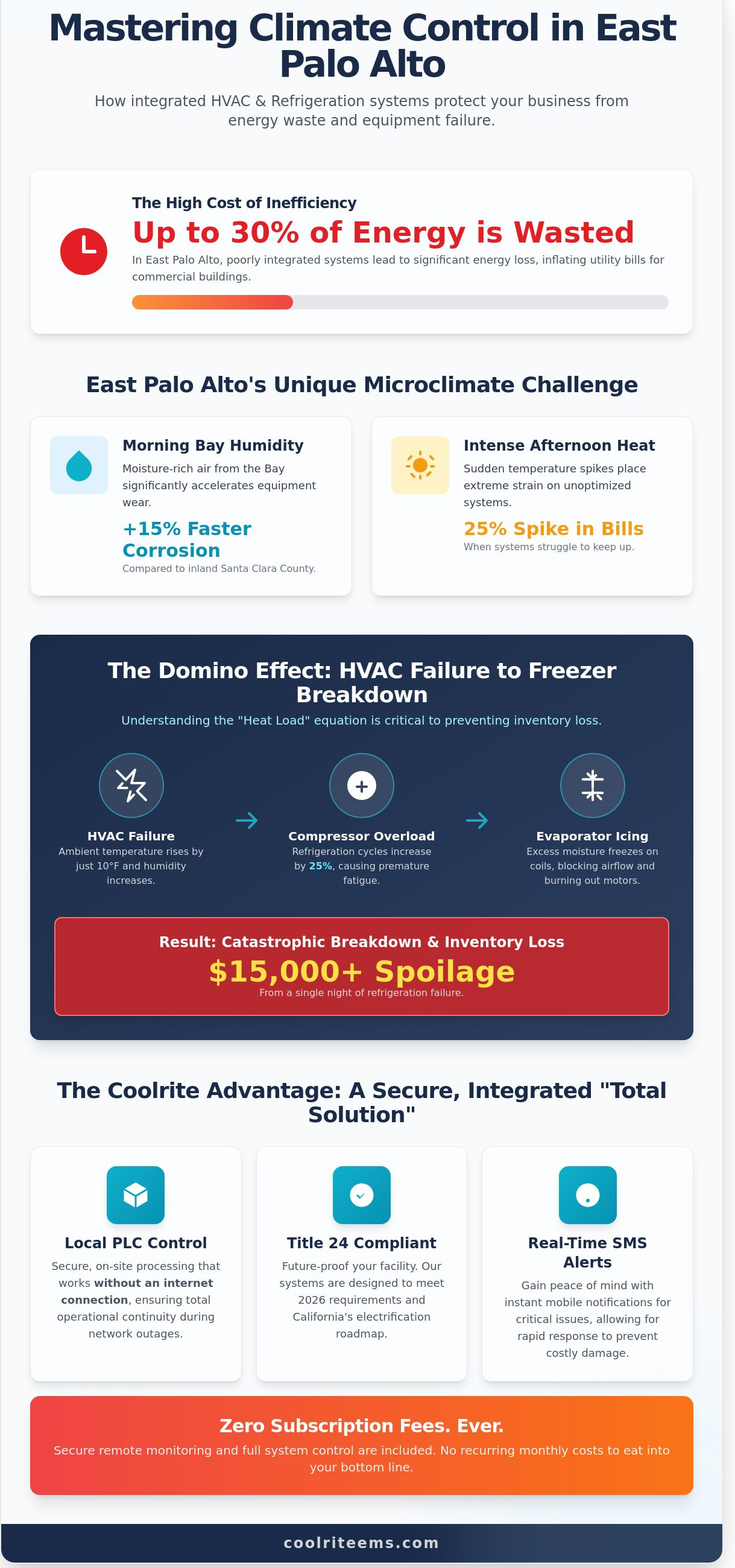
The city's geography creates a specific microclimate. Morning Bay humidity often collides with intense afternoon heat. This moisture accelerates equipment corrosion by 15% more than inland Santa Clara County sites. Managing commercial hvac east palo alto systems effectively requires specialized coatings and robust hardware. Local industrial sectors lose thousands annually due to inefficient systems that struggle against these fluctuating conditions.
The economic impact of inefficient cooling is measurable. Retailers in East Palo Alto see energy bills spike by 25% when systems aren't optimized. For a local supermarket, a single night of refrigeration failure can result in $15,000 of spoiled inventory. Integrated systems mitigate these risks through constant monitoring and rapid response times. Forward-thinking managers prioritize uptime and reliability over low-cost, short-term fixes.
The Scope of Commercial HVAC-R Services
Distinguishing between standard rooftop units and industrial refrigeration is vital. RTUs provide office comfort, but walk-in coolers require specialized hardware and custom control logic. General contractors often miss the nuances of energy management. We use local PLC control to ensure your system works without an internet connection. This prevents downtime during network outages. Our systems provide real-time SMS alerts and secure remote monitoring without monthly subscription fees.
Local Zoning and Environmental Factors
The 2026 landscape introduces stricter zoning requirements for new developments. New commercial hvac east palo alto projects must meet specific noise ordinance standards for outdoor condensing units, often capped at 60 decibels in mixed-use zones. Salt-air corrosion remains a major factor. Equipment near the water requires frequent inspections and preventative maintenance to reach its full life expectancy. We design every installation to account for these environmental variables, ensuring your investment lasts for decades.
- Integrated Control: Seamless management of both HVAC and refrigeration units.
- Corrosion Resistance: Specialized treatments for equipment near the Bay.
- Energy Efficiency: Reduced operational costs through optimized PLC logic.
- Zero Subscriptions: Full remote access without recurring monthly fees.
Reliability is the cornerstone of our service. We provide 24/7 support to ensure your business never faces an unexpected shutdown. Contact Coolrite EMS today for a professional consultation and see how our bespoke climate solutions protect your bottom line.
The Critical Link Between HVAC and Commercial Refrigeration
Commercial refrigeration units don't operate in a vacuum. The efficiency of a walk-in cooler is tethered to the ambient building temperature maintained by your commercial hvac east palo alto system. When indoor temperatures rise by just 10 degrees, a refrigeration compressor may increase its cycle frequency by 25%, leading to premature mechanical fatigue.
The "Heat Load" equation explains why an AC failure is the primary cause of freezer breakdowns. If your HVAC system stops dehumidifying the air, moisture infiltrates the refrigeration seals. This excess water vapor turns to ice on evaporator coils, blocking airflow and forcing the system into a permanent "pull-down" state that burns out motors. Maintaining 24/7 uptime requires a commercial refrigerator repair strategy that accounts for these environmental variables.
Optimizing airflow prevents this icing. Technicians ensure that air from the HVAC system isn't blowing directly into open-case coolers, which disrupts the "air curtain" and causes 15% more energy waste. Investing in energy-efficient commercial HVAC equipment provides the stable baseline needed for refrigeration stability.
Optimizing Walk-In Performance via HVAC
Strategic placement of reach-in units relative to HVAC registers is vital for performance. Placing a refrigerator directly under a high-velocity vent can cause the thermostat to misread the internal temperature, resulting in short-cycling. Proper commercial refrigeration control involves managing humidity to reduce defrost cycle frequency, which can save up to 12% on monthly utility bills.
- Humidity Management: Maintaining 40% to 50% indoor humidity prevents frost buildup on coils.
- Heat Recovery: Modern systems use refrigeration exhaust to assist in water heating or space heating.
- Placement: Keep condensers away from dead-air zones to ensure 100% heat rejection capability.
Hardware Synergy: Rack Systems and Condensers
Rack systems serve as the heart of a centralized energy management system. These setups allow multiple refrigeration loads to be managed by a single group of compressors, improving redundancy. For East Palo Alto labs and breweries, Glycol systems are becoming the standard because they offer precise temperature control without the risks associated with high-pressure refrigerant lines in occupied spaces.
Choosing the right condensing units for the East Palo Alto microclimate requires hardware with corrosion-resistant coatings. The salt-heavy air near the Bay can degrade standard aluminum fins 30% faster than inland areas. Implementing a smart refrigeration controller allows you to monitor these hardware synergies in real-time, ensuring that your HVAC and cooling systems work as a unified, efficient machine.
Energy Efficiency and Title 24 Compliance for EPA Businesses
Operating a business in East Palo Alto requires strict adherence to evolving state mandates. The 2026 updates to the Title 24 Building Energy Efficiency Standards represent a significant shift for local enterprises. These regulations don't just suggest efficiency; they mandate specific performance thresholds for refrigeration and HVAC systems to reduce the state's carbon footprint. For many facility managers, this means the era of gas-fired rooftop units is ending as California pushes toward full electrification.
Transitioning away from gas equipment is a technical challenge that demands a strategic roadmap. Modernizing your commercial hvac east palo alto infrastructure involves replacing legacy boilers and furnaces with high-efficiency heat pump technology. This shift reduces onsite emissions and aligns your facility with the 2030 net-zero goals. Implementing energy management solutions allows you to bridge the gap between these strict mandates and your operational profit by optimizing how and when your equipment draws power.
Navigating Local Rebates and Incentives
San Mateo County provides several financial pathways to offset the costs of electrification. Peninsula Clean Energy currently offers rebates for small businesses switching to electric heat pumps, often covering a substantial portion of the hardware costs. Specialized utility programs also target high-efficiency ice machines and reach-in display cases, which are vital for East Palo Alto’s food service sector. You can also claim federal tax credits for installing smart energy management controllers that provide demand-response capabilities.
Performance Metrics That Matter
Understanding the difference between EER and SEER is critical for calculating your return on investment. EER measures efficiency at a specific peak temperature, which is essential for surviving a Bay Area heatwave. SEER accounts for seasonal variations. Data shows that upgrading to a system with electronically commutated motors (ECMs) can reduce fan energy consumption by as much as 70% compared to standard shaded-pole motors. This technical upgrade is a core component of a commercial hvac east palo alto strategy focused on long-term savings.
Real-time monitoring is no longer optional. It's the only way to prove compliance and prevent product loss. Coolrite EMS utilizes local PLC control logic that functions without an internet connection, ensuring your data is secure and your systems stay online. Our platform provides real-time SMS alerts and detailed energy reports without any monthly subscription fees. This technical precision ensures your refrigeration and climate systems operate at peak efficiency every hour of the day.
Preventative Maintenance: Protecting Your East Palo Alto Investment
Many facility managers treat their climate systems like a light switch. They expect performance without participation. This "set and forget" mentality leads to catastrophic failure in high-stakes environments where temperature stability is non-negotiable. For any business relying on commercial hvac east palo alto, neglect isn't just a maintenance oversight; it's a direct financial liability. Professional quarterly inspections act as a safeguard against the natural wear that occurs in the Bay Area's salt-heavy air.
A comprehensive HVAC-R inspection goes beyond a simple visual check. Technicians look for specific early warning signs that indicate deeper mechanical distress. Oil spots near fittings often signal a refrigerant leak, while an increase in compressor vibration or heat signatures indicates internal fatigue. Our quarterly checklist includes:
- Calibrating local PLC controls to ensure logic remains precise and efficient.
- Clearing condensate lines to prevent water damage and mold growth.
- Inspecting evaporator and condenser coils for debris that forces the system to work harder.
- Testing refrigerant levels to maintain optimal heat transfer efficiency.
- Evaluating compressor start-up cycles to identify electrical resistance or mechanical drag.
High-grade filtration is your first line of defense. It protects both indoor air quality and the internal health of the equipment. According to data from the Department of Energy, restricted airflow from a dirty filter can increase a system's energy consumption by 15% because the motor must overcome the added resistance to move air.
The Cost of Neglect
The math of maintenance is simple. Consider a supermarket that skips a routine inspection. A slow refrigerant leak goes unnoticed until the compressor seizes on a Saturday afternoon. By the time a technician arrives, the facility faces a $50,000 inventory loss in perishable goods. Proactive care, such as replacing worn door gaskets, prevents air infiltration that forces systems to run 24/7. Keeping coils clean ensures your commercial hvac east palo alto maintains its design efficiency, preventing the 30% energy spike common in neglected systems.
24/7 Emergency Response Protocols
Reliability depends on more than just a phone number. A professional service contract must prioritize rapid dispatch for grocery and medical cold storage. Coolrite EMS utilizes secure remote monitoring that operates without a constant internet connection via local PLC control. This technology identifies a 3-degree temperature drift and sends real-time SMS alerts before the product is compromised. This proactive approach often allows for remote diagnosis, reducing the need for expensive, middle-of-the-night on-site visits.
Don't wait for a system failure to compromise your operations. Contact Coolrite EMS today for a custom preventative maintenance plan that secures your inventory and reduces energy costs.
The Coolrite Advantage: Secure, No-Subscription Energy Management
Most energy management systems lock you into a cycle of monthly fees and cloud dependence. The CoolriteEMS Controller breaks this pattern by offering a proprietary, localized solution. We provide East Palo Alto businesses with a robust platform that prioritizes local hardware over external servers.
Our system utilizes industrial-grade PLC (Programmable Logic Controller) technology. This hardware manages your refrigeration and climate systems directly on-site. It ensures your operations continue without interruption, even if your building loses its internet connection. You gain full control over your equipment without the burden of recurring subscription costs.
We tailor every installation to your specific operational hours and load requirements. For example, a supermarket can program aggressive energy-saving modes for overnight hours when foot traffic is zero. This custom logic optimizes your commercial hvac east palo alto investment by reducing unnecessary wear on compressors and motors.
- Zero Subscription Fees: You own the hardware and the software logic with no monthly billing.
- Local PLC Intelligence: System logic resides on-site, not in a remote data center.
- Customized Logic: We program the system to match your specific business schedule.
- Energy Optimization: Automated set-point adjustments can reduce monthly utility consumption by measurable margins.
Security and Reliability in Silicon Valley
Reliability is the standard in a region defined by high-tech infrastructure. The CoolriteEMS Controller eliminates "Internet Down" downtime by functioning as a standalone unit. If your network fails, your cooling and ventilation systems stay online and continue to follow their programmed logic.
Security is a primary concern for any connected business. Our system allows for secure remote access that does not require compromising your internal business network. You receive real-time SMS and email alerts the moment a temperature excursion is detected. This 24/7 monitoring ensures you can react to equipment issues before they result in product loss.
Your Total Solution Partner
Coolrite serves as your single point of contact for design, distribution, and long-term optimization. We understand the critical nature of commercial hvac east palo alto infrastructure for grocery stores, warehouses, and restaurants. Our team handles the entire lifecycle of your energy management system to ensure peak performance.
We invite you to see the difference that local, proprietary control makes for your bottom line. Our technicians can demonstrate the CoolriteEMS interface and show you how custom logic saves on operational costs. Contact our team today to schedule a live demo of our energy management solutions and take full control of your facility.
Securing Your Facility’s Operational Future
Managing a facility in 2026 requires more than just reactive repairs; it demands a total solution that integrates climate control with critical refrigeration. By prioritizing Title 24 compliance and preventative maintenance, businesses can avoid the high costs of equipment failure and energy waste. Implementing a robust commercial hvac east palo alto strategy ensures that your infrastructure remains efficient and reliable under the most demanding conditions.
Coolrite EMS provides the technical precision needed to maintain 100% uptime through local PLC control. Our systems operate independently of internet connectivity, removing the risk of communication blackouts. You'll benefit from a platform with no monthly subscription fees and the security of 24/7 emergency support across Northern California. This approach transforms your HVAC-R setup from a recurring expense into a high-performing asset that protects your bottom line.
Don't leave your operational continuity to chance. Request a custom HVAC-R energy audit for your East Palo Alto facility to identify immediate efficiency gains. We're ready to help you optimize your infrastructure for the long term.
Frequently Asked Questions
What are the current Title 24 requirements for commercial HVAC in California?
The 2022 Title 24 Building Energy Efficiency Standards require all new commercial HVAC installations to feature automated demand response and high-efficiency fan motors. These regulations mandate economizers for units exceeding 33,000 Btu/h to leverage outdoor air for cooling. Our team ensures your commercial hvac east palo alto project meets these specific mandates to avoid compliance penalties and maximize your operational efficiency.
How much can a commercial energy management system save my business?
A commercial energy management system typically reduces annual energy consumption by 15% to 30% for most facilities. By optimizing compressor cycles and eliminating simultaneous heating and cooling, businesses see a direct reduction in monthly utility costs. These savings often allow the system to pay for itself within 18 to 24 months of operation through reduced waste and improved equipment performance.
Do I need a separate contractor for refrigeration and HVAC in East Palo Alto?
You don't need separate contractors when you partner with a total solution provider. We manage both climate control and refrigeration systems under one roof to ensure seamless integration across your facility. This unified approach prevents communication errors between different mechanical systems and simplifies your maintenance schedule, providing a single point of accountability for all your critical infrastructure.
What is the difference between a standard thermostat and a CoolriteEMS controller?
A standard thermostat only monitors air temperature, while a CoolriteEMS controller manages entire refrigeration and HVAC logic via a local PLC. Our system operates independently of an internet connection, ensuring your equipment stays running even if your Wi-Fi fails. You receive custom logic and real-time alerts without the burden of monthly subscription fees or vulnerable cloud dependencies.
How does the East Palo Alto gas equipment ban affect my current HVAC system?
The East Palo Alto all-electric building mandate affects new construction and major renovations by requiring electric heat pumps instead of gas furnaces. If your current commercial hvac east palo alto system is gas-fired, you can continue to maintain it. However, future replacements may require a transition to high-efficiency electric alternatives to align with California's goal to reduce carbon emissions by 40% by 2030.
Why is real-time temperature monitoring essential for food safety compliance?
Real-time temperature monitoring is critical for meeting HACCP standards and preventing product loss during equipment failure. Our system sends SMS and email alerts the moment a walk-in freezer deviates from its set point. This immediate notification allows your team to intervene before food safety is compromised, protecting your valuable inventory and your brand reputation from the costs of spoilage.
What is the average lifespan of a commercial rooftop HVAC unit in the Bay Area?
The average lifespan of a commercial rooftop unit in the Bay Area is 15 to 20 years. Proximity to the San Francisco Bay means salt air can accelerate corrosion on condenser coils if they aren't properly maintained. Regular preventative maintenance and specialized protective coatings can extend this lifespan and maintain peak energy performance throughout the unit's entire operational life.
Can I integrate my existing walk-in coolers into a new energy management system?
You can integrate existing walk-in coolers and reach-in cases into a new energy management system without replacing your current units. We install bespoke controllers on your legacy equipment to bring them into a centralized monitoring network. This upgrade provides modern features like remote access and energy optimization to your existing infrastructure, saving you the cost of a full equipment overhaul.
Related: See our transparent pricing for refrigeration repair, browse customer success stories, or get a quote at your local service area.